

Decompression explained: what really raises the risk of decompression sickness
We all know the rule “ascend slowly and do a safety stop” (3 minutes at about 5 m before surfacing). But why does it actually work? And what, besides the dive profile (the course of depth over time: how deep, how long and how fast you ascended), decides whether we feel fine after leaving the water?
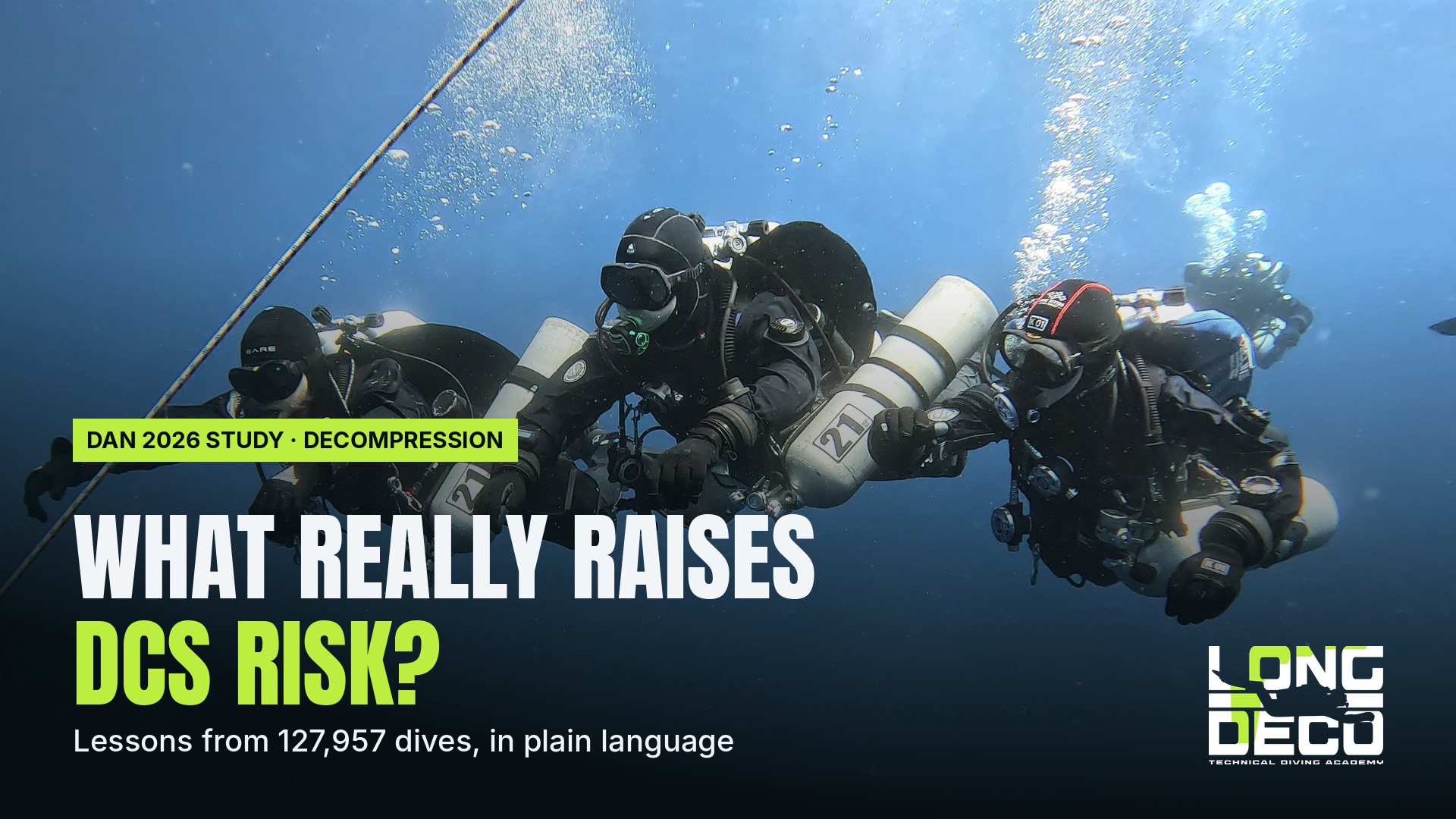
In February 2026 the journal International Maritime Health published a study that tested this on a huge sample: 127,957 real dives made by 5,907 divers and recorded in the DAN (Divers Alert Network) database. DAN is an international organisation focused on diver safety: it runs research, first aid training and round-the-clock medical help for divers. Divers send it records from their computers together with a short questionnaire about how they felt. The authors include Prof. Jacek Kot from the National Centre for Hyperbaric Medicine in Gdynia. Below we translate the most important findings into diving language.
First, briefly: what is decompression?
Air is about 79% nitrogen. Underwater, pressure rises by 1 bar every 10 m, so at 30 m we breathe air at 4 bar, four times denser than at the surface. The deeper and longer we stay, the more nitrogen dissolves in our tissues. It is like a bottle of fizzy water: as long as the cap is on (that is, we are under pressure), you cannot see the gas.
When we ascend, pressure drops and the nitrogen has to leave the tissues. If we do it slowly, the body calmly removes it through the lungs. If we do it too fast, the nitrogen starts forming bubbles, as in a bottle opened suddenly. This is decompression sickness (DCS). It can cause joint pain, tingling, a rash, excessive fatigue and, in more serious cases, problems with sensation, movement or breathing.
Decompression is the process of getting rid of nitrogen in a controlled way during the ascent. In recreational diving a slow ascent and a safety stop are enough. On longer and deeper dives you have to make mandatory decompression stops at set depths, because surfacing without them would be too risky. This is decompression diving, which is taught on technical diving courses.
Different tissues take up nitrogen at different rates. Blood and well-perfused organs are “fast tissues”: they take up nitrogen quickly and release it quickly. Joints and fatty tissue are “slow tissues”. A dive computer calculates this in parallel for a dozen or so such model tissues. Most often it uses the Bühlmann model: a set of formulas developed by the Swiss physician Albert Bühlmann, which describes the body as 16 “compartments” with different saturation rates. For each compartment the model also sets a limit: how much nitrogen above ambient pressure you can safely carry at a given depth (the so-called M-value).
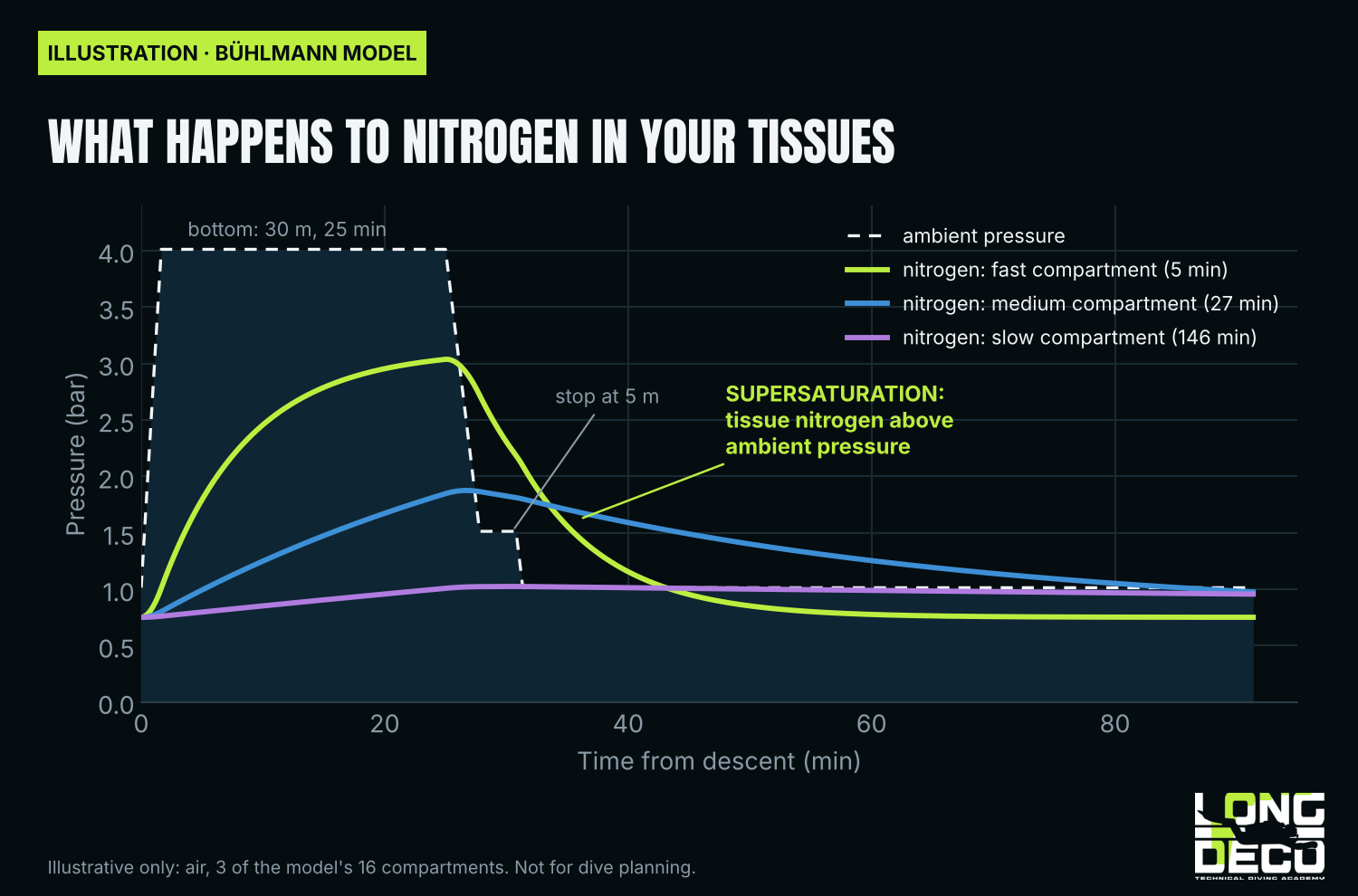
The chart shows a dive to 30 m for 25 minutes with a stop at 5 m. The dashed line is the water pressure around the diver. The fast tissue (lime) saturates almost immediately, the medium one (blue) more slowly, and the slow one (purple) is only just starting. The numbers in brackets are the so-called half-times: after that many minutes the tissue has taken up half of the nitrogen it can take up at that depth. After surfacing, the tissue lines are above ambient pressure: the tissues hold more nitrogen than they “should” at the surface. This is supersaturation: a state in which the tissues hold more dissolved gas than the ambient pressure corresponds to. A small amount of supersaturation is normal and safe, because it is exactly what lets nitrogen “flow out” of the tissues. The problem starts when there is too much of it.
Supersaturation: the most important number in the whole study
For each of the more than 127 thousand dives, the authors calculated how supersaturated the tissues were with nitrogen at the moment of surfacing. They called this value DSSG (DAN Surface Supersaturation Gradient). Put simply, it is a number that tells you how close to the limit allowed by the Bühlmann model the diver was when leaving the water. 0.5 means a large margin, 1.0 means reaching the limit itself, and above 1.0 the limit has been exceeded. Some dive computers show a similar value as “GF” or “SurfGF”.
The result is very clear. Supersaturation was the strongest risk factor of all those examined, and the risk does not rise evenly but accelerates.
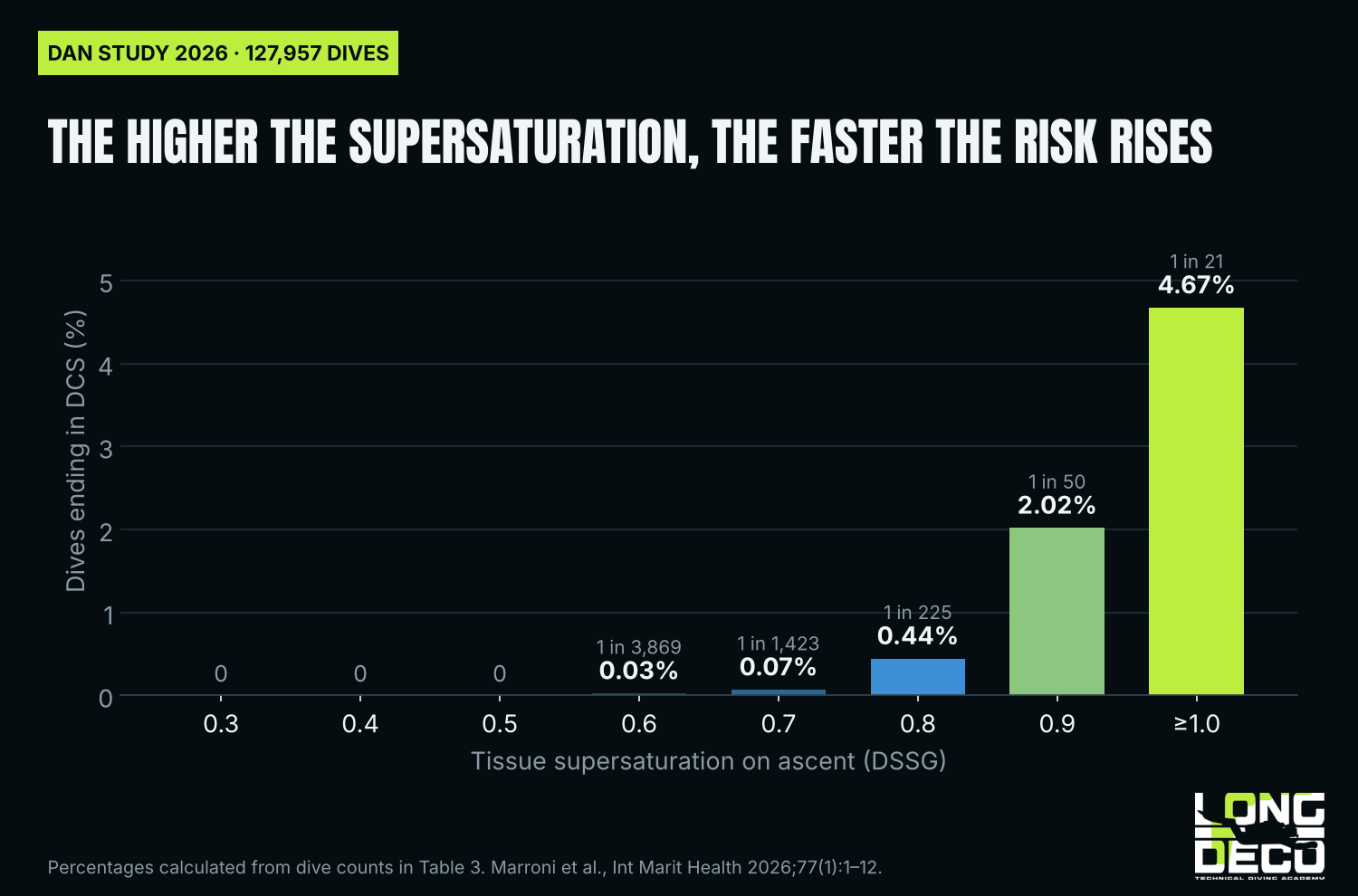
- At a DSSG up to 0.5 the database contained not a single case of DCS.
- At 0.7 it is roughly 1 case per 1,400 dives.
- At 0.9 it is already 1 in 50.
- At 1.0 and above, that is at the limit or beyond it, 1 in 21.
What does this mean in practice? That how you dive is in your own hands. Supersaturation depends on depth, time, ascent rate and stops. Every extra minute at a stop and every slower ascent moves you to the left on this chart.
What else matters?
Besides the dive profile, the authors examined several dozen other factors and built a model that predicted the occurrence of DCS with very good accuracy (AUC 0.91). AUC measures how accurate such a model is on a scale from 0.5 (a coin toss) to 1.0 (flawless), so 0.91 is a very good result. In the end 12 factors turned out to be significant. Important: the results below are already adjusted for the dive profile, so they show the effect of each factor at the same level of supersaturation.
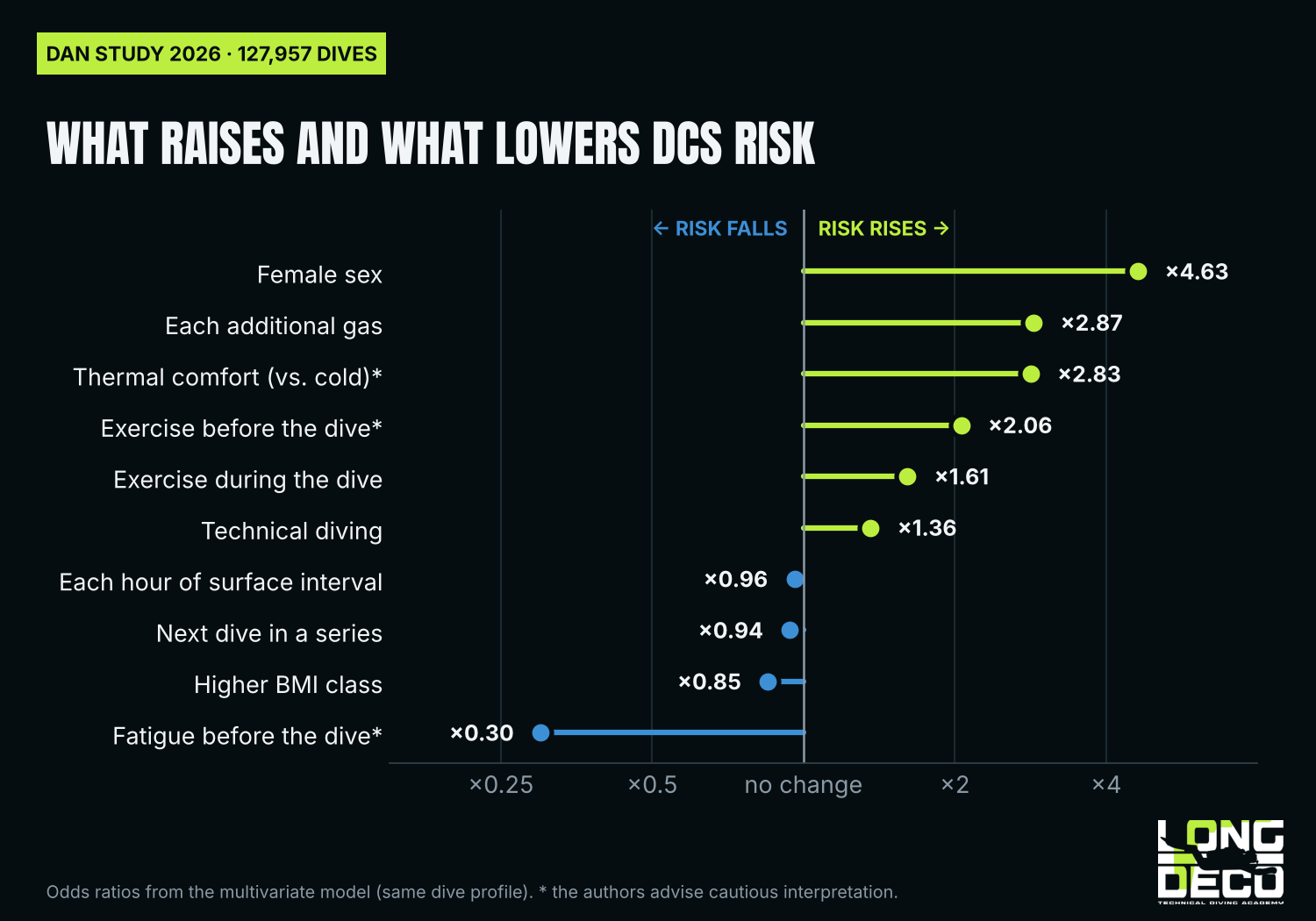
On the chart below each factor has a so-called odds ratio. “×2” means the odds of DCS are twice as high, “×0.5” that they are half as high, and “no change” (×1) that the factor has no effect. We marked with an asterisk the results that the authors themselves say should be treated with caution.
Sex
For women the odds of DCS in the model were about 4.6 times higher than for men. In the raw data: 1.27% of women’s dives against 0.38% for men. The study does not explain the cause, but it is a strong argument for women divers to choose more conservative computer settings.
Number of gases and technical dives
In technical diving you often use several breathing mixtures: one for the bottom and one or two for the ascent. The latter are decompression gases, usually with a high oxygen content (for example nitrox 50% or pure oxygen), which speed up the removal of nitrogen at the stops. Nitrox is air enriched with oxygen, so it contains less nitrogen. Trimix is a mixture of oxygen, nitrogen and helium for dives below about 50 m, where ordinary air starts to have a narcotic effect.
Each additional gas increased the odds of DCS almost 3 times, and technical dives (those beyond recreational limits: deeper than 40 m, with mandatory decompression or with several gases) had a DCS rate about twice as high as recreational ones. This does not mean that nitrox or decompression gases are “dangerous”. Dives with several gases are simply deeper and longer dives with mandatory decompression, and on those it is easier to make a mistake when switching gas or to shorten a stop. That is exactly why these dives require proper training.
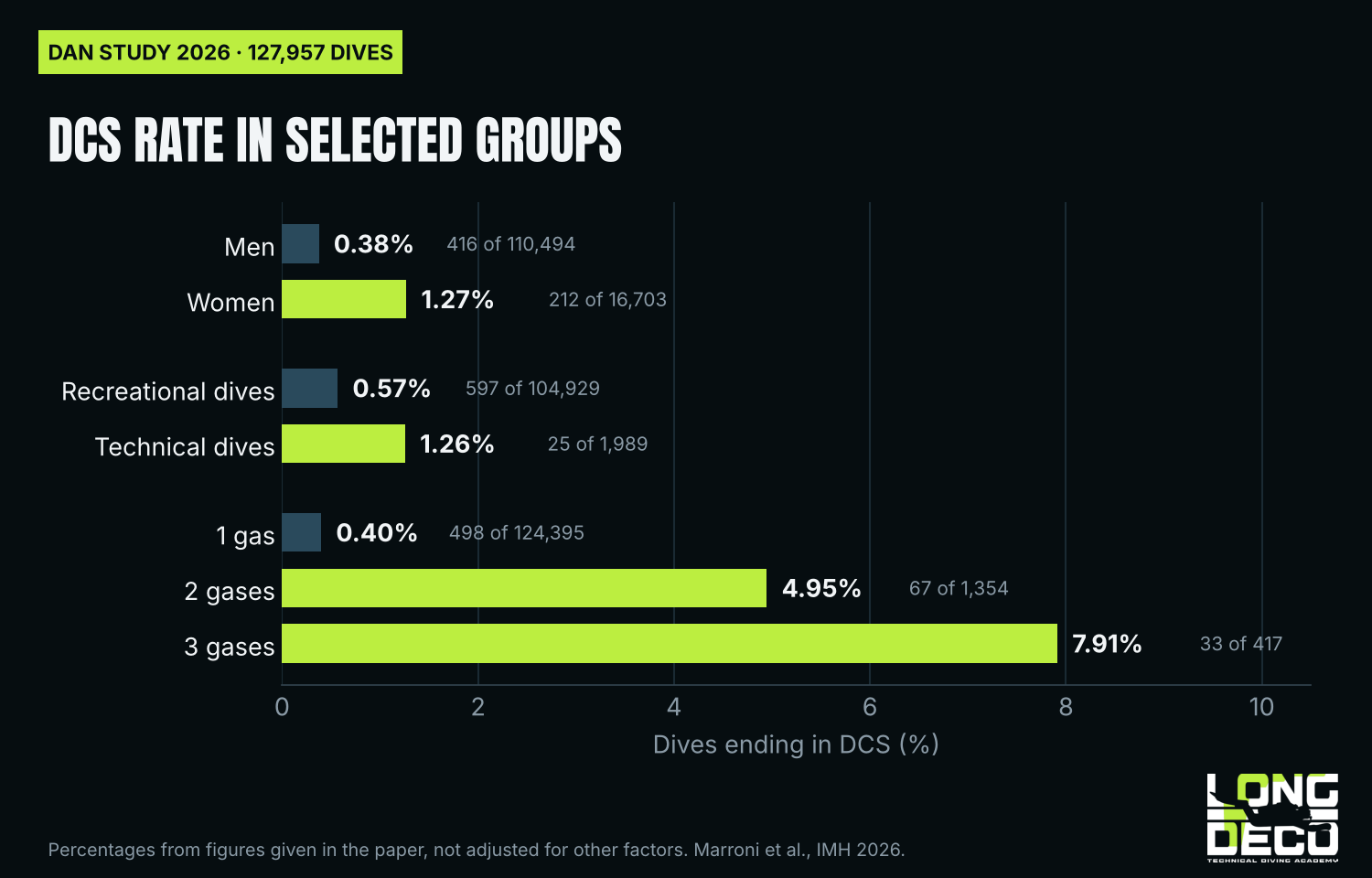
The chart above shows raw percentages, that is, simply what percentage of dives in a given group ended in DCS, without accounting for other factors.
Exertion and temperature
Heavy work underwater (strong current, towing, intense finning) increased the odds of DCS by about 60%. Exertion speeds up circulation and the uptake of nitrogen by the tissues.
Two results are surprising, and the authors themselves ask for caution:
- dives in thermal comfort had a higher risk than those in the cold,
- divers who were tired before the dive had a lower risk than rested ones.
The authors suspect that someone who feels worse or is cold dives more carefully and for less time. So this is no encouragement to dive in the cold or after a sleepless night. It is more a reminder that feeling good dulls your alertness.
Surface intervals
A surface interval is the time between leaving the water and the next descent. During this time the body keeps getting rid of nitrogen from the previous dive. Each additional hour between dives lowered the odds of DCS by about 4%. That sounds small, but with an interval of 3 to 4 hours instead of 1 hour it is already a noticeable difference.
What this means for you: 6 practical rules
- Watch supersaturation, not only the no-decompression limit. The no-decompression limit (NDL) is the time you can spend at a given depth and still be able to ascend without mandatory stops. Diving “to zero” on the computer is the zone where risk rises fastest. Leave yourself a margin.
- Ascend slowly and extend your stops. The last metres matter most, because that is where pressure changes the most in relative terms: from 10 m to the surface it drops by half (from 2 to 1 bar), while from 30 to 20 m it drops by only a quarter.
- Set your computer more conservatively, meaning so that it leaves a larger safety margin: shorter limits and longer stops. Depending on the manufacturer this is called a conservatism level, a personal setting or gradient factors (GF). Do this especially if you are a woman, dive several days in a row or work hard underwater.
- Plan long surface intervals between dives.
- Avoid heavy exertion underwater and right after the dive.
- Do dives with several gases and decompression only after proper training. This is not something worth learning by trial and error.
Finally: limitations of the study
The data come from real dives collected over many years, so not all of them contain exact profiles. The database also lacks information on factors that may matter a great deal, such as a patent foramen ovale (PFO), hydration or diet. PFO is a small connection between the atria of the heart, which about one person in four has. It usually causes no symptoms, but it can let nitrogen bubbles pass into the arterial blood and raise the risk of more serious forms of DCS. Thermal comfort and exertion were rated by the divers themselves. Even so, this is one of the largest analyses of its kind, and the authors propose that in the future similar models should be built into dive computers and calculate risk individually for each diver.
Glossary
- Decompression sickness (DCS): symptoms caused by nitrogen bubbles that form in the tissues and blood after pressure drops too quickly.
- Decompression: controlled removal of nitrogen from the body during the ascent.
- Safety stop: a voluntary stop (usually 3 minutes at 5 m) at the end of every recreational dive.
- Decompression stop: a mandatory stop at the depth shown by the computer or plan, without which you must not surface.
- No-decompression limit (NDL): the time at a given depth after which the ascent requires decompression stops.
- Supersaturation: more gas dissolved in the tissues than the ambient pressure corresponds to.
- DSSG: a measure of supersaturation at surfacing, used in the DAN study. 1.0 means reaching the limit of the model.
- Bühlmann model, M-value: the most widely used decompression calculation model in dive computers, and the supersaturation limit for each of its 16 tissues.
- Gradient factors (GF): a computer setting that tells how much of the M-value you may use. A lower GF means a larger margin.
- Dive profile: the course of depth over time: descent, bottom, ascent and stops.
- Surface interval: the time between consecutive dives.
- Nitrox, trimix, decompression gas: breathing mixtures: air enriched with oxygen, a mixture with helium for deep dives, and an oxygen-rich mixture for the stops.
- Odds ratio: how many times the odds of DCS change when a given factor is present.
- PFO: patent foramen ovale, an opening in the heart found in about 25% of people.
- DAN (Divers Alert Network): an organisation focused on diver safety and diving medicine.
Want to dive deeper and more safely?
Planning decompression, working with several gases and setting your computer deliberately are the basis of technical diving courses. At Long Deco we teach this step by step:
- Nitrox course: the first step to longer dives with less nitrogen load,
- PADI Tec 40: an entry into decompression diving,
- PADI Tec 45 and Tec 50: deeper dives and several decompression gases,
- PADI Tec Trimix 65 and Tec Trimix Diver: dives below 50 m with helium.
Write to us, and we will help you choose a course that fits your experience.
Source: Marroni A., Kot J., Pieri M., Pelliccia R., Balestra C. Identification of DCS risk factors in recreational diving: multifactorial model based on the DAN DSL Database 2024. International Maritime Health 2026; 77(1): 1-12. DOI: 10.5603/imh.108038. Open access article (CC BY-NC-ND 4.0).
Charts prepared by Long Deco from the data in the article. This text is educational and does not replace training or the advice of a diving medicine doctor. If you have symptoms after diving (joint pain, tingling, dizziness, shortness of breath, unusual fatigue), give oxygen and contact DAN or the nearest hyperbaric medicine centre.