


Advanced first aid and incident management
Diver Medic Technician (DMT): Advanced help in diving accidents
Course description
The Diver Medic Technician course, certified by DAN, builds on the skills gained at First Responder level and focuses on in-depth assessment of the casualty’s condition, interpretation of symptoms and support for medical decision-making in diving incidents.
The programme prepares you to act in environments where the time to professional medical help may be longer, and a correct assessment of the diver’s condition is decisive for what happens next. Particular emphasis is placed on neurological assessment, telling the symptoms of decompression sickness and gas embolism apart, and the organisation of transport and medical communication.
The difference from First Responder level is one of quality, not quantity. There the point was to carry out a procedure; here it is to answer the question of what is actually happening to this diver and how to describe it to the person on the other end of the emergency phone line. Symptoms of diving injuries can be subtle, change over time and mislead, and decisions have to be made with incomplete information.
The training includes simulations of more complex accidents, case analysis, teamwork with debriefing, and incident management in an environment with limited medical support. It is a course for divers who want to move from first reaction to informed medical support and incident management.
About 10 training days (about 80 hours of classes), depending on the schedule and the group’s level of experience.
Theory workshops on diving physiology and decompression injuries, practical exercises in extended medical assessment, scenarios simulating incidents in technical and expedition diving, and case analysis with debriefing.
A competence-based and analytical programme: participants build the ability to interpret symptoms, assess the situation and support medical decisions, not merely to carry out procedures.
A maximum of 8 people per instructor, which allows intensive practical work and individual feedback.
The course gives no medical qualifications in the professional sense. It develops the diver’s skills in assessment, monitoring and medical communication.
The DMT certificate is valid for 2 years; renewal requires recertification.
The participant acts as a person who supports the medical assessment process and the management of the incident. They do not replace the medical system but are an important link in it, through accurate assessment, monitoring of condition and correct passing on of information.
The role includes carrying out an extended assessment, supporting decisions on further management, coordinating medical communication, monitoring changes in the casualty’s condition and preparing for transport.
Awareness of the limits of this role is as important as the skills. A course participant does not make a diagnosis and does not make therapeutic decisions. They give reliable information to those who are authorised to do so.
- Certification: a completed DAN First Responder course or equivalent rescue skills;
- Education: no requirement for medical education or experience in professional rescue;
- Mindset: readiness for analytical work and work in scenarios;
- Attitude: understanding the role of medical safety in diving and accepting work in realistic scenarios.
Training fee
The price is set individually, depending on the training model: in person, hybrid or group.
Registration and certification fee
Training materials and DAN certification, according to the current price list of the certifying organisation.
Additional costs
Logistics and accommodation for courses away from base. Practice equipment is provided as part of the course.
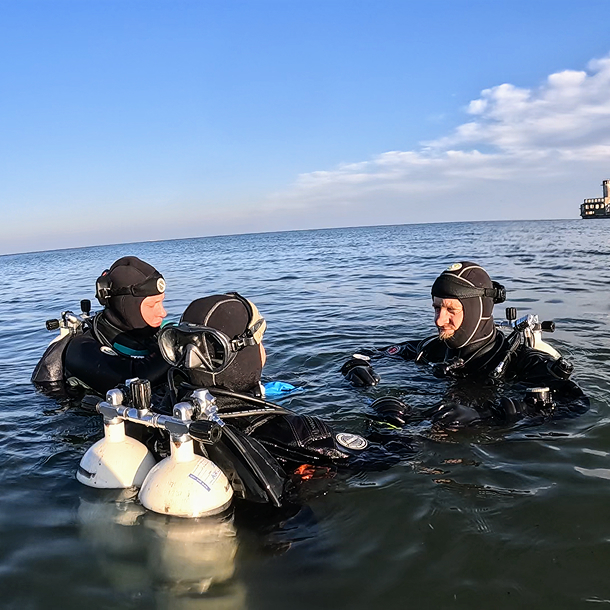
Scope of competence after the course
After the course you can:
- carry out an extended neurological assessment of a diver: motor, sensory and cognitive functions,
- analyse symptoms and tell apart potential diving injuries,
- interpret changes in the casualty’s condition over time and document them,
- support planning of further medical management,
- coordinate communication with the medical system and the DAN emergency hotline,
- take part in managing an incident during technical diving or an expedition,
- support the organisation of transport and preparation for hyperbaric therapy.
The greatest practical value is a baseline assessment that is done properly and written down. It lets the doctor tell whether the condition is getting worse, and without a reference point that cannot be done.
Theory
The theory part covers in-depth knowledge of diving medicine and physiology, the foundation for interpreting symptoms:
- diving physiology and the mechanisms of decompression injuries;
- telling decompression sickness, gas embolism and other diving injuries apart;
- principles of neurological assessment and its limits;
- interpreting symptoms and monitoring changes in condition over time;
- organising medical communication and transport of the casualty;
- basics of hyperbaric therapy and preparing the casualty for transport;
- psychological aspects of managing an incident and working as a team under pressure.
Classes are interactive and analytical, with the emphasis on understanding processes. In a real incident, symptoms rarely follow the textbook pattern, so we teach thinking, not picture recognition.
Practice
The practical part builds the ability to apply that knowledge in realistic scenarios:
- extended neurological assessment, carried out systematically and repeatably;
- monitoring the casualty’s parameters and documenting changes;
- analysing symptoms and telling injuries apart with incomplete information;
- diving incident scenarios that call for medical interpretation;
- communicating with the team and passing information to the medical services and DAN;
- organising transport and preparing for further treatment;
- debriefing the incident and analysing the decisions taken.
The key skill practised on the course is giving medical information over the phone in a short, orderly way. It sounds trivial, yet in practice it decides how good the remote consultation will be.

FAQ
The next step on your path
Directions for further development after reaching this level:
- Qualified First Aid (Kwalifikowana Pierwsza Pomoc, KPP), a Polish state course with a wider rescue scope and a natural extension of your skills;
- further DAN modules and specialist courses;
- training in incident management and expedition safety planning;
- in the longer term, formal education in emergency medicine, if the subject turns out to be a career direction.
It is worth knowing this limit: this is the highest level of medical competence that makes sense for a diver without a related degree. Everything above it is medical education, not diving education.
Work and practice
Using the skills in everyday diving and project practice:
- the role of the person responsible for the team’s medical safety during dives and projects;
- helping to build contingency plans and response procedures before departure;
- running and taking part in safety simulations and workshops;
- checking the team’s medical back-up and knowing the nearest hyperbaric centres;
- helping less experienced team members build medical awareness.
Regular practice consolidates analytical skills and shortens reaction time. A neurological assessment done once on the course is not enough: it has to be practised well enough to be carried out on a rocking deck.