


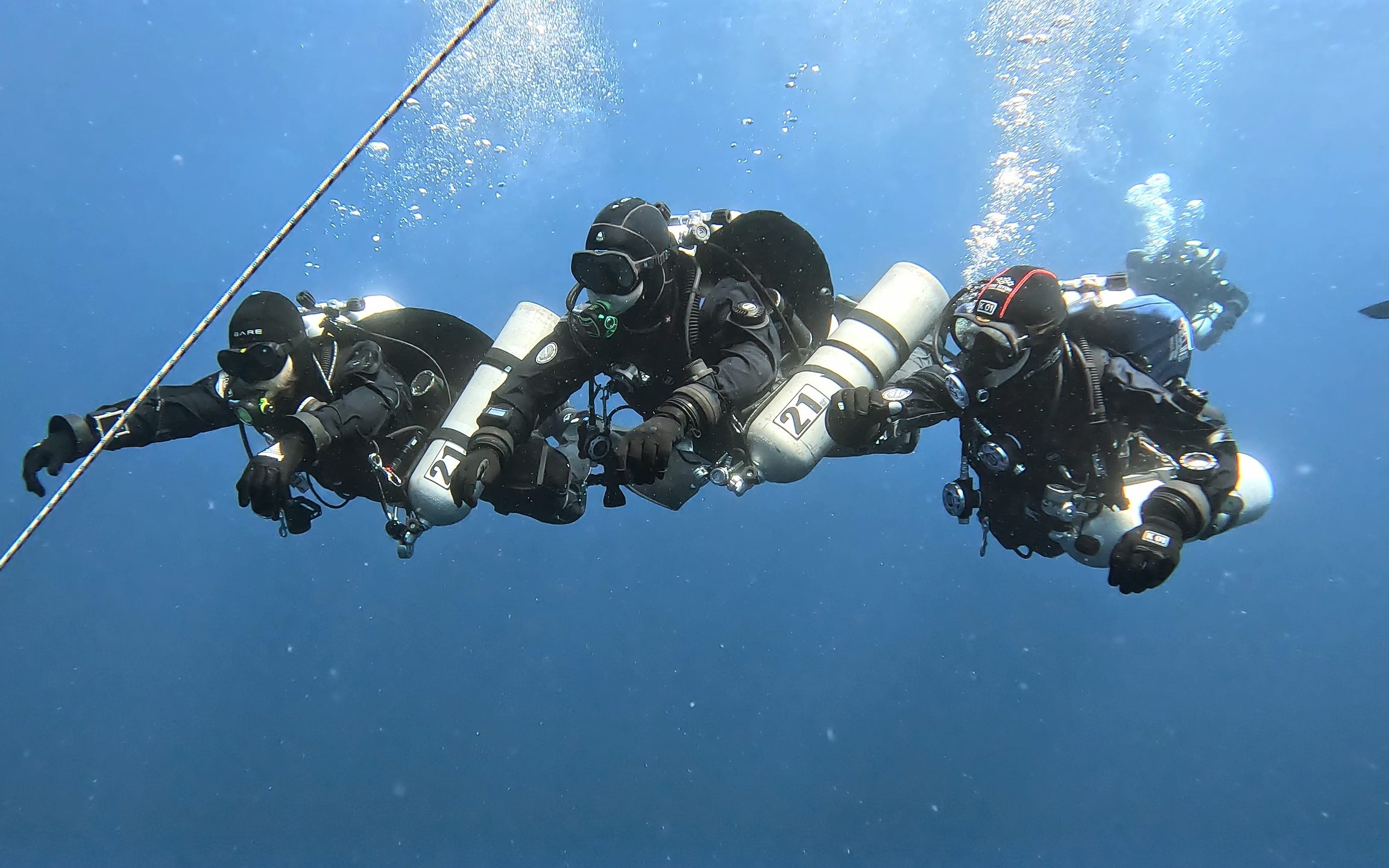
Trimix dives to 100 metres
PADI Tec Trimix Diver: full trimix course

Course description
PADI Tec Trimix Diver is the highest level of open circuit diver training in the PADI TecRec system. The course is meant for experienced technical divers who want to carry out very deep trimix dives: exploring deep wrecks, research projects and technical expeditions.
The training covers dives to 100 metres, with trimix as the bottom gas, trimix as the travel gas and several decompression gases. At these depths the oxygen content of the bottom gas drops below 18%, and the mix becomes hypoxic, meaning it is not breathable at the surface. This changes the whole logic of the dive: you need a separate travel gas for the descent, and a mistake in the order of gas switches stops being a slip and becomes a threat to life.
The programme builds on the skills gained at Tec 50 and Tec Trimix 65: planning complex multi-gas profiles, handling up to four stage and decompression cylinders, the logistics of advanced dives and emergency procedures in conditions where a direct ascent is not possible under any circumstances.
A large part of the theory is devoted to risk management. At this level there is no room for improvisation. Safety comes only from accurate planning, procedural discipline and a well-coordinated team.

5-6 days of intensive training, depending on conditions, location and the pace of the team.
Theory sections, practical sessions and training dives.
The full programme includes 8 training dives of increasing depth. A diver with a PADI Tec Trimix 65 certification completes only the three deepest dives, provided they continue training with the same instructor within 6 months.
Maximum depth: 100 metres.
Bottom gas: trimix, including hypoxic mixes (below 18% oxygen) that need a travel gas.
Decompression gases: nitrox and oxygen (up to 100%). At this level, usually several gases in one profile.
A maximum of 2 people per instructor.
A PADI Tec Trimix Diver certification qualifies you to plan and carry out dives independently:
- to a depth of 100 metres,
- with hypoxic trimix as the bottom gas and a travel gas for the descent,
- with several decompression gases in one profile,
- with extended, multi-stage decompression, in a team of suitably qualified divers.
It is the highest level of open circuit diver training in the PADI TecRec system. Further development leads towards specialisation: exploration, closed circuit or the instructor path.
- Age: 18 years completed;
- Technical certification: PADI Tec 50 Diver or PADI Tec Trimix 65 Diver, or an equivalent certification from another organisation;
- Rescue certification: PADI Rescue Diver or equivalent. For a qualification from another federation, proof of first aid and CPR training from the last 2 years is required;
- Experience: a minimum of 150 dives recorded in a logbook;
- Health: a current medical statement (signed by a doctor within the last 12 months);
- Insurance: current diving insurance covering decompression dives and treatment in a hyperbaric chamber.
The formal requirements are a minimum. Before accepting you onto the course, we check your real, recent decompression experience. At this level, what matters is not the number of logbook entries but when and in what conditions they were made.
Main configuration
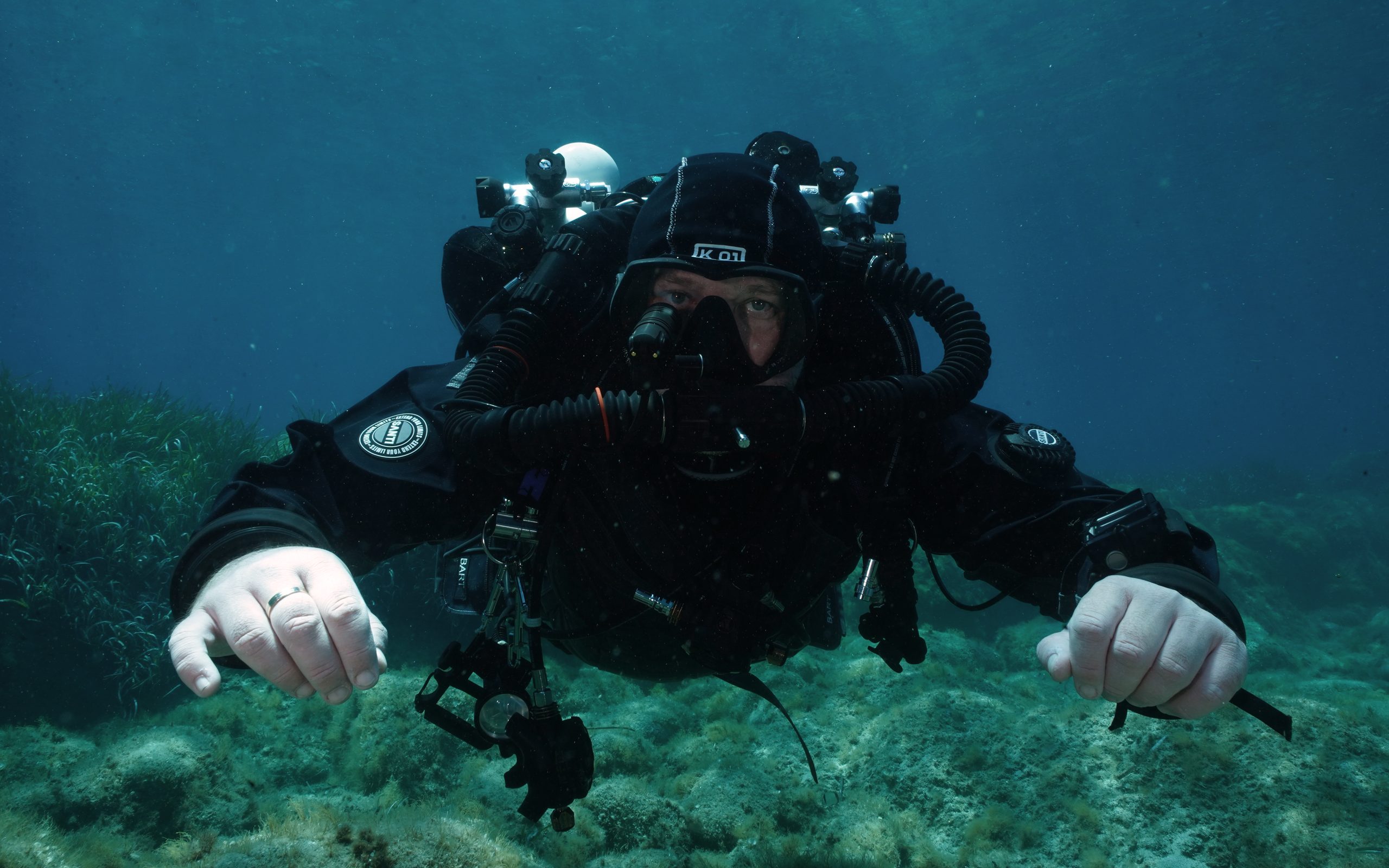
- a twinset (minimum 2 × 12 l, larger preferred) with an isolation manifold, or an equivalent sidemount set,
- a backplate and a one-piece harness,
- a wing with buoyancy suited to a full multi-cylinder setup,
- two independent regulators: a primary on a long hose (approx. 2 m) and a backup on a bungee necklace,
- a pressure gauge on every first stage,
- backup buoyancy control: a second buoyancy bladder or a dry suit suited to the weight of the setup.
Stage and decompression cylinders
- up to four stage and decompression cylinders, including a cylinder with the travel gas,
- an independent regulator with a pressure gauge for every cylinder, with regulators for oxygen-rich gases prepared for work with oxygen,
- a harness for each cylinder with double-ended bolt snaps,
- an absolutely legible label with the mix and MOD on every cylinder. With four cylinders, labelling is the basic safety mechanism.
Instruments and safety equipment
- two independent computers that support trimix and multiple gases,
- a DSMB with a reel or spool and a spare DSMB,
- two cutting tools placed independently,
- a spare mask,
- an underwater slate with the main plan and contingency profiles,
- a primary light and at least one backup.
Also recommended
- a dry suit with an undergarment suited to very long exposures,
- a dry suit argon inflation system,
- decompression software that supports helium mixes and multi-gas profiles,
- your own oxygen and helium analyser,
- a full set of tools and consumables.
Training fee
The price is set individually, depending on the training location, dive logistics and the number of training dives.
Registration and certification fee
According to the current price list of the certifying organisation.
Training materials
The PADI Tec Trimix Diver package, charged separately unless it was bought with the Tec Trimix 65 course.
Additional costs
Breathing gases, dive logistics, equipment rental, travel, accommodation and meals. Helium is the most significant and most variable item in the budget. We prepare the estimate individually once the profiles are set.
Theory
The theory part focuses on the complexity that hypoxic trimix and several gases in one profile bring:
- hypoxic mixes: the consequences of an oxygen content below 18%, the need for a travel gas, descent and ascent procedures;
- gas selection strategy: equivalent narcotic depth, gas density, MOD and the order of switches;
- advanced decompression planning, models and gradient factors, deep stops;
- isobaric counterdiffusion and the consequences of choosing decompression gases that contain helium;
- the physiology of very deep dives, including high pressure nervous syndrome and work of breathing;
- expedition logistics: gas supply, surface support, an evacuation plan and access to a hyperbaric chamber;
- risk management and a critical review of the plan before the dive.
Practice
Training dives are progressive, from checking your skills to full trimix dives at great depths:
- handling up to four cylinders: clipping them on, the order of switches, checking labels and contents;
- a gas switch procedure carried out in a fixed sequence, with a team confirmation at every cylinder;
- working with a travel gas when descending on a hypoxic mix;
- planning and carrying out complex profiles with multi-stage decompression;
- simulated emergencies: gas loss, a regulator failure, a configuration problem, a problem with your buddy at depth;
- teamwork and division of roles: at this level, safety is a function of coordination, not of individual skill.
The aim of the emergency drills is to build automatic reactions. At 100 metres there is no time to think about the order of actions. It has to be drilled until it is a reflex.

FAQ
Projects
Dives with a specific task to complete. At this level, a project is the main reason to take this course:
- exploring and documenting deep wrecks, out of reach of most technical divers;
- photogrammetry and photo documentation of objects at great depths;
- surveying and mapping new sites, line work and measurements;
- research and conservation cooperation with institutions that look after underwater heritage;
- taking part in technical expeditions, either as a deep diver or in a support role for the target team.
For trimix dives we require a check dive before every project, regardless of the certifications you hold. Without regular practice, procedures at this level fade quickly.
Trips
A few days in a row with the same team builds experience faster than the same number of dives spread over a whole season:
- trips abroad to deep sites, the basic format of diving at this level;
- deep Baltic wrecks, accessible only to trimix divers;
- small teams, a dive plan of growing complexity and a full gas supply arranged before departure;
- confirmed availability of helium, oxygen and a compressor on site, which with hypoxic trimix is a condition for the trip to be feasible;
- surface support, an emergency plan that includes a hyperbaric chamber, and an evacuation procedure.
Before a trip, plan an equipment check, a check dive in your target configuration and insurance that covers decompression diving. We keep the trip calendar separately.
Further training
Once you have completed the open circuit path, development leads towards specialisation:
- closed circuit (rebreather): longer exposures and a clearly lower gas cost on deep dives;
- PADI Tec Gas Blender: preparing helium mixes yourself, a real saving at this intensity of diving;
- wreck and exploration training, including penetration;
- the PADI TecRec instructor path, if you are thinking about a professional career in technical diving.
The direction depends on what you want to do underwater. We are happy to talk it through individually, because at this level general recommendations stop making sense.