


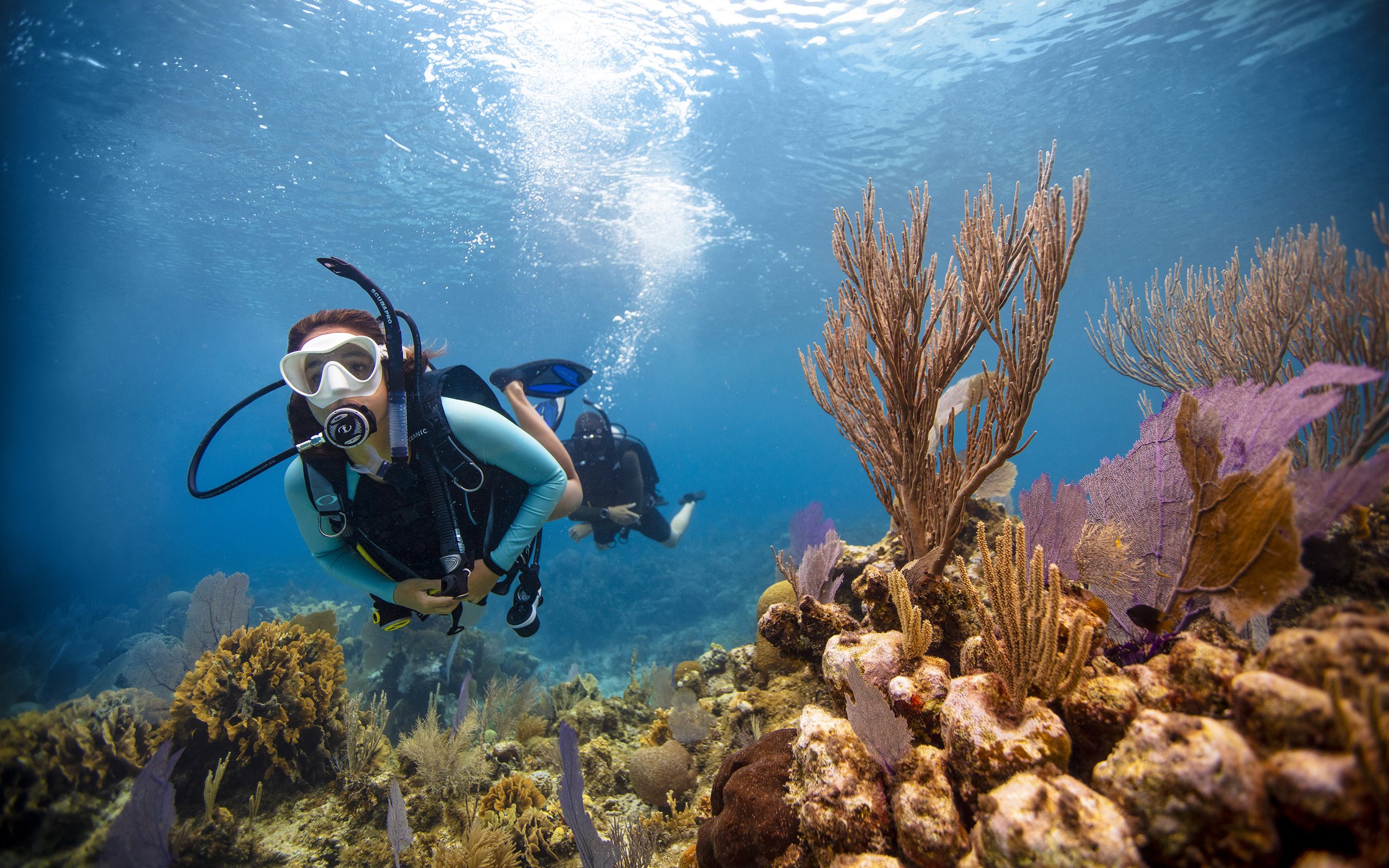
A well-informed start in diving
PADI Open Water Diver: solid foundations for diving

Course description
PADI Open Water Diver is the first full diving course and the moment you earn the right to dive independently with a buddy. It is not only about learning basic skills, but above all about understanding the environment you move in.
The programme covers theory, confined water sessions and open water dives. You learn buoyancy control, working with equipment, communication underwater and reacting to basic problem situations. We put a lot of emphasis on understanding why you do something, so that every action is deliberate and not repeated from memory.
The aim of the course is solid foundations that let you dive calmly and with full control. This matters whether diving stays an occasional holiday activity or becomes the start of a longer road, because the habits formed at this level stay with you for years.
We run the course in groups of a maximum of 4 people, clearly smaller than the standard allows. When learning to dive, the number of people per instructor translates directly into how many times someone corrects your position in the water.

3-4 training days; we recommend 4-5 days to keep a comfortable learning pace. Spreading the course over time is also possible.
4 open water dives and a series of confined water sessions (pool), where you develop your skills before going out into open water.
A maximum of 4 students per instructor, deliberately below the limit the standard allows.
The PADI Open Water Diver certificate qualifies you to:
- dive independently with a suitably qualified buddy,
- dive to a depth of 18 metres, in conditions that match your experience,
- rent equipment and fill cylinders at dive centres worldwide,
- join dive trips and continue your training.
Restrictions for junior divers: those aged 10-11 dive to 12 metres only with a parent, guardian or professional; those aged 12-14 dive to 18 metres with a certified adult. After turning 15, it can be upgraded to the full Open Water Diver certificate, without additional training.
Air
- Age: minimum 10 years (at ages 10-14, Junior Open Water Diver certification);
- Swimming: basic ease in the water; simple swimming tasks are done during the course;
- Health: no contraindications to diving: medical form, and a doctor’s consultation if needed;
- Experience: none, the course starts from the basics.
Basic equipment: your own is recommended
- a mask that fits your face, the item that affects comfort most;
- snorkel and fins;
- thermal protection suited to the conditions.
Equipment provided by the centre
- regulator with a pressure gauge,
- jacket (BCD),
- diving cylinder,
- weight system,
- dive computer.
It is worth building up your own equipment gradually, starting with the mask. There is no need to buy a full set before the course, and buying decisions made after the course are usually better ones.
Training fee
The price is set individually, depending on the location and logistics.
Registration and certification fee
Training materials (e-learning) and the certification fee, according to the current price list of the certifying organisation.
Additional costs
Equipment rental, breathing gases, entry to dive sites, travel, accommodation and meals.
Theory
The theory part is done through e-learning and discussed with the instructor. We focus on understanding, not memorising:
- diving physics: pressure, buoyancy, gas behaviour;
- physiology: equalising pressure, the effect of depth on the body, decompression sickness;
- how diving equipment is built and how it works;
- dive planning and using a dive computer;
- communication underwater and the rules of diving with a buddy;
- solving basic problems and emergency procedures.
Practice
Confined water sessions, followed by 4 open water dives:
- assembling, checking and handling equipment;
- buoyancy control and holding a stable position;
- clearing and removing the mask underwater;
- recovering the regulator and sharing air with a buddy;
- controlled descents and ascents;
- basic navigation and orientation underwater;
- simple swimming tasks that confirm you are comfortable in the water.
We repeat the exercises until you have control and feel comfortable, not until a time limit runs out. If something needs an extra session, we simply do it.

FAQ

The next step on your path
A natural continuation after the basic course:
- PADI Advanced Open Water Diver: diving to 30 metres, navigation and themed dives;
- PADI Enriched Air (Nitrox) Diver: longer no-decompression times, useful from your first trip;
- specialties suited to the environment: dry suit, night diving, navigation;
- PADI Rescue Diver: the next big step, after the Advanced course and some experience.
In Polish conditions a dry suit course pays for itself very quickly: it extends the season and really changes how comfortable diving is.
Trips
Trips are where the skills from the course turn into experience:
- the course done as a trip, in warmer water with better visibility;
- trips for newly certified divers, with staff support;
- dives in varied conditions: lakes, quarries, the sea;
- combining a trip with the next course, e.g. Advanced Open Water Diver;
- family and group dives.
We keep the trip calendar separately. It is worth planning your first trip after the course soon after certification.