

Is oxygen narcotic like nitrogen? Narcosis, END and trimix planning
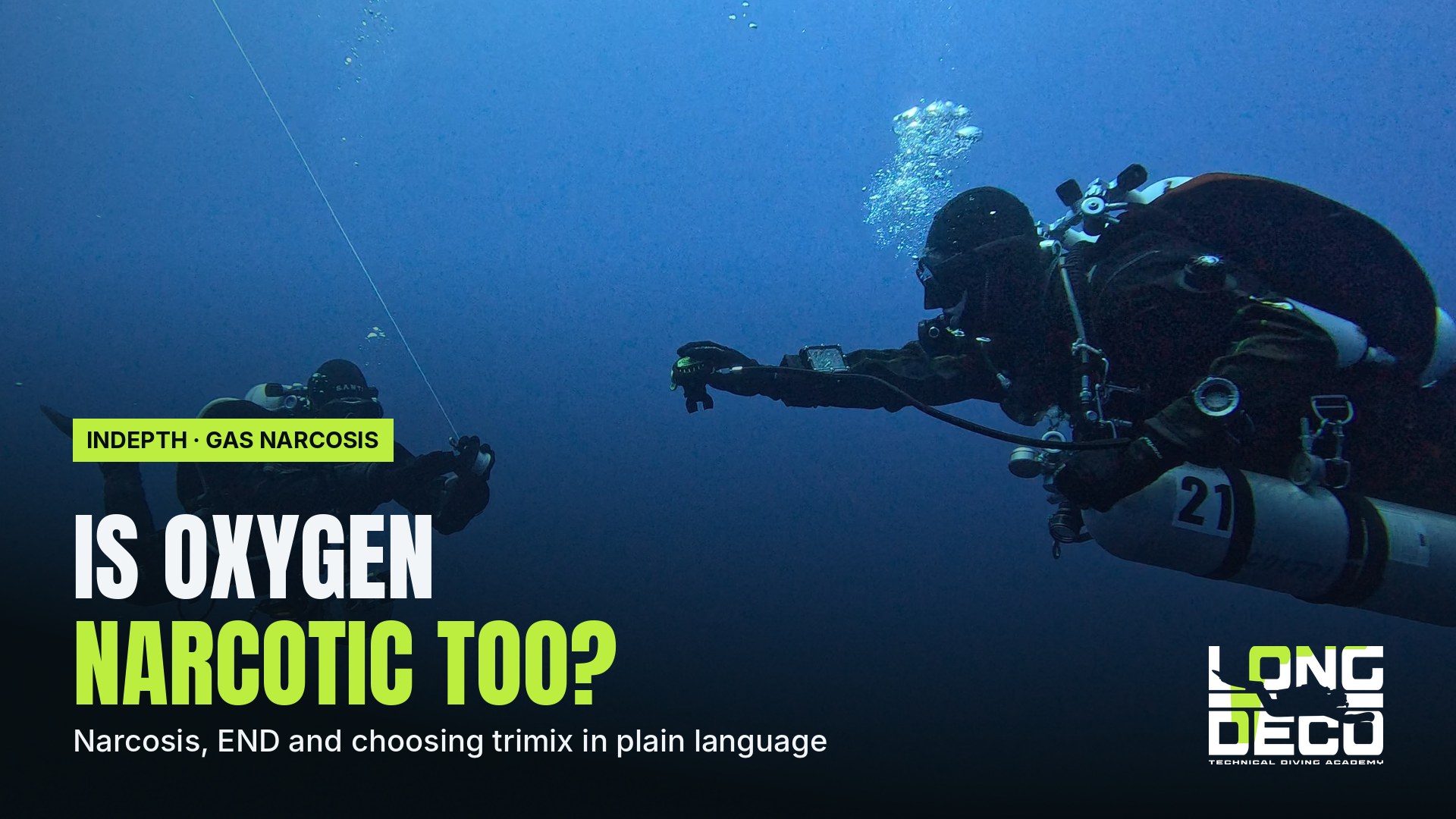
Anyone who has gone below 30 metres on air knows the feeling: thinking gets a little slower, counting gas gets harder, and sometimes there is odd cheerfulness or unease. This is gas narcosis, which many people simply call “rapture of the deep”. We know nitrogen is mostly to blame. But what about oxygen? Is there such a thing as oxygen narcosis? This seemingly academic dispute has very practical consequences: the answer decides how much helium you put in the cylinder and how you judge the mix on your rebreather.
The subject was taken up by Dr Xavier Vrijdag, a diving medicine researcher at the University of Auckland, in an article for InDEPTH magazine, one of the most-read pieces in that magazine in 2023. Below we describe what he found and explain what it means for your dive plan.
Narcosis in brief
Narcosis is a reversible disturbance of brain function caused by a breathing gas under increased pressure. The deeper you go, the greater the partial pressure of the gas, meaning the share of the total pressure that belongs to a given component of the mix. At 30 m we breathe air at 4 bar, so nitrogen affects us as if there were four times as much of it as at the surface. Narcosis goes away when you ascend, but underwater it can badly spoil your judgement, and in technical diving judgement is the most valuable thing you have.
The remedy is helium. It is a gas that does not narcotise, so in trimix (a mixture of oxygen, helium and nitrogen) it replaces part of the nitrogen. A mix is written as two numbers: 18/45 means 18% oxygen and 45% helium, and the rest, 37%, is nitrogen.
END: one name, two ways of calculating
To compare how narcotic different mixes are, we use END (from equivalent narcotic depth). It is the depth at which air would narcotise you the same as a given mix at the planned depth. If the END of your trimix at 60 m is 30 m, your head should feel roughly as it does at 30 m on air.
The problem is that END is calculated in two ways:
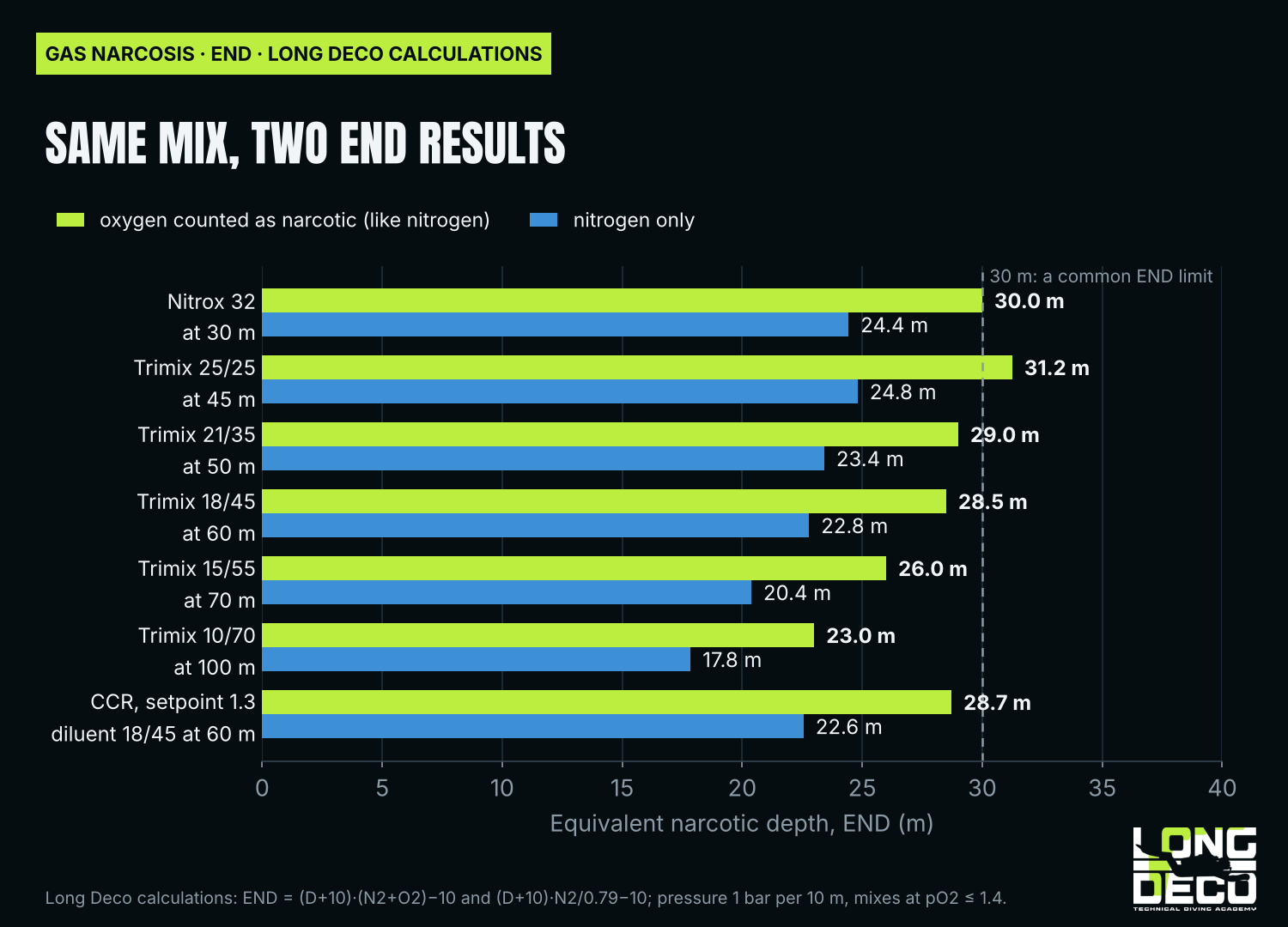
- with oxygen: oxygen is treated as just as narcotic as nitrogen. Then END = (depth + 10) × (nitrogen fraction + oxygen fraction) − 10. This is how PADI, GUE, CMAS and PSAI, among others, calculate it.
- without oxygen: only nitrogen counts, compared with the 79% nitrogen in air. END = (depth + 10) × nitrogen fraction ÷ 0.79 − 10. This is how TDI, IANTD, BSAC and NAUI, among others, calculate it.
The difference is not cosmetic. For 18/45 trimix at 60 m you get 28.5 m when oxygen is counted and 22.8 m when it is left out. The chart below collects several typical mixes: in every case the version with oxygen gives a result about 5 to 6.5 m deeper.
Why oxygen is suspect at all
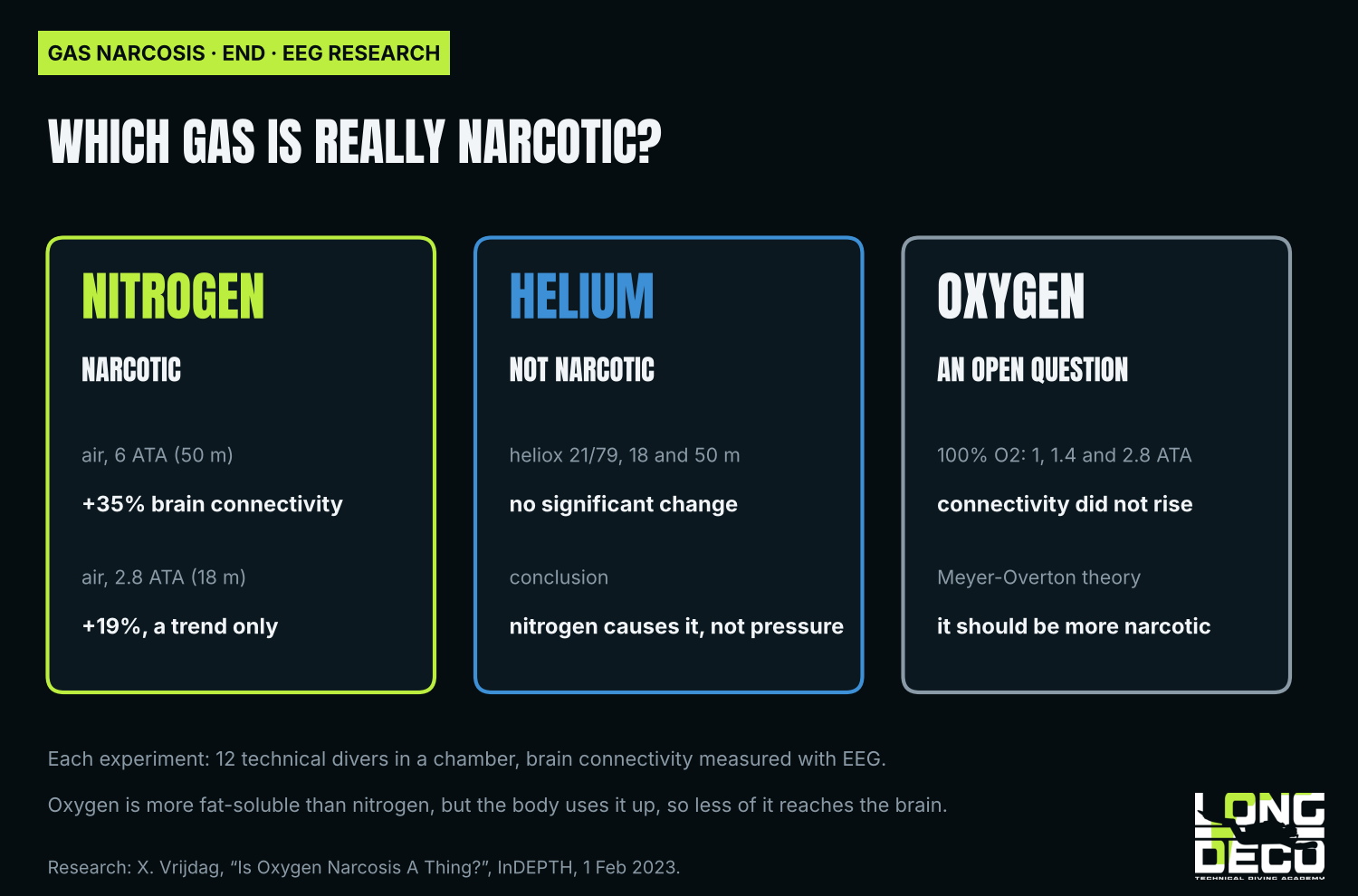
For over a hundred years anaesthesiology has worked with the Meyer-Overton rule: the better a gas dissolves in fat, the more strongly it narcotises. Oxygen dissolves in fat better than nitrogen, so by this rule it should narcotise even more. But there are two catches. First, the rule has exceptions: some gases behave differently from what it predicts. Second, oxygen is not an inert gas. The body constantly uses it up, so its pressure in brain tissue is much lower than in the gas we breathe. Nitrogen and helium are not consumed, so they reach the brain “in full”.
How do you measure narcosis?
It is harder than it looks. Classic psychometric tests, meaning tasks on counting, memory or dexterity, have weak points: subjects learn them with every further attempt, and the result depends on motivation. The popular CFFF test (critical flicker fusion frequency, the point at which a flashing light starts to look continuous) showed no narcosis at all in Vrijdag’s studies on air at 6 ATA, which is about 50 m.
The Auckland team therefore proposed a different measure: functional connectivity of the brain, measured with an EEG recording, that is, the electrical activity of the brain picked up by electrodes on the head. In simple terms, it checks how much different areas of the brain “talk” to each other and how efficiently they pass information along.
What came out in the chamber
First they had to check whether the method picks up narcosis at all. Twelve technical divers breathed air and heliox (21% oxygen, 79% helium) in a hyperbaric chamber at pressures equal to 18 m (2.8 ATA) and 50 m (6 ATA). On air at 6 ATA, connectivity in the brain rose by 35% compared with the surface, and at 2.8 ATA there was a trend towards a 19% rise. On heliox nothing significant changed. Since the pressure and the amount of oxygen were the same, the difference comes from nitrogen. The method works.
Then it was oxygen’s turn. In the second study twelve technical divers breathed pure oxygen at the surface, at 1.4 ATA (4 m) and at 2.8 ATA (18 m). Connectivity in the brain did not rise. The author’s hypothesis is that oxygen simply does not act on the same receptors in neurons as nitrogen does.
For nitrox divers this is good news: the extra oxygen probably makes the mix slightly less narcotic than air. But the limitations have to be kept in mind. These are small groups, one measurement method, and conclusions that the author himself presents as a hypothesis. An oxygen partial pressure of 2.8 ATA, at which the study was run, is unacceptable in diving: in such conditions oxygen toxicity and convulsions are a real risk.
What this means for planning mixes
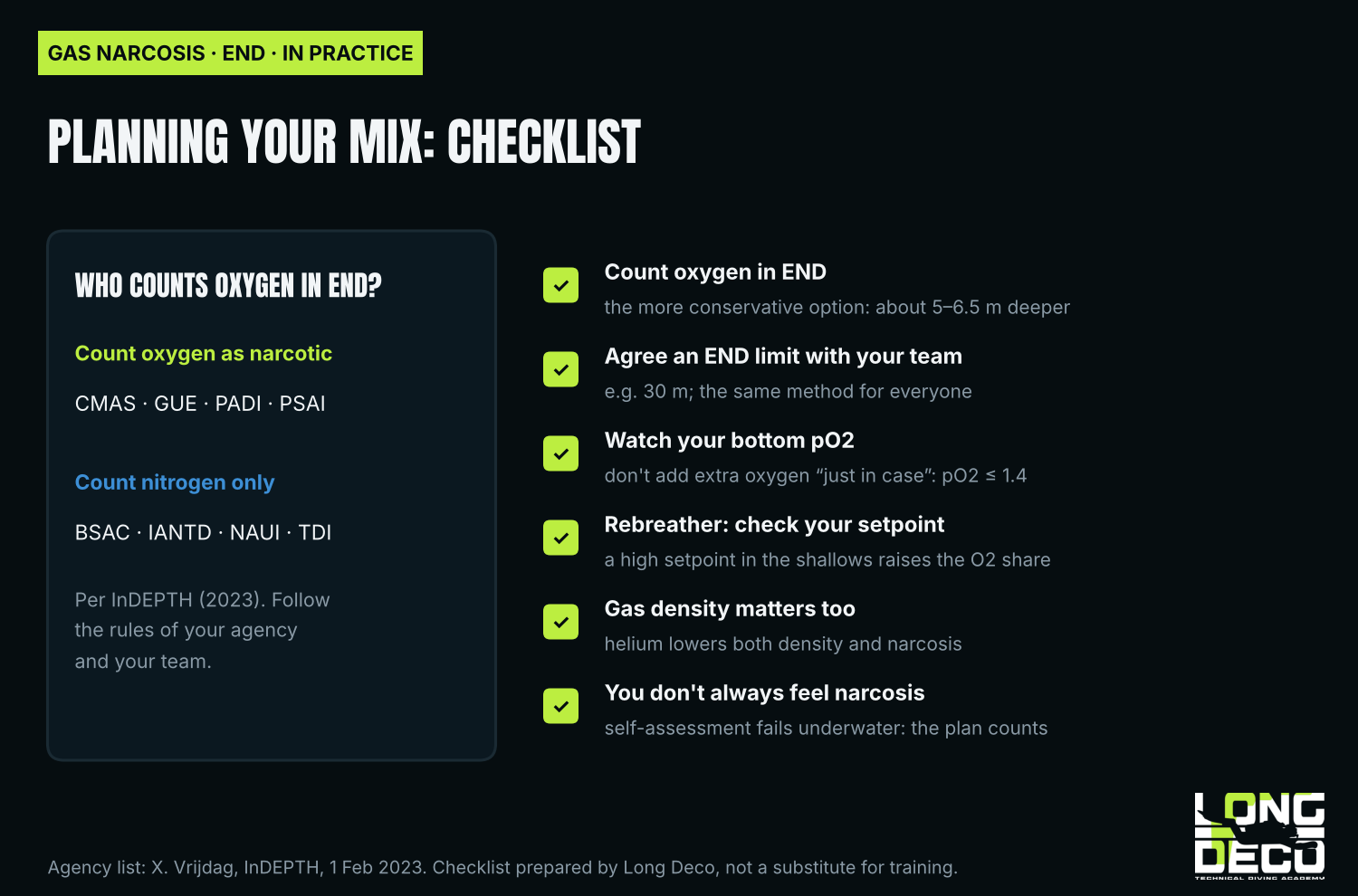
1. Calculating END with oxygen is a safety margin, not a mistake. If oxygen narcotises less than we assume, then END calculated with oxygen simply overstates narcosis by a few metres. You go on the dive with a clearer head than the plan predicted. The opposite error would be worse.
2. The margin costs helium. An example: at 60 m with 18% oxygen you want an END of 30 m. Counting oxygen as narcotic, you need about 43% helium. Counting only nitrogen, about 37% is enough. On large cylinders and over many dives that is a noticeable difference in the cost of a fill. Helium has other advantages too: it lowers gas density, and dense gas makes breathing harder and encourages carbon dioxide retention, which itself increases narcosis.
3. Rebreather. On a closed circuit (CCR) the oxygen partial pressure is constant (the so-called setpoint), so at shallower depths the oxygen share in the loop is large. If you count oxygen in END, the rebreather at intermediate depths comes out “more narcotic” than the EEG studies suggest. If you do not count it, the result is closer to what the EEG showed, but you lose the margin. What matters is that the whole team and the decompression planner use the same method.
4. Stick to your organisation’s standard. PADI, under which we train at Long Deco, counts oxygen as narcotic. One study does not change standards overnight and is not a reason to “slim down” the helium in your mix on your own.
5. Do not trust self-assessment. The same chamber showed that a simple visual test did not detect narcosis at 50 m, although the EEG saw it. Underwater it is similar: feeling “fine” does not mean you think as well as you do at the surface. That is why END is set on land, in the plan, and not on the bottom.
Glossary
- Gas (nitrogen) narcosis: a reversible slowing and disturbance of brain function caused by a breathing gas under pressure.
- Partial pressure (pO2, pN2): the part of the total gas pressure that belongs to a given component of the mix.
- ATA: atmosphere absolute, pressure counted together with the pressure of the air above the water (1 ATA at the surface, about 2 ATA at 10 m).
- END (equivalent narcotic depth): the depth at which air would narcotise the same as a given mix.
- Trimix: a mixture of oxygen, helium and nitrogen; 18/45 means 18% oxygen and 45% helium.
- Heliox: a mixture of oxygen and helium only.
- Nitrox: air enriched with oxygen, for example nitrox 32 is 32% oxygen.
- Rebreather (CCR): a closed-circuit unit that removes carbon dioxide and adds oxygen, keeping a constant pO2.
- Setpoint: the oxygen partial pressure the rebreather maintains, for example 1.3.
- Diluent: the diluting gas in a rebreather, usually trimix for deeper dives.
- Meyer-Overton rule: the principle that the better a gas dissolves in fat, the more strongly it narcotises.
- EEG: a recording of the electrical activity of the brain.
- CFFF: the critical flicker fusion frequency test, used to assess narcosis.
- Oxygen toxicity: the harmful effect of oxygen at too high a pO2; underwater it risks convulsions.
Want to plan your mixes with confidence?
Choosing gases, calculating END and oxygen limits are the core of technical diving courses. At Long Deco we teach this in practice, on real plans and real dives:
- PADI Tec 40 and Tec 45: an entry into decompression diving,
- PADI Tec 50: down to 50 m with several decompression gases,
- PADI Tec Trimix 65: first dives with helium and calculating END in practice,
- PADI Tec Trimix Diver: deep dives on hypoxic trimix.
Write to us and we will help you match a course to your experience.
Source: Xavier Vrijdag, Is Oxygen Narcosis A Thing?, InDEPTH, 1 February 2023, Read the article on InDEPTH. The article describes studies by a University of Auckland team published in 2022 in Scientific Reports (nitrogen) and Physiological Reports (oxygen), funded by the US Navy’s Office of Naval Research.
The END values in the chart and in the examples were calculated by Long Deco. This text is educational and does not replace technical diving training.