


Gradient factors in plain language: how to set your dive computer after the deep stops era
Almost every decompression dive computer has a “GF” entry in its menu with two numbers, for example 30/70 or 50/80. Many divers leave it as the manufacturer set it, others copy the settings from a buddy. Yet those two numbers decide at what depth you make your first stop and how long you hang on the last few metres.
One of the most widely read texts in InDEPTH magazine is an article by Dr David Doolette, a decompression physiologist at the US Navy Experimental Diving Unit (NEDU) and a cave diver. His thesis is simple: research of recent years shows that deep stops are not as good as we thought, so it is worth setting gradient factors differently. Below we explain it step by step.
The basics first: tissues and M-values
During a dive, inert gas dissolves in the body (that is, a gas that takes no part in the body’s metabolism: nitrogen, and in trimix also helium). On ascent the ambient pressure drops and the tissues start to release that gas. The gas pressure in the tissue is then higher than the pressure around us. This is supersaturation, and decompression would not work without it, but too much supersaturation favours the formation of bubbles and decompression sickness (DCS). We wrote more about the risk of DCS itself in the post Decompression explained.
Most computers calculate decompression with the Bühlmann ZH-L16 model. It describes the body as 16 model “tissues” (compartments) that saturate with gas at different rates: from a few minutes to a few hours. For each tissue the model has an M-value, which is the highest inert gas pressure that tissue can hold at a given depth. It is the limit of the model, not a comfort zone: reaching it does not guarantee a dive without DCS.
ZH-L16 is a so-called gas content model: it tracks how much gas is in the tissues. There are also bubble models (for example VPM-B), which try to describe how micro-bubbles behave. The latter usually call for deeper stops.
What are gradient factors?
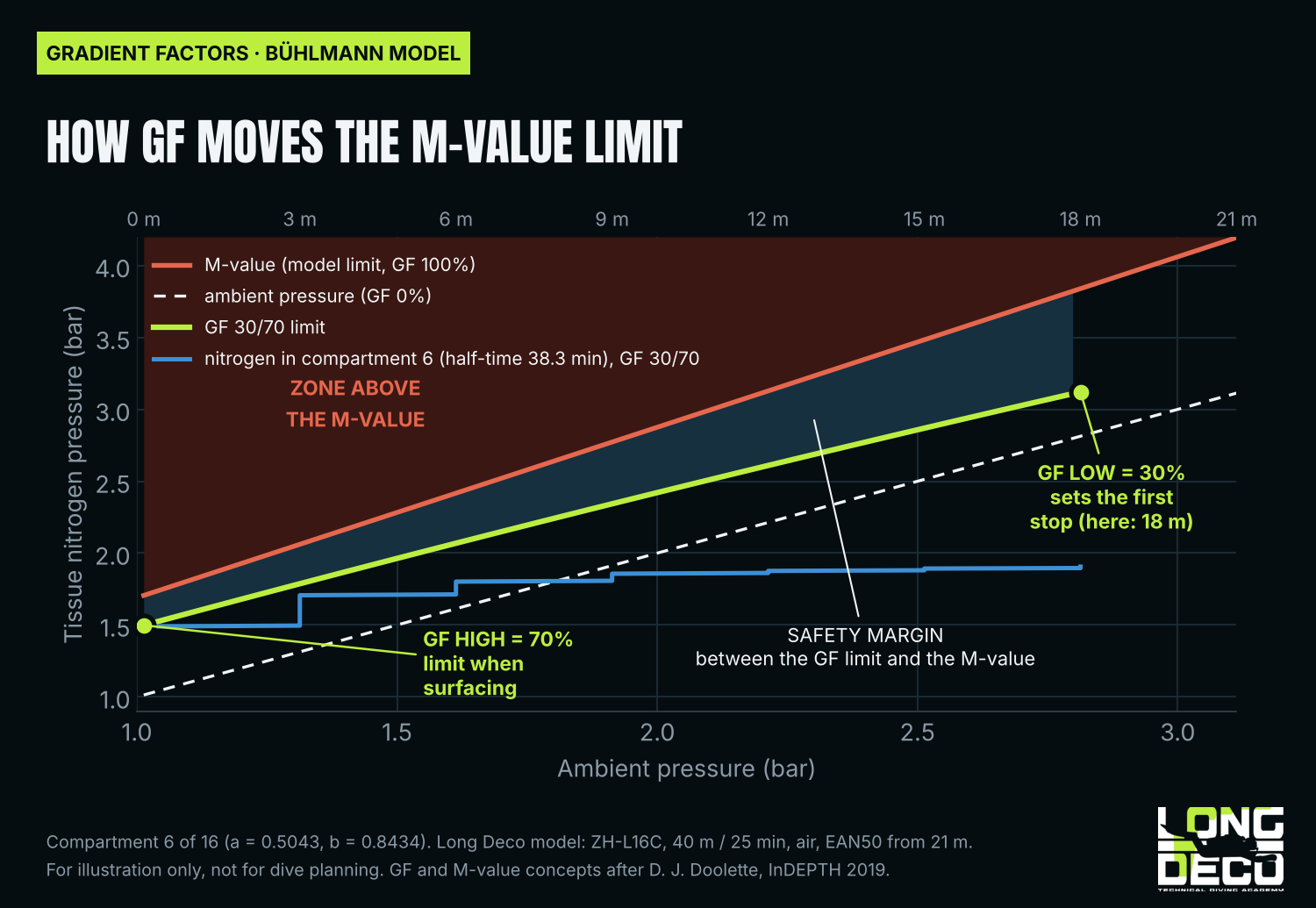
Gradient factors (GF) are a way of staying away from the M-value. They say what part of the “distance” between the ambient pressure and the M-value you are allowed to use. GF 100% is pure Bühlmann, with no margin. GF 0% would mean zero supersaturation, that is, an ascent that would never end. GF 80% is 80% of that distance.
The setting has two numbers:
- GF low (the first number) applies to the first, deepest stop. The lower it is, the deeper the computer makes you stop.
- GF high (the second number) applies to the moment you surface. The lower it is, the longer the stops on the last few metres.
Between the two, the computer draws a straight line: at each successive stop the permitted supersaturation rises a little.
Where deep stops came from
The fashion for deep stops started with the so-called Pyle stops. Ichthyologist and technical diving pioneer Richard Pyle stopped deeper because he had to vent gas from the swim bladders of fish collected at great depth. Bubble models gave this a theory: if we stop earlier, the bubbles do not have time to grow. In the Bühlmann world the same effect was obtained with a low GF low, for example 30 or less.
What the research showed
Since about 2005 more and more comparative decompression studies have appeared, and none of those described in the article showed an advantage for deep stops:
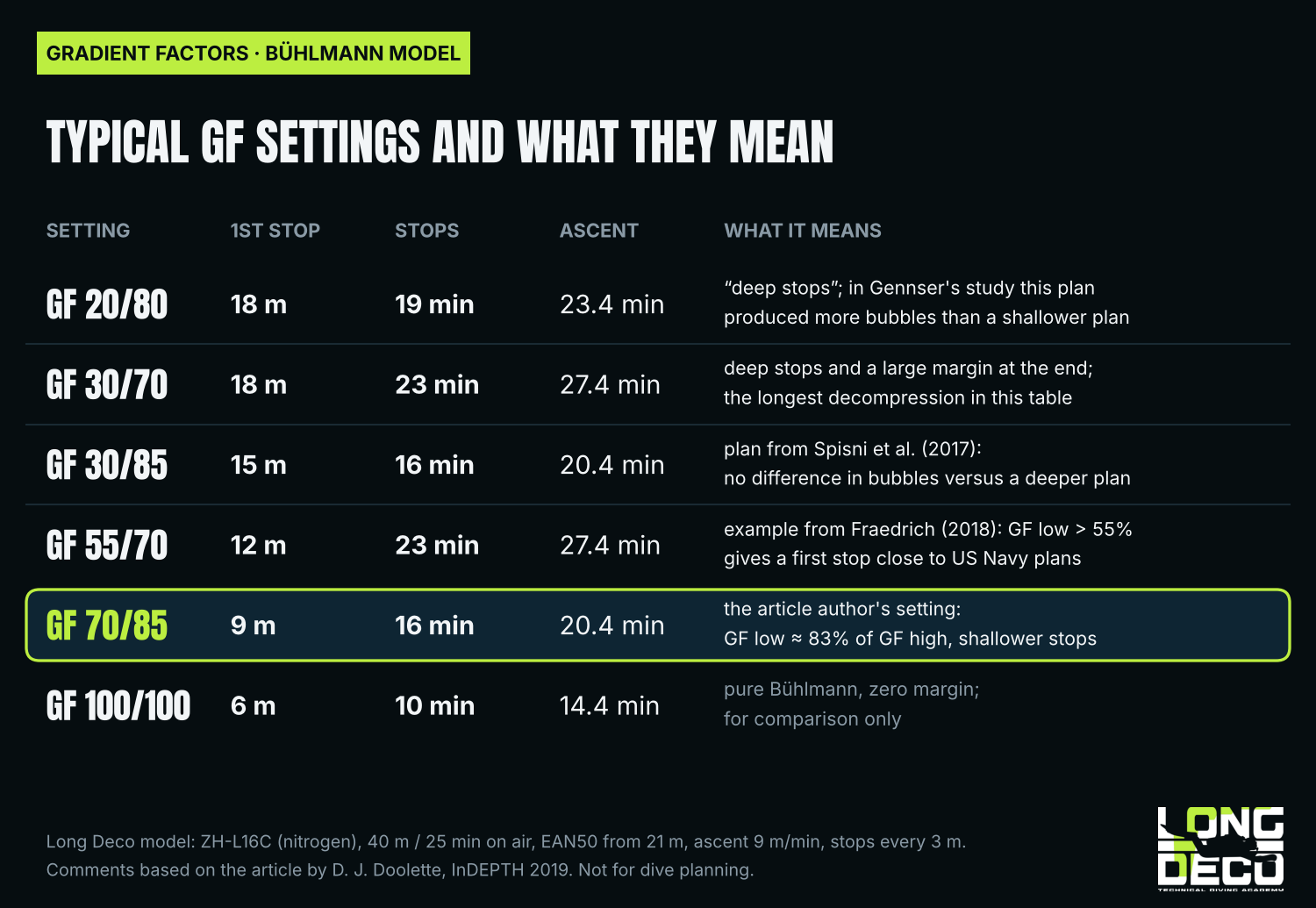
- NEDU study (2011), air dives, 30 minutes at about 52 m. The plan with shallow stops (first stop at about 12 m) produced 3 cases of DCS in 192 dives. The plan with deep stops from a bubble model (first stop at about 21 m): 11 cases in 198 dives.
- French Navy (Blatteau et al.): table versions with deep stops gave the same or more gas bubbles in venous blood (VGE), plus a few cases of DCS, even though decompression took longer.
- Spisni et al. (2017): trimix dives with GF 30/85 versus a plan with even deeper stops: no difference in bubbles.
- Gennser (2015, unpublished work): a Bühlmann plan with GF 20/80 produced clearly more bubbles than a plan with shallow stops of similar duration.
Doolette’s conclusion: deep stops are not more efficient, and may be less efficient than shallow ones. The explanation given most often: while you sit deep, the slower tissues keep taking up gas, and you have to make up that time higher up.
So how should you set GF
The author cites work by Fraedrich (2018), who compared computer algorithms with well-tested US Navy tables. Bühlmann with a GF low above 55% (for example 55/70) put the first stop in the same depth range as the proven Navy plans.
Doolette also has a simple rule for himself: he sets GF low at about 83% of GF high, for example 70/85. This is not by chance. In the Bühlmann model, at deeper stops the permitted supersaturation is greater than at shallower ones (M-values rise with depth faster than ambient pressure). GF set this way roughly evens that out and allows a similar supersaturation at each stop. The author stresses that this is his own choice, not an official recommendation.
To see what this changes, we calculated the same dive with a simplified ZH-L16C model: 40 m for 25 minutes on air, with EAN50 from 21 m.
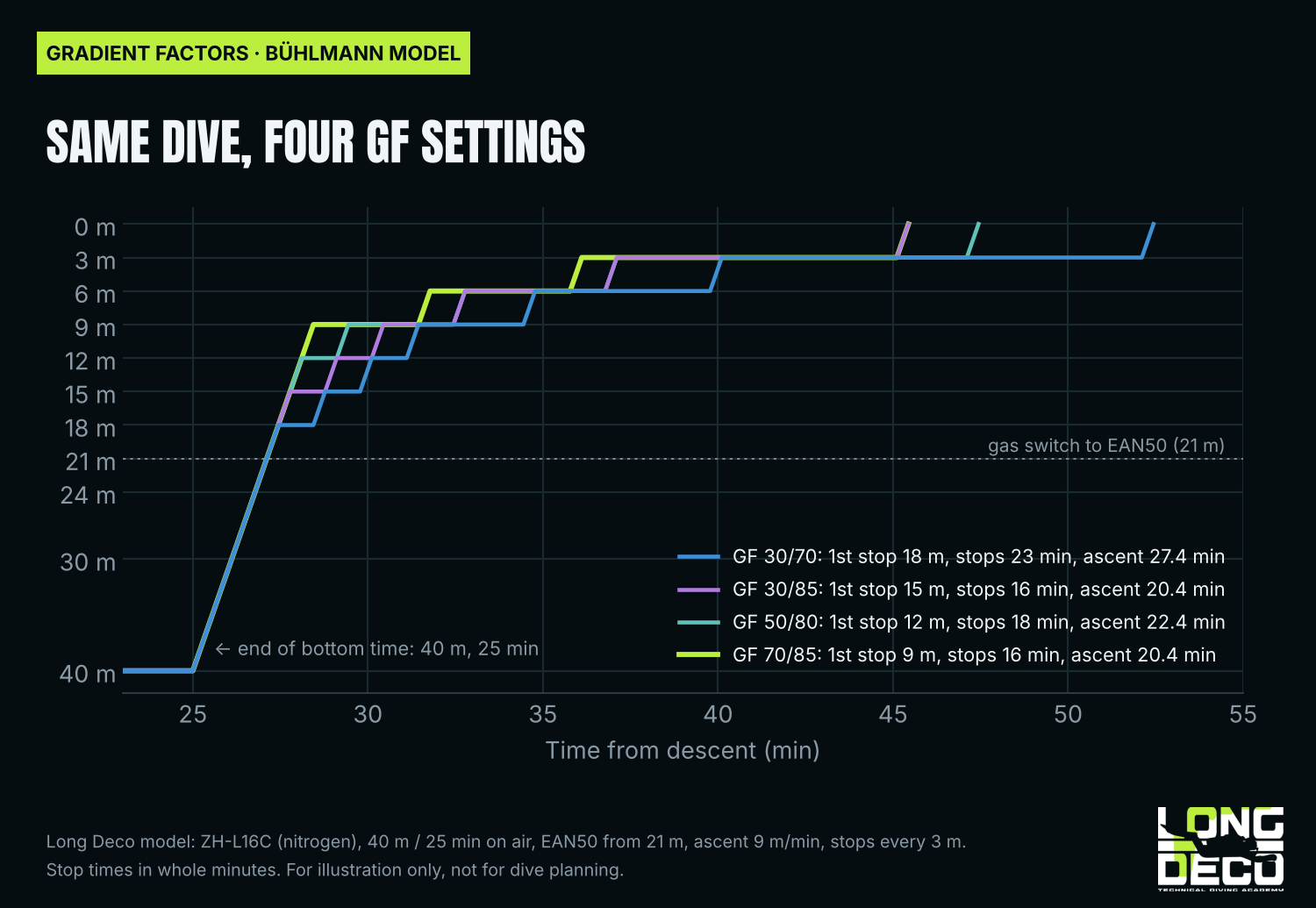
At 30/70 the first stop is at 18 m and the stops last 23 minutes. At 70/85 we start at 9 m and finish after 16 minutes. The comparison of 30/85 and 70/85 is interesting: the total time is the same, but at 70/85 we spend all of it shallower, where the slow tissues are already off-gassing rather than still taking gas up. This is exactly the change the article is about.
What this means in practice
- Check what you have set. If GF low is low (30 or less), the computer takes you through the ascent with deep stop logic.
- A bigger margin comes from GF high, not from a low GF low. Lowering GF high lengthens the shallow stops and reduces supersaturation at the surface. Lowering GF low mostly adds time at depth. This is our conclusion from the logic of the article.
- Plan and dive on the same settings. The plan from your software and the computer on your wrist should calculate the same way, and so should your buddy’s computer.
- Do not change settings by feel. Every GF change changes the profile. Discuss it with an instructor who knows your dives.
GF is not a magic safety knob. It will not replace good hydration, rest, a calm ascent and a sensible plan. But since you set it anyway, it is worth knowing exactly what it does.
Glossary
- Inert gas: nitrogen (and helium in trimix), which dissolves in the tissues and takes no part in the body’s metabolism.
- Supersaturation: a state in which the gas pressure in a tissue is higher than the ambient pressure; this is how tissues release gas.
- Bühlmann ZH-L16 model: a decompression model with 16 model tissues, used in most computers.
- M-value: the highest gas pressure the model allows in a given tissue at a given depth.
- Gradient factors (GF): what part of the margin between ambient pressure and the M-value may be used.
- GF low / GF high: the limit at the first stop / the limit at surfacing.
- Deep stops: stops clearly deeper than the classic model gives, for example with GF low of 30 or less.
- Bubble model (for example VPM-B): a model describing how bubbles behave; usually gives deeper stops.
- VGE: gas bubbles in venous blood, measured by ultrasound (Doppler) after a dive.
- DCS: decompression sickness.
- NEDU: Navy Experimental Diving Unit, the US Navy’s experimental diving unit.
Want to understand your computer, not just obey it?
Decompression planning, working with several gases and setting your computer knowingly are the foundation of technical diving courses. At Long Deco we teach it step by step:
- PADI Tec 40: an entry to decompression diving,
- PADI Tec 45 and Tec 50: deeper dives and several decompression gases,
- PADI Tec Trimix 65 and Tec Trimix Diver: dives below 50 m with helium.
Write to us and we will help you choose a course that fits your experience.
Source: David J. Doolette, Gradient Factors in a Post-Deep Stops World, InDEPTH, 29 May 2019. Read the article on InDEPTH. The author wrote in a personal capacity, not on behalf of the US Navy.
The charts were prepared by Long Deco. Stop times were calculated with a simplified ZH-L16C model (nitrogen only, 40 m / 25 min on air, EAN50 from 21 m, ascent at 9 m/min, stops every 3 m, whole minutes). Your computer may calculate slightly differently. This text is educational, is not meant for planning dives and does not replace training.