

Deep or shallow decompression stops? What the 2026 DAN Europe study showed
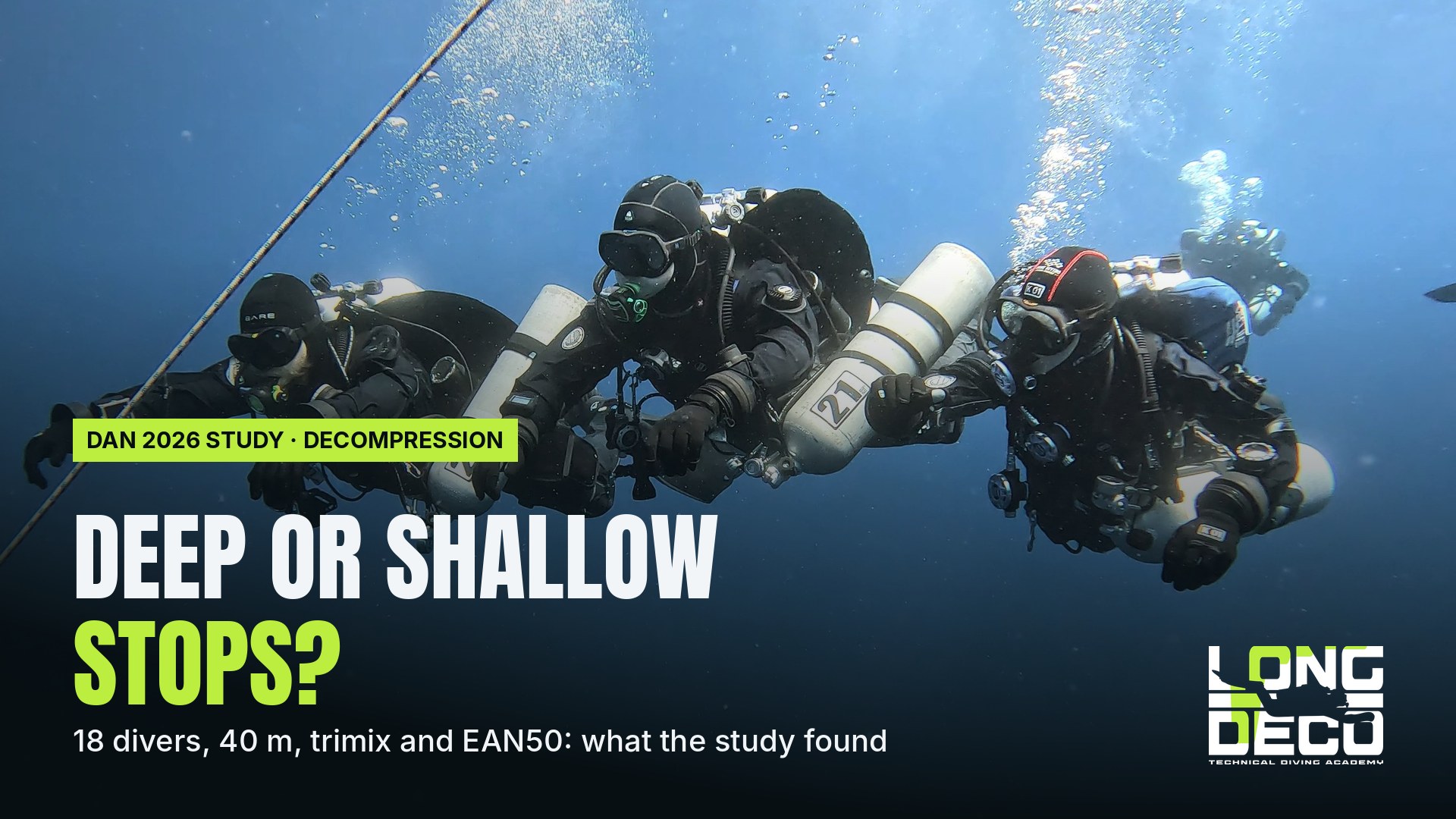
Deep or shallow stops? This argument in technical diving comes back every few years. In our post Gradient factors in plain language we wrote that the research of the last decade gave deep stops no advantage. Now a study has appeared that shows the opposite. The DAN Europe team compared two ways of spreading the same decompression and measured how many gas bubbles circulate in the blood after the dive. The results are interesting, but it is easy to overrate them, so let us go through them calmly.
How the study was run
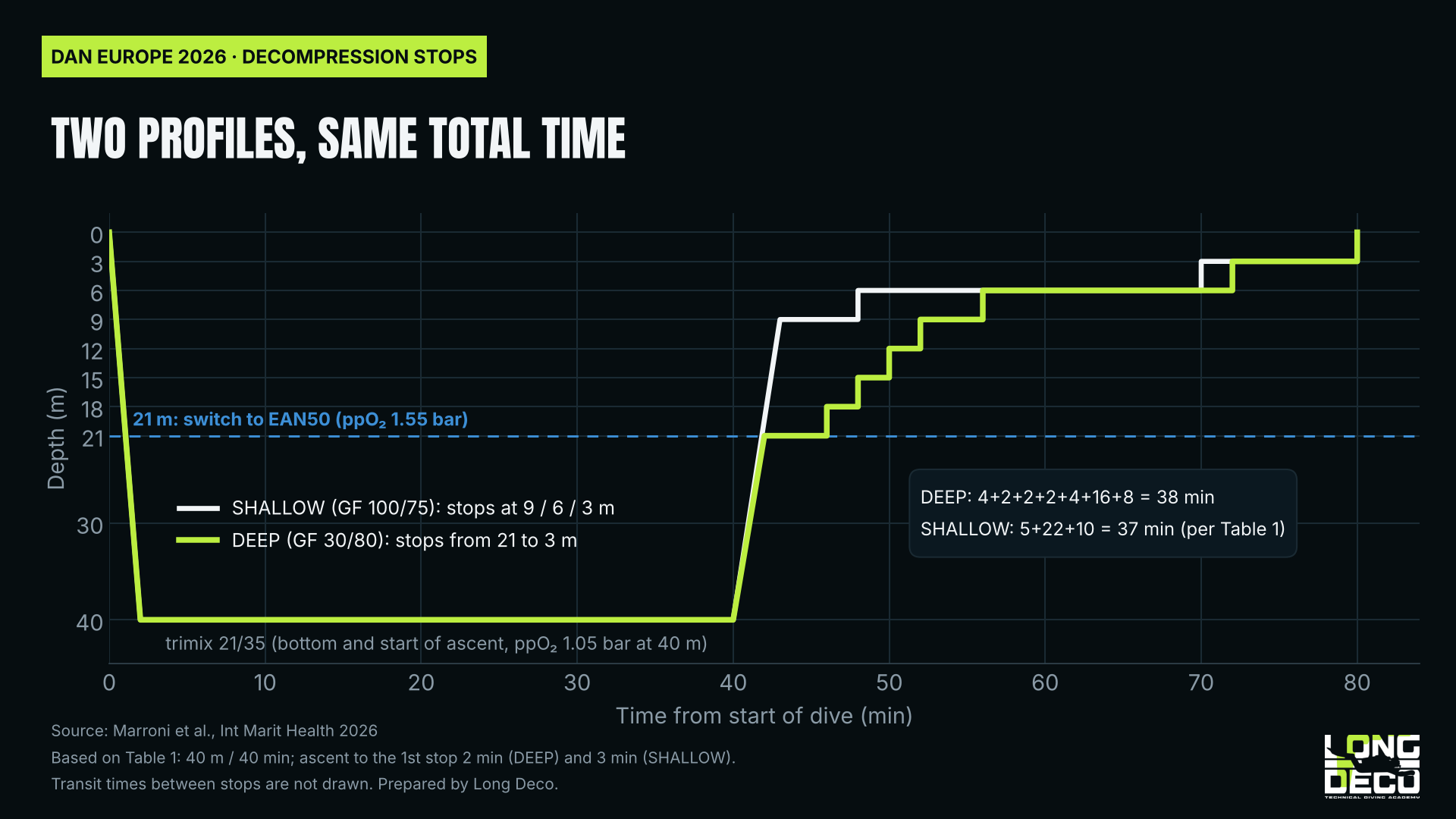
It involved 18 experienced divers (17 men and one woman, 45 years old on average), all with instructor qualifications. Each made two dives in the Y-40 pool in Montegrotto: 40 m, 40 minutes of bottom time, trimix 21/35, and from 21 m to the surface nitrox EAN50. The order of the dives was random, and the interval between them was 3 to 30 days. This is a so-called cross-over design: each diver is his or her own control group, which limits the effect of differences between people.
Only the stops differed. The total decompression time was almost the same, but distributed differently:
- DEEP (roughly GF 30/80): first stop at 21 m, then 18, 15, 12, 9, 6 and 3 m. Times: 4, 2, 2, 2, 4, 16 and 8 minutes, 38 minutes in total. About one third of that time was spent on the stops between 21 and 9 m, on EAN50.
- SHALLOW (roughly GF 100/75): first stop at 9 m. Times: 5, 22 and 10 minutes, 37 minutes in total according to the table in the paper. This is logic close to the classic tables.
After surfacing, the researchers recorded the heart with an echocardiograph: within 5 minutes of leaving the water, and then every 15 minutes up to 90 minutes. They counted the bubbles (VGE) visible in the right atrium. The bubble count is used here as a measure of decompression stress.
What was measured
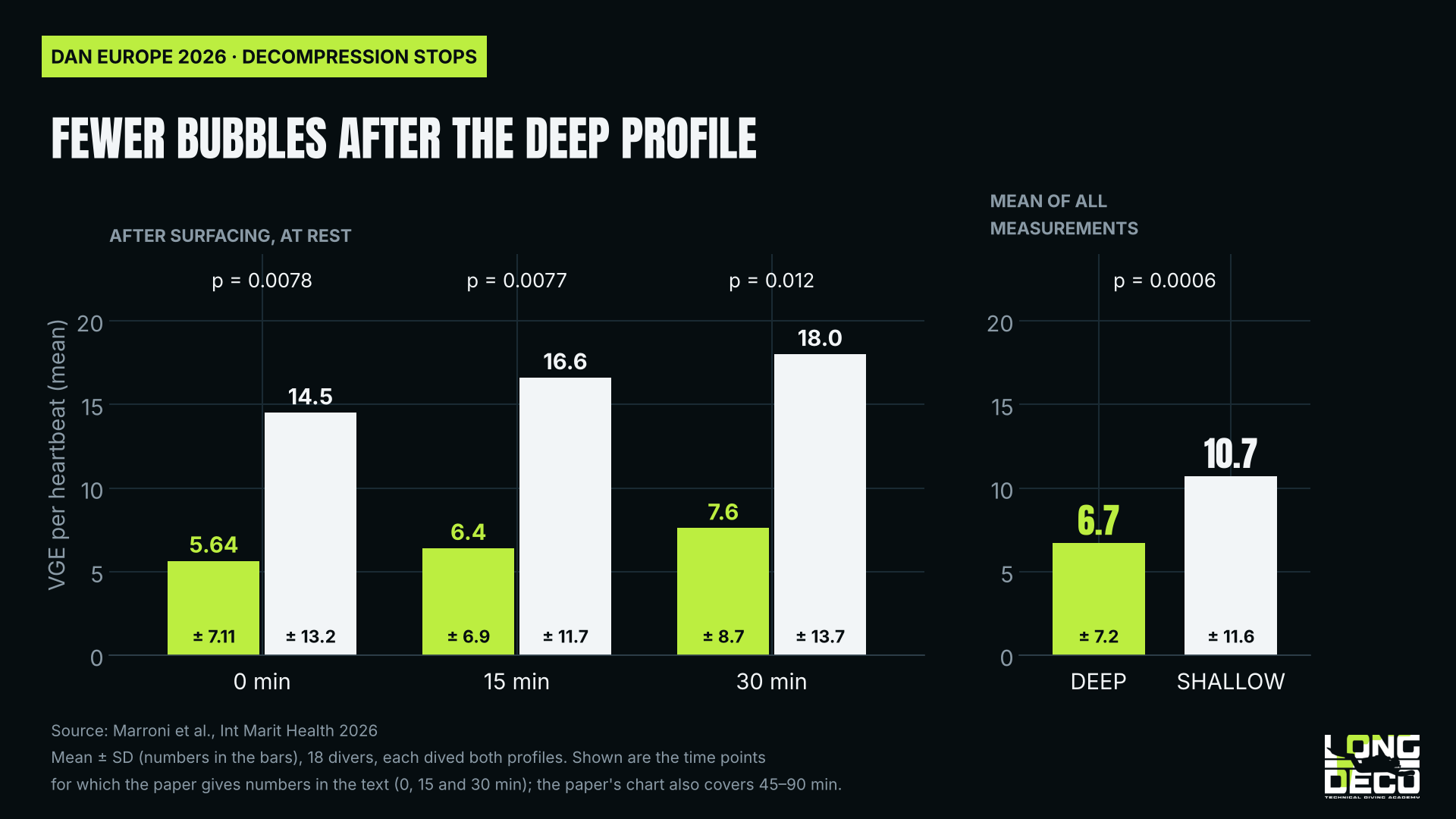
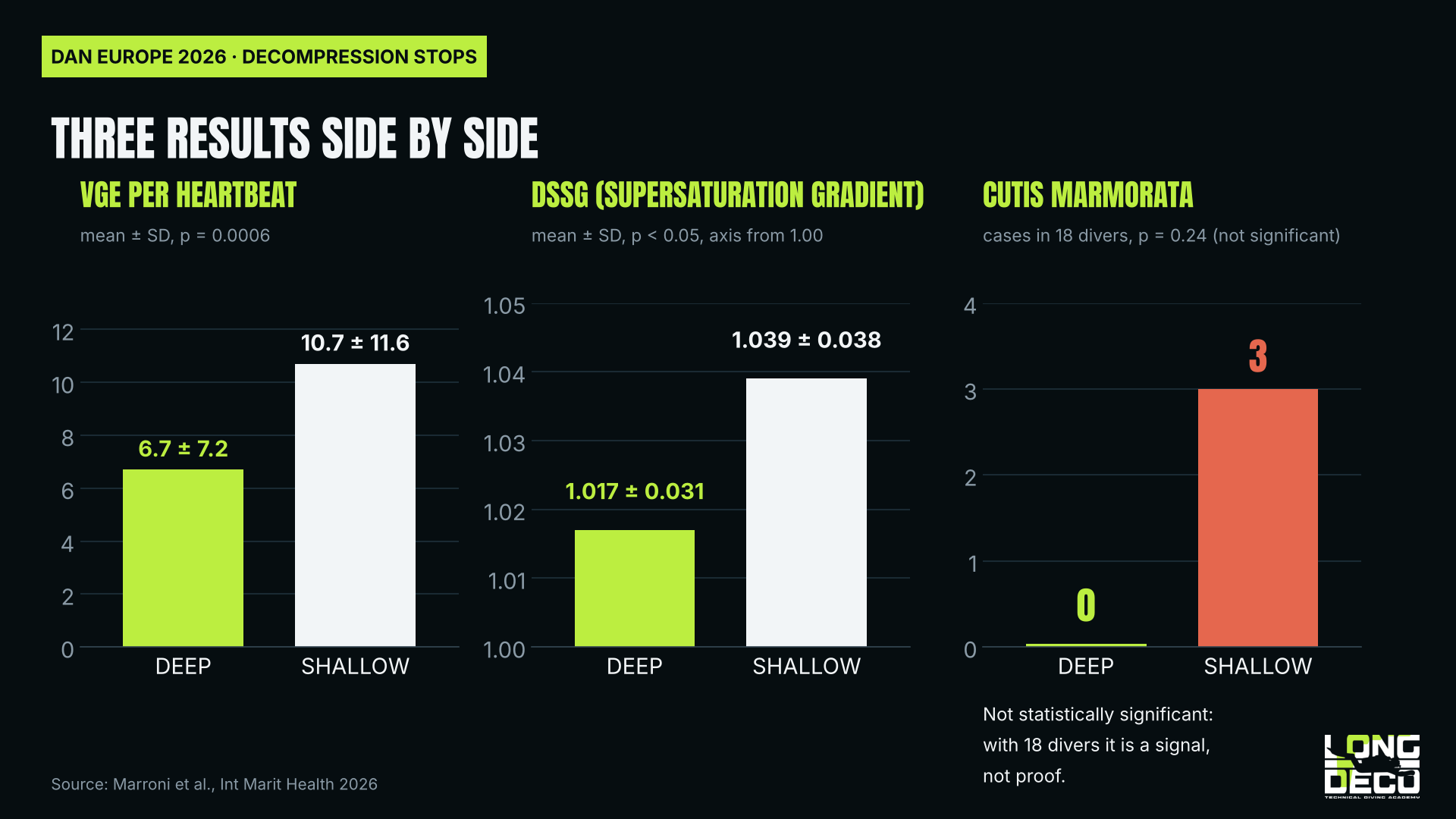
Bubbles. On average 6.7 ± 7.2 VGE per heartbeat after the DEEP profile and 10.7 ± 11.6 after SHALLOW (p = 0.0006). The difference is visible right after surfacing: 5.64 versus 14.5 at time zero, 6.4 versus 16.6 after 15 minutes and 7.6 versus 18.0 after 30 minutes. The chart in the paper suggests that after roughly an hour the difference stops being significant.
Surface supersaturation. From the dive computer records the DSSG index was calculated: 1.017 after DEEP and 1.039 after SHALLOW (p < 0.05). A curiosity: in both versions it came out higher than the planned GF high (85 for DEEP and 82 for SHALLOW). The authors explain this by the fact that the computers finish their calculations when the depth drops to 0.5 m, while the diver goes on to zero.
Symptoms. After the SHALLOW profile three divers developed cutis marmorata (marbled skin), after DEEP none did. All three had more than 40 bubbles per heartbeat. They were given normobaric oxygen for 60 minutes and the symptoms resolved completely. However, with 18 people a difference of 3 to 0 is not statistically significant (p = 0.24).
Why it may have turned out this way
The authors propose several explanations, all of them hypotheses for now. The most important: in the DEEP profile the diver breathed EAN50 for longer at 21 and 18 m, where the ppO₂ is 1.55 and 1.40 bar. A high ppO₂ widens the so-called oxygen window, that is, the undersaturation of tissues with inert gas, which could help dissolve bubble seeds. The second possibility: higher pressure at depth makes it harder for microbubbles to grow. The third: fast tissues off-gas earlier and later do not “feed” the bubbles.
Note the authors’ conclusion: they do not claim that stop depth is good in itself. They write that the advantage may have come from the combination of deeper stops and a higher ppO₂ on the decompression gas.
What this study does not prove
- The sample is small. 18 people, almost all men, of different body builds. The researchers did not check beforehand which divers “produce” a lot of bubbles.
- It was a pool. No cold, current, exertion or stress of the kind typical of dives at sea or in open water.
- PFO. The divers declared no patent foramen ovale and cardiologists examined them, but no standardised test was used. The authors admit that some participants may have had an undetected small PFO.
- VGE is a surrogate marker. Many bubbles usually mean a higher risk of DCS, but it is not the same as decompression sickness. The study does not measure the incidence of DCS.
- The symptoms are not statistically significant. Three cases of marbled skin are a signal, not proof.
Does it contradict the NEDU research?
On the surface, yes. The NEDU study from 2011 (air dives, 30 minutes at about 52 m) produced 3 cases of DCS in 192 dives with shallow stops and 11 in 198 with deep ones. That study, however, measured decompression sickness, not bubbles, and used air and a different plan. The DAN trial involved trimix, EAN50 from 21 m, a different ppO₂ and different GF. The authors themselves point out that the difference may come from the strategy: extended stops at 21 and 18 m on nitrox 50.
Our conclusion: these studies do not have to exclude each other, because they answer different questions in different conditions. Both are worth knowing, and neither settles the matter. If you want to understand where different profiles come from, also read the post Decompression explained.
What to do with this in practice
- Do not change your computer settings on the basis of one study. Changing GF changes the whole profile: gases, times, consumption of your gas reserve.
- Do not copy the profile from the paper. The table from the study applies to one specific dive, specific gases and specific people.
- Remember the direction, not the numbers. The decompression gas and the ppO₂ during stops are important tools, not an add-on. A high ppO₂ also has its limits.
- Discuss it with your instructor. How to match GF, gases and stops to your dives is something we teach on technical courses.
Glossary
- VGE (vascular gas emboli): gas bubbles in venous blood, detected by echocardiography or Doppler after a dive.
- DSSG (DAN Surface Supersaturation Gradient): a DAN index, that is, the calculated supersaturation of the most saturated tissue at the moment of surfacing (in other words, the gradient at the end of the dive).
- GF (gradient factors): what part of the margin between ambient pressure and the M-value may be used; GF low applies to the first stop, GF high to surfacing.
- ppO₂: partial pressure of oxygen in the breathing mix, in bar.
- Oxygen window: undersaturation of tissues resulting from the body consuming oxygen; the higher the ppO₂, the larger it is.
- Cutis marmorata: marbled colouring of the skin, a mild form of cutaneous DCS; it may indicate significant decompression stress.
- PFO: patent foramen ovale, a connection between the atria of the heart through which bubbles can pass to the arterial side.
Do you want to understand decompression, not just count it down?
Planning stops, decompression gases and setting up your computer with understanding are the core of technical diving courses. At Long Deco we teach this step by step:
- PADI Tec 40: an entry into decompression diving,
- PADI Tec 45 and Tec 50: deeper dives and several decompression gases,
- PADI Tec Trimix 65 and Tec Trimix Diver: dives below 50 m with helium.
Write to us and we will help you choose a course that fits your experience.
Editorial note: in the paper, the stop time at 3 m in the SHALLOW profile is given in the text as 11 minutes and in Table 1 as 10 minutes. We use the table, hence 37 minutes in total. In the abstract the authors write about “DCS cases”, while in the results they describe cutis marmorata, so we stay with the description from the results.
Source: Marroni A., Pieri M., Imbert J.-P., Pelliccia R., Arena M., Marroni L., Germonpré P., Cialoni D., Balestra C. Deep versus shallow decompression stops: illustration of different decompression strategies used in technical diving. Int Marit Health 2026, DOI: 10.5603/imh.106791. Open access article (CC BY-NC-ND 4.0 licence).
The charts were prepared by Long Deco from data in the paper (Table 1 and the results); the profile diagram is simplified and does not include the transit time between stops. This text is educational, is not meant for planning dives and does not replace training.