

The gas switch that can hurt you: isobaric counterdiffusion in practice
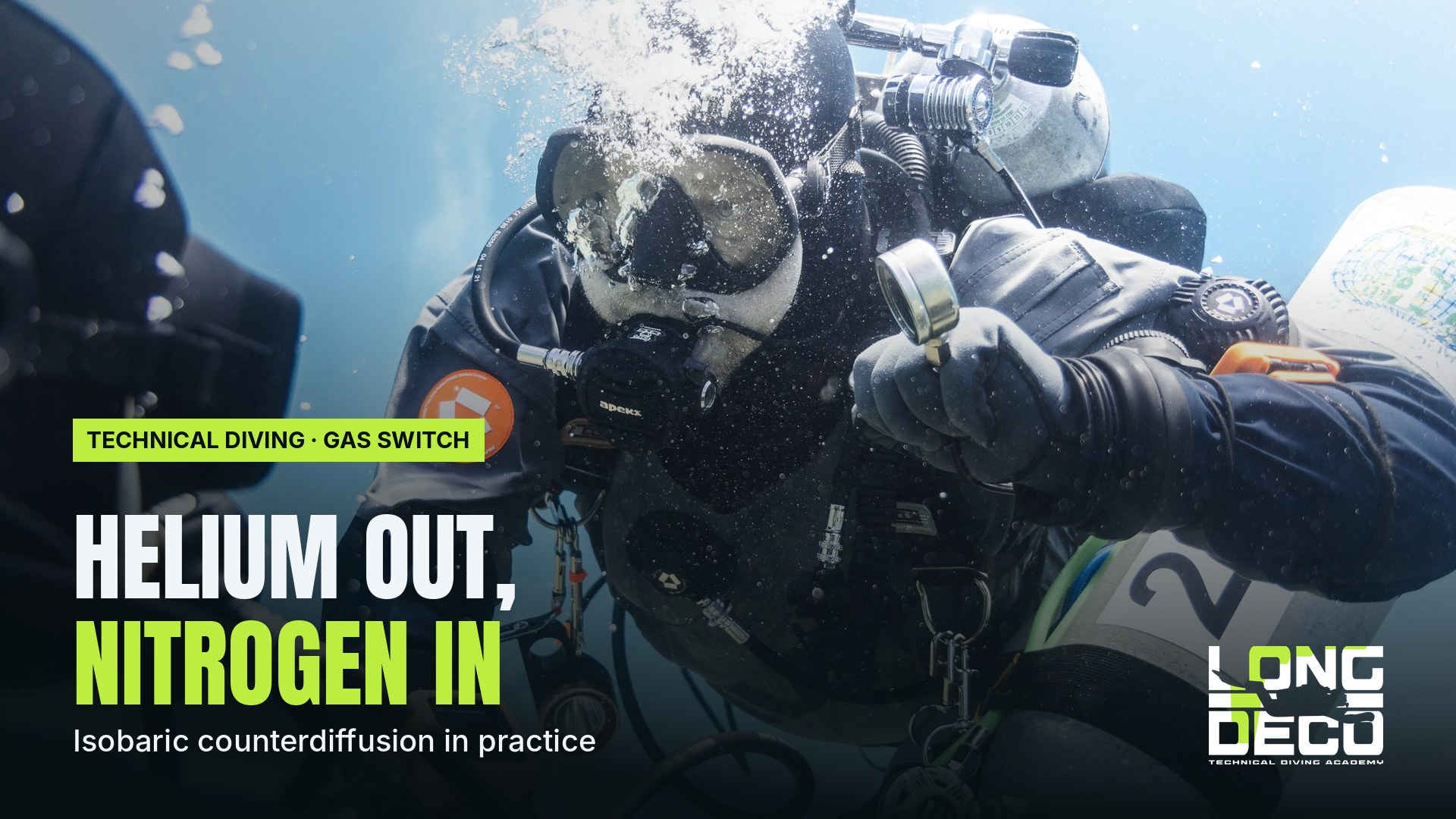
On a dive with helium there is a moment that looks completely ordinary: you reach the stop, check your depth, your buddy confirms the cylinder, you clip in the regulator from the stage and breathe the new gas. You have practised the same thing since your first decompression course. And yet this is exactly where a problem can begin that no computer will show you: isobaric counterdiffusion, ICD for short.
The topic is often treated as academic, and different training programmes handle it very differently. Reilly Fogarty of DAN (Divers Alert Network, an organisation focused on diving safety and medicine) wrote about it in InDEPTH magazine, in a piece that was one of the magazine’s most-read articles in 2020. Below we go through the main conclusions in our own words and add examples with numbers.
What is it, exactly?
First, two terms. Inert gas is the part of the breathing mixture that the body does not use up: nitrogen and helium. These are the gases that dissolve in the tissues under pressure, and they are the ones that drive decompression. Trimix is a mixture of oxygen, helium and nitrogen, and Nitrox (EAN) is a mixture of oxygen and nitrogen with more oxygen than air.
“Isobaric” means “at the same pressure”. “Counterdiffusion” means two gases passing in opposite directions. So: your depth does not change, but one inert gas moves into the tissues while another moves out. This happens every time you switch from a mixture with a lot of helium to a mixture with a lot of nitrogen (or the other way round).
The trouble is that these gases do not move at the same speed. Helium moves through tissue about 2.65 times faster than nitrogen. If in some tissue nitrogen briefly comes in faster than helium can leave, the total of dissolved inert gas goes up even though you have not changed depth. The tissue can temporarily end up supersaturated, meaning it holds more gas than it “should” at that pressure. And supersaturation is where bubbles come from.
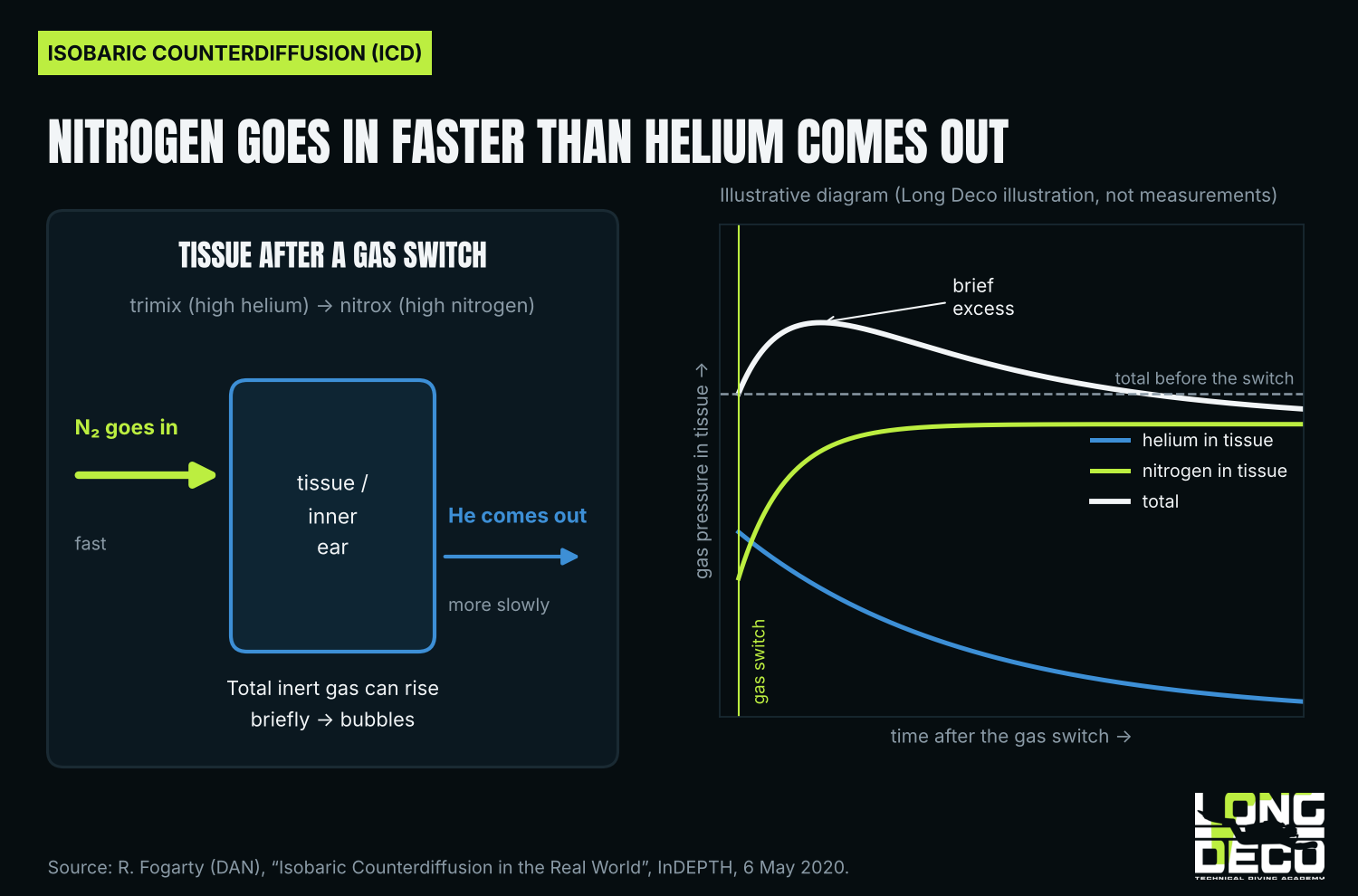
Two kinds of ICD
Superficial (skin) ICD. This concerns the gas surrounding the body, not the gas you breathe. It was classically described in saturation divers who breathed air or a mixture with little helium in a chamber filled with heliox (oxygen with helium). Helium from the surroundings quickly entered through the skin while nitrogen left slowly, and the result could be painful, red skin lesions. In recreational and technical diving this is mostly theory, but it is the reason people advise against inflating a dry suit with helium. Helium insulates poorly anyway, so you would be cold. Argon, which some divers use in the dry suit for better insulation, moves more slowly, so it is not the scenario described here (the source article does not discuss it).
Deep ICD. This is the one a technical diver actually meets. It occurs when you switch your breathing gas to a mixture whose inert gas moves at a different speed: from a travel nitrox to a bottom trimix on the way down, or from a bottom trimix to a decompression nitrox on the way up. Bubbles formed this way can cause itchy skin, then joint pain, and in recent years they have been linked above all to inner ear decompression sickness (IEDCS).
Why the ear?
The inner ear is a small fluid-filled organ responsible for hearing and balance. The 2003 model by Doolette and Mitchell shows that gas exchange here works in an unusual way: through the fluids of the ear and a limited blood flow, and hardly at all through the round window (the membrane separating the inner ear from the middle ear). After a switch from a helium-rich gas to a gas with a lot of nitrogen, the nitrogen coming in can for a short time outpace the helium going out. Even a brief supersaturation is enough for bubbles to form and grow. This mechanism explains well the cases of inner ear DCS reported after gas switches on technical dives.
The symptoms to watch for after a gas switch and after the dive are mainly dizziness (a spinning feeling), nausea and vomiting, ringing in the ears, worse hearing and balance problems. You must not “wait it out” with symptoms like these: oxygen, contact DAN and a hyperbaric medicine centre.
What does the research say?
Isolating ICD as the sole cause of DCS is hard, because many factors act at once on every dive. Even so, several studies give a consistent picture. In a 1977 study on goats saturated at 5 atmospheres, swapping nitrogen for helium at the same pressure increased the number of bubbles, which suggests the effect may occur even at depths familiar from recreational diving. During the French saturation mission Hydra V, divers developed DCS after moving from a mixture of hydrogen, helium and oxygen to the faster-diffusing heliox. Other models differ in the details, but they share one point: the problem is the temporary supersaturation of tissues just after the gas switch.
How to plan gas switches
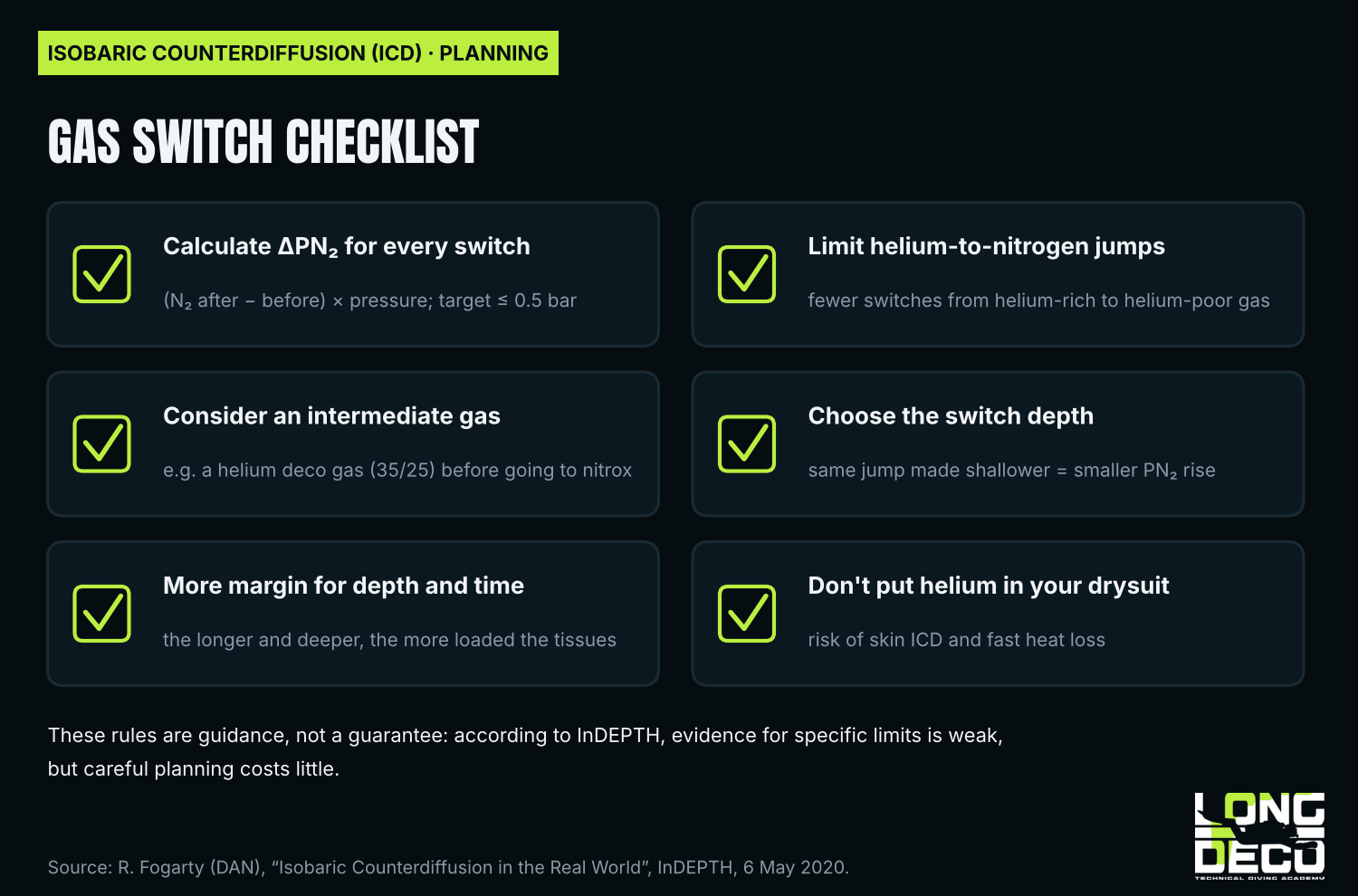
Fogarty stresses that the specific mechanisms are partly theoretical, but careful planning costs little: sometimes a slightly longer decompression. In practice:
- Plan gas switches so that they limit supersaturation. Some researchers proposed that a switch from helium to nitrogen be considered acceptable and the reverse be done only with recompression, which is hardly feasible on a boat. Doolette and Mitchell suggested limiting switches from trimix to nitrox during the ascent, or planning them at a depth where the supersaturation is smallest.
- Limit switches from a helium-rich gas to a helium-poor one, as far as your accepted level of risk allows.
- Increase your margin with depth and bottom time, because the tissues are more saturated then.
- Choose the more conservative option when it adds no new risk.
The only concrete number in the article is the recommendation of the British federation BSAC: a rise in the partial pressure of nitrogen (PN₂) at the moment of the gas switch of no more than 0.5 bar. Partial pressure is the “share” of a given gas in the ambient pressure: the gas fraction times the absolute pressure. Mike Rowley, former head of the BSAC technical section, notes that this is a guide value and that 0.7 bar does not mean disaster. Other rules exist too, for example the so-called rule of fifths (usually described as the rise in nitrogen fraction not exceeding one fifth of the drop in helium fraction), or calculating separate tissue compartments for helium and nitrogen. According to Fogarty, however, there is no evidence that any of them actually prevents accidents.
We calculated a few typical switches (ambient pressure: 1 bar + 1 bar for every 10 m):
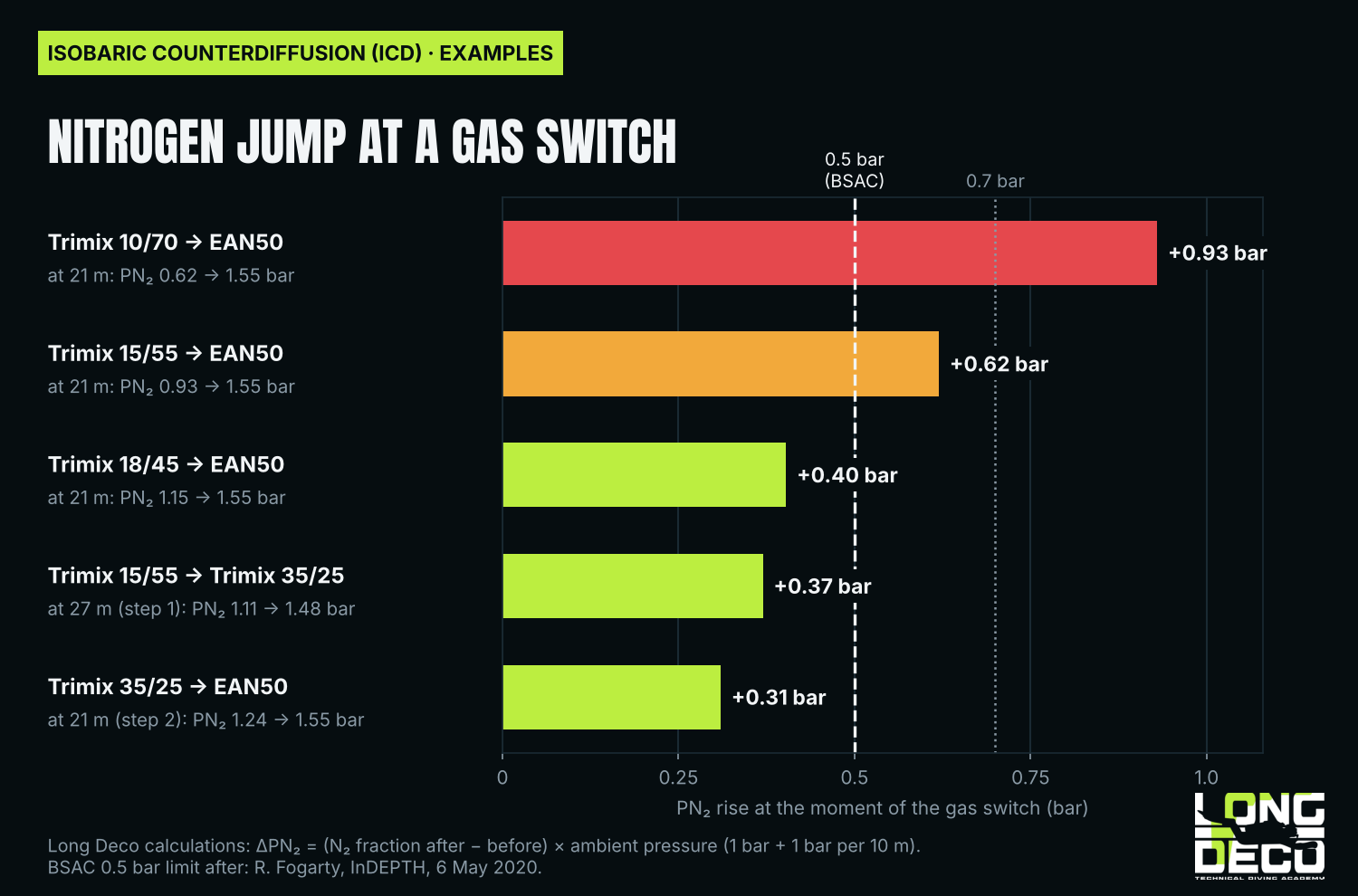
Going from trimix 15/55 (15% oxygen, 55% helium, 30% nitrogen) straight to EAN50 at 21 m raises PN₂ from 0.93 to 1.55 bar, that is by 0.62 bar. From trimix 10/70 the jump reaches 0.93 bar. A bottom trimix with less helium (18/45), or an intermediate gas with helium, for example trimix 35/25 at 27 m, and only then EAN50, spreads the same “jump” over smaller steps. Note also that ΔPN₂ depends on depth: the same fraction difference at a shallower depth gives a smaller rise. These are examples for understanding the principle, not a ready plan: always choose your gas configuration with an instructor and planning software.
Glossary
- ICD (isobaric counterdiffusion): two inert gases passing in opposite directions at constant pressure, for example after a gas switch.
- Inert gas: nitrogen or helium in the breathing mixture; it dissolves in the tissues and determines decompression.
- Trimix X/Y: a mixture with X% oxygen and Y% helium; the rest is nitrogen.
- EAN50: Nitrox with 50% oxygen, a typical decompression gas.
- Partial pressure (PN₂): the part of the ambient pressure that belongs to a given gas (fraction × absolute pressure).
- Supersaturation: a state in which the tissue holds more dissolved gas than the ambient pressure corresponds to; it favours bubbles.
- IEDCS: inner ear decompression sickness (dizziness, ringing, hearing loss, balance problems).
- Heliox: a mixture of oxygen and helium.
Want to practise gas switches with an instructor?
Gas planning, gas switches and decompression with helium are the core of technical diving courses. At Long Deco we teach it step by step:
- PADI Tec 40: your entry into decompression diving,
- PADI Tec 45 and Tec 50: deeper dives and several decompression gases,
- PADI Tec Trimix 65: first dives with trimix and planning gas switches,
- PADI Tec Trimix Diver: full trimix and dives below 65 m.
You can read more about what affects the risk of decompression sickness in the post Decompression explained. Write to us and we will help you choose a course that fits your experience.
Source: Reilly Fogarty (DAN), Isobaric Counterdiffusion in the Real World, InDEPTH, 6 May 2020, Read the article on InDEPTH. Works cited in the article: Lambertsen 1989; D’Aoust et al. 1977; Rostain et al. 1987; Doolette and Mitchell, J Appl Physiol 2003; 94(6): 2145-50; Burton 2004.
Graphics and calculations: Long Deco. This text is educational and does not replace training or the advice of a diving medicine doctor.