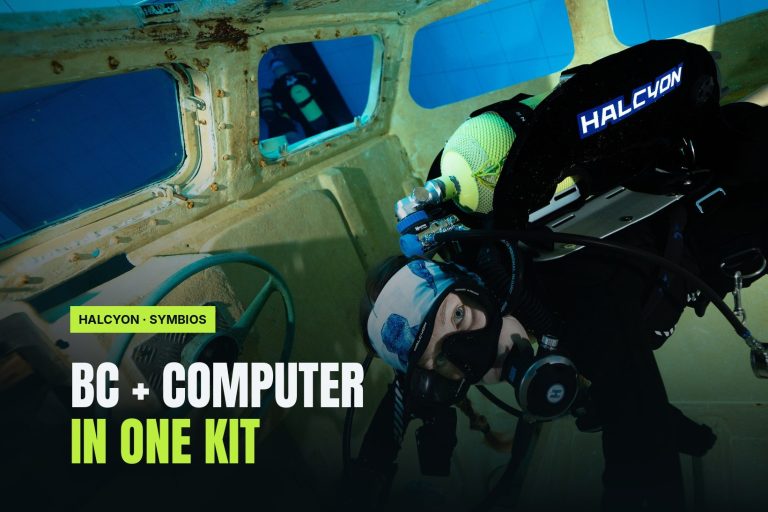


Divesoft changes owner. What does it mean for divers using the Liberty rebreather?
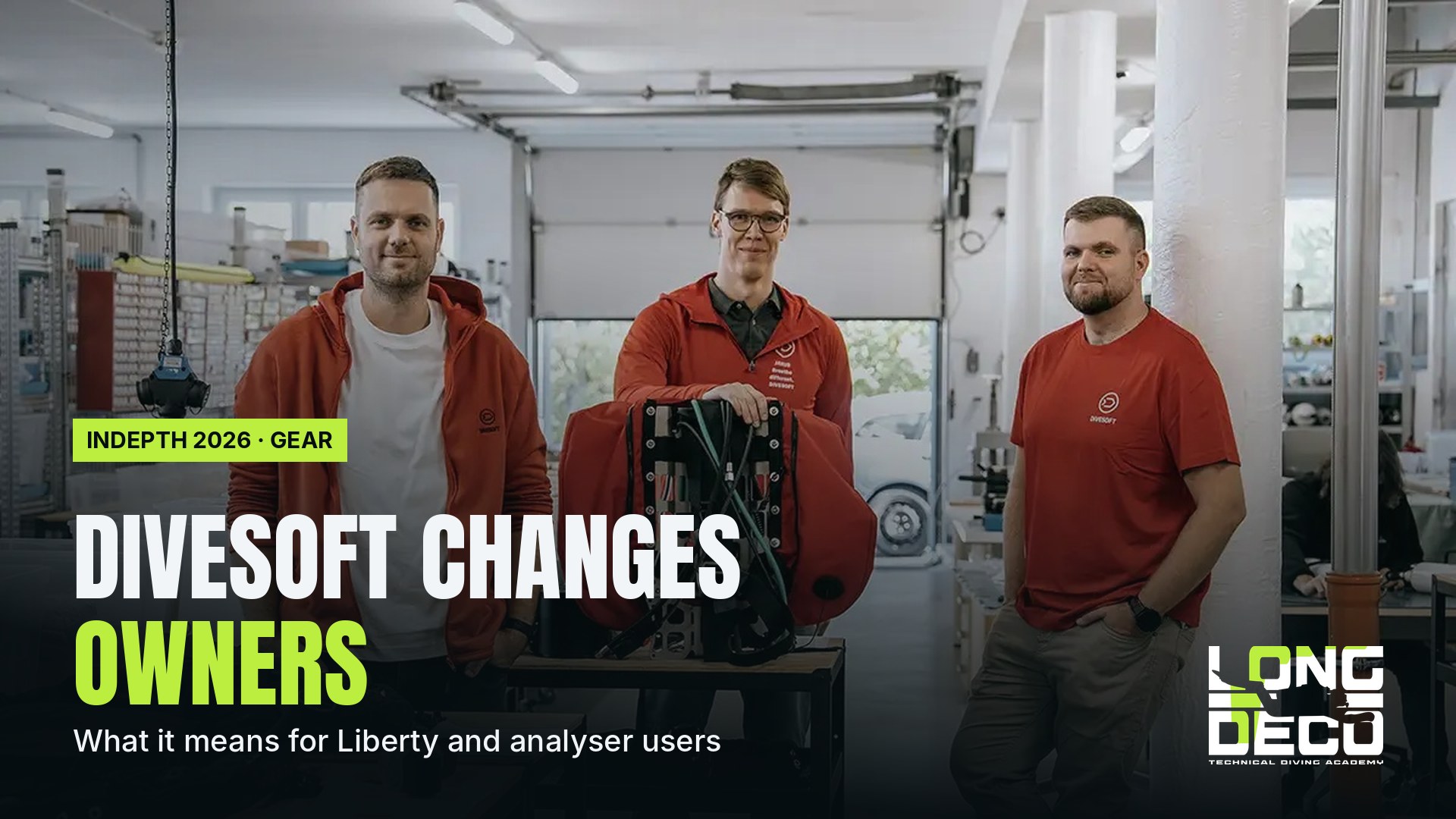
If you dive technically, you almost certainly come across Divesoft: as a Liberty rebreather, as the gas analyser at your dive base, or as someone’s computer on your team. The Czech manufacturer is going through a change of ownership. On 9 October 2026, InDEPTH magazine published a long interview with the founders and the new owners of the company. Below we summarise the main points and explain what they mean for people who use the equipment.
What happened?
After more than twenty years, Divesoft’s founders, Lucie Smejkalová and Aleš Procházka, are handing the company to three people from its current management. They are not selling it to an outside investor or a large investment group. The company is being taken over by people who already run it day to day. The financial terms of the deal have not been disclosed.
According to Lucie Smejkalová, there was no single moment that decided it. The decision matured gradually: both founders are of retirement age, and the new owners bring the energy and ideas the company needs for its next stage. Smejkalová says the main reason she feels calm is the team, because Divesoft has not depended only on her and Aleš for a long time. She also admits that the hardest part for her is no longer taking part in the daily life of the company. What mattered most to her was how the new owners will run it: how they treat employees, customers and partners, and whether the company will keep honouring its commitments.
Aleš Procházka points out that the technical handover has been going on for years, through daily work with the designers. As he puts it, an engineering culture cannot be passed on through documentation alone. He stays available for consultation if the development team needs him.
Who runs Divesoft now?
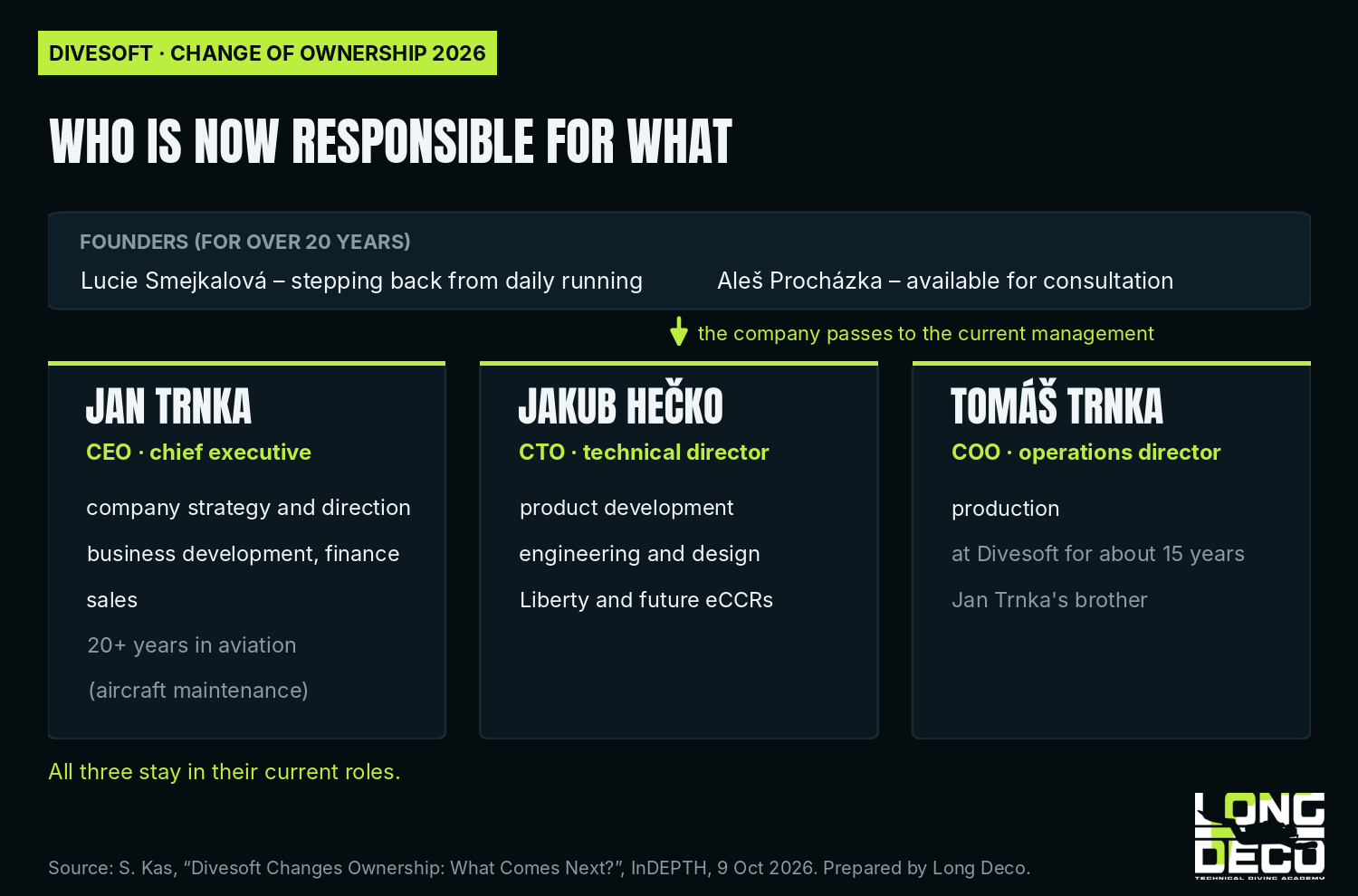
- Jan Trnka, CEO (chief executive): the direction of the company, strategy, business development, finance and sales. Before that he spent over 20 years in aviation, mostly in aircraft maintenance.
- Jakub Hečko, CTO (chief technical officer): product development and engineering.
- Tomáš Trnka, COO (chief operating officer): production. He has worked at Divesoft for about 15 years. Jan and Tomáš are brothers.
All three stay in their current roles. For customers, instructors and partners this means continuity: they keep talking to the same people.
Jan Trnka says that from aviation he mainly brings an approach to part traceability, quality control, discipline in maintenance and clear procedures. He also looks at the whole life cycle of the equipment, not just the moment of sale. That matters for equipment a diver’s life depends on.
What is meant to stay the same?
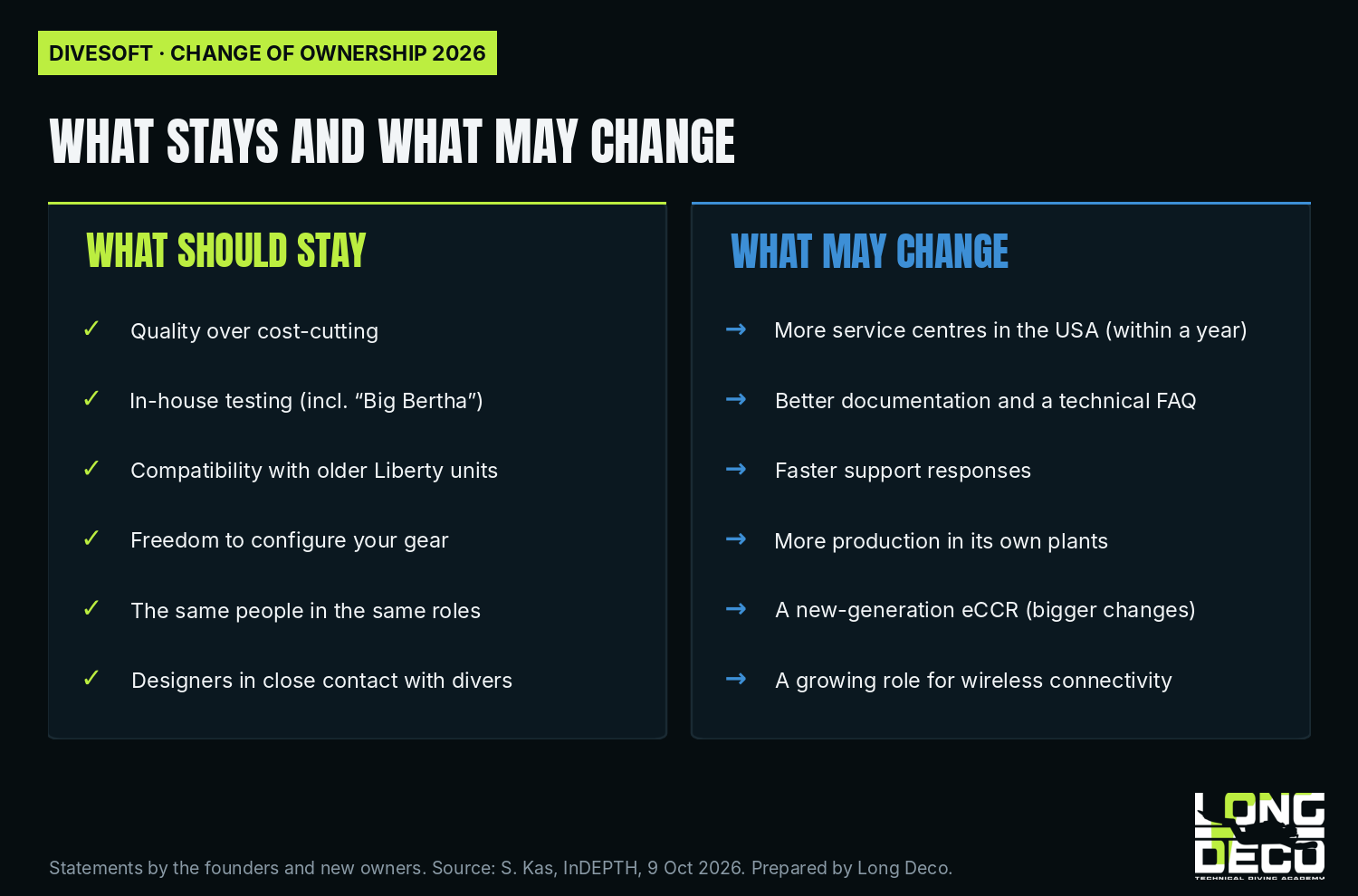
The most important declaration is about quality. Aleš Procházka says this is the principle he most wants to see preserved: Divesoft has never looked for savings at the expense of reliability or safety.
The company has its own test laboratory. An important part of it is a machine called “Big Bertha”, designed and built by Procházka, which allows pressure and temperature tests. According to the article, the laboratory can also test rebreathers under the conditions required by CE rules (the European marking of conformity with safety requirements).
The new owners stress that they do not want to change anything just to show that new management has arrived. Jan Trnka talks about development, but “not at all costs”. Jakub Hečko adds that with every change he asks whether it really improves safety, ease of use or the capabilities of the equipment, and that if good data show something works, it should be kept.
The diver’s freedom is also meant to stay: Divesoft does not want to impose one rigid way of configuring and using the equipment. Designers who dive themselves are to keep working closely with divers, instructors, testers and service partners, without many layers of intermediaries.
What may change?
Service. Jan Trnka admits that in some markets customers have trouble with shipping, customs or access to an authorised service centre. Within the next year the company wants to clearly increase the number of service points in the United States and make servicing and technical support easier to reach. Trnka stresses that the relationship with the customer should not end at the moment of sale, and that local partners know their customers and diving environments better than the head office in the Czech Republic.
Support and documentation. Jakub Hečko says openly that support is an area that needs improvement. Better technical documentation, faster replies and a fuller technical FAQ are in preparation.
Production. Tomáš Trnka would like to move more production in-house, but only where it clearly improves quality control, delivery time or resilience to supplier problems. As he puts it, design, production and service are linked.
The next generation of rebreathers. This is the most interesting thread. Hečko says that gradual improvements to Liberty are approaching the point where a bigger design change may be needed, and he sees the main opportunity in the next generation of electronically controlled rebreathers (eCCR). In his view, wireless communication is becoming more and more important. At the same time the company is trying to keep compatibility with older Liberty units, because it does not want customers to feel their equipment becomes obsolete with every novelty. No launch date or technical details were given.
As examples of products that came from solving specific problems divers had, Hečko names the helium and oxygen analysers and the Liberty Sidemount Bailout eCCR. Aleš Procházka, for his part, would like the ideas the company already has today to become products that divers really use.
What does this mean for you?
- Do you own a Liberty? Nothing changes today: the same people are responsible for the design, the production and the company. The company says it cares about compatibility with older units, but with future novelties it is worth asking the manufacturer or a service centre what exactly will fit your setup.
- Planning to buy a rebreather? The next generation is for now only an indication of direction, with no dates or specifications. By buying today you choose equipment with declared further support. With any rebreather, check where the nearest authorised service centre is and how long a service takes.
- Do you use a Divesoft analyser or computer? The article does not announce any changes for these products. Dive computers are not discussed in it at all. The announced improvements to support and documentation apply to the whole company.
- Service in Poland? The announced expansion of the service network concerns the United States. The article says nothing about Europe or Poland, so here it is worth following announcements from the manufacturer and local partners.
A change of owner at a maker of equipment a diver’s life depends on always raises questions. Here the scenario looks calm: the company is being taken over by people who have helped build it for years, and the stated priorities are quality, service and evolution instead of revolution. Tomáš Trnka says that in five years he would like to see Divesoft bigger and stronger, but still recognisably the same. The coming years will show whether that happens.
Glossary
- Rebreather (closed-circuit breathing apparatus): equipment in which the diver breathes the same gas over and over. A scrubber removes carbon dioxide from the exhaled gas, and the missing oxygen is added. The gas lasts a very long time, and there are far fewer bubbles underwater.
- CCR / eCCR: CCR (closed circuit rebreather) is a closed-circuit rebreather. In an eCCR, electronics add the oxygen and keep the oxygen partial pressure at the set value (the setpoint). Liberty is an eCCR.
- Open circuit: classic diving with a cylinder and regulator, where every exhaled breath goes into the water.
- Bailout: a backup gas source the diver switches to when the main system fails. Usually these are open-circuit cylinders, but it can also be a second rebreather.
- Sidemount: a configuration in which the cylinders (or the rebreather) are worn on the sides of the body instead of on the back. Among other things, it helps in tight spaces.
- He/O2 analyser: a device that measures how much oxygen (O2) and helium (He) is in a cylinder. Every mix, such as nitrox or trimix, is checked before the dive, because a wrong composition can be dangerous.
- Trimix: a mixture of oxygen, helium and nitrogen used for deep dives.
- CE: a European marking by which the manufacturer confirms that a product meets the safety requirements in force in the EU.
- Authorised service centre: a facility trained and authorised by the manufacturer to service and repair its equipment.
- Backward compatibility: the ability to use new parts or functions with older units of the equipment.
- CEO, CTO, COO: the chief executive, chief technical officer and chief operating officer of a company.
Want to dive deeper and more safely?
The best equipment will not replace good training. Gas planning, working with several mixes, analysing gas before the dive and emergency procedures are the basis of technical diving courses. At Long Deco we teach this step by step:
- Nitrox course: the first step to longer dives and to working with an oxygen analyser,
- PADI Tec Basics: first steps in technical diving,
- PADI Tec 40: an introduction to decompression diving,
- PADI Tec 45 and Tec 50: deeper dives and several decompression gases,
- PADI Tec Trimix 65 and Tec Trimix Diver: dives below 50 m with helium,
- PADI Tec Sidemount Diver: the sidemount configuration in technical diving,
- PADI Tec Gas Blender: blending gases and working with an analyser.
Write to us, and we will help you choose a course that fits your experience.
Source: Stratis Kas, Divesoft Changes Ownership: What Comes Next?, InDEPTH Magazine, 9 October 2026, indepthmag.com/divesoft-ownership-change. The text is our own adaptation based on this article; the interviewees’ statements are given in our translation and summary.
Header and thumbnail photo: InDEPTH Magazine (Photo: InDEPTH). Graphics prepared by Long Deco based on the article. Long Deco is not affiliated with Divesoft, and this post is not sponsored content.