


Know where you are. Return to where you planned.
PADI Underwater Navigator: underwater navigation instead of wandering

Course description
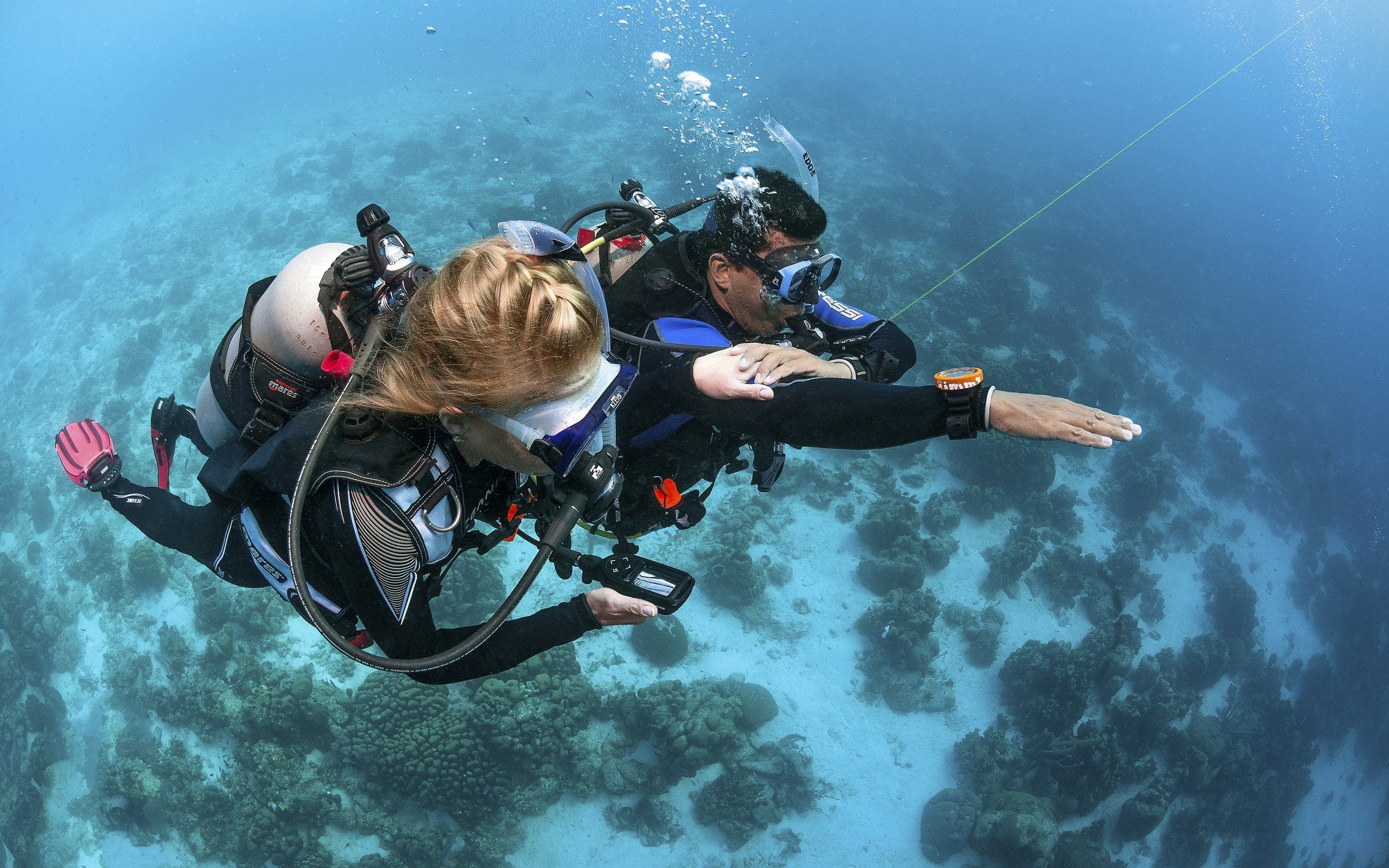
The PADI Underwater Navigator course teaches underwater navigation, one of the most underrated skills in diving: moving through the water with awareness. A diver who knows where they are ends the dive at the planned place, with gas in reserve and without a long swim on the surface. A diver who does not know loses time, gas and calm, and often the buddy too.
The programme covers measuring distance (kick cycles, time, number of breaths), working with the compass on simple and complex routes, and natural navigation: using the shape of the bottom, vegetation, structures, the direction of light and the current. We teach how to combine both methods, because in practice the compass gives the direction and the bottom confirms that we are going the right way.
Navigation does not exist without buoyancy and trim (if you want to sort those out first, PADI Peak Performance Buoyancy is a good introduction). A diver who sinks to the bottom or tilts sideways can neither hold a course nor count kicks reliably. That is why on the course we work in a stable horizontal position, with the compass held in line with the body, and we pay attention to communication in the team: who leads, who counts, who watches time and gas.
In Polish lakes and quarries visibility is sometimes limited to a few metres, and the bottom often looks the same over a large area. These are good conditions for learning: if you navigate confidently in a Polish quarry with a few metres of visibility, you will manage on a reef and on a wreck. The skills from this course are also the foundation for work on wrecks, in caves and in technical diving, where a planned return is part of the gas plan.

Usually 2 training days: a theory part (e-learning or classroom sessions) and three open-water dives. The course can be spread over two weekends or combined with another course.
3 open-water dives. The first navigation dive can be counted as an adventure dive in the PADI Advanced Open Water Diver course.
Training dives take place at moderate depths, usually down to 18 m. Navigation is best practised where the bottom is visible and buoyancy is stable, so in practice we work shallower.
A maximum of 4 students per instructor. In a small group everyone leads the route alone and gets individual feedback.
Air or nitrox for those with PADI nitrox certification. With several dives in a day, nitrox extends no-decompression time and reduces fatigue.
Skills after the course:
- measuring distance by kick cycles, time and number of breaths,
- holding a compass course and navigating on the reciprocal course,
- swimming a square, a triangle and a rectangle back to the starting point,
- natural navigation using the bottom, structures, light and current,
- combining compass and natural navigation during one dive,
- planning the dive route with gas and the exit point in mind,
- setting a heading from the surface and navigating as a team.
- minimum age: 10 years,
- PADI (Junior) Open Water Diver certification or an equivalent from another organisation,
- current health that allows diving (medical questionnaire, a doctor’s certificate if needed),
- basic buoyancy control; a few dives after the entry-level course are recommended.
Specialist equipment
- dive compass (wrist-mounted or on a console; a computer with a digital compass as a supplement),
- a slate with a pencil,
- surface marker buoy or decompression buoy (DSMB) with a reel.
Standard kit
- wetsuit or dry suit suited to the water temperature,
- jacket or wing, cylinder, regulator with an octopus,
- dive computer,
- mask, fins, torch.
You can rent a compass and the rest of the equipment from Long Deco. If you have your own compass, bring it to the course: it is best to learn on the equipment you will dive with.
Training fee
Price set individually, depending on location, date and number of people.
Registration and certification fee
Registration and certification according to the current PADI price list.
Additional costs
Equipment rental, gases, entry to dive sites, travel, possibly accommodation.
Theory
The theory is short and practical. Its aim is to understand why divers drift off course and how to prevent it, not to learn formulas.
- how a dive compass is built and works, a compass versus a computer with a digital compass,
- methods of measuring distance and their limits,
- navigation patterns: reciprocal course, square, triangle, rectangle,
- natural navigation: bottom, vegetation, light, current, sound,
- interfering factors: current, poor visibility, magnetic equipment near the compass,
- planning the route and landmarks before entering the water,
- navigating as a team and what to do after losing orientation.
Practice
Every dive starts with a plan: route, landmarks, gas and time limits. After surfacing we compare the plan with what actually happened.
Dive 1: measuring distance
- calibrating your kick cycle over a section of known length,
- measuring distance by time and by number of breaths,
- a one-way route and a return on the reciprocal course.
Dive 2: natural navigation
- identifying landmarks and remembering them,
- navigating by the shape of the bottom, structures and light,
- returning to the starting point without using a compass.
Dive 3: compass and complex routes
- swimming a square and a triangle back to the starting point,
- combining the compass with natural navigation,
- leading a team along a planned route on your own.
Hold the compass in line with your body and look over it, not at it. Most navigation errors are not a wrong heading but a tilted position and uncounted kicks.

FAQ

The next step on your path
- PADI Advanced Open Water Diver, for which you can count the first dive from this course,
- PADI Night Diver and PADI Search and Recovery Diver, where navigation is the basic tool,
- PADI Wreck Diver and PADI Cavern Diver as preparation for diving in environments that require a planned return,
- PADI Tec Basics, where navigation combines with gas and decompression planning.
Navigator counts as one of the specialties towards Master Scuba Diver. It is a good course to start with, because its effects show on every later dive.
Trips
- shore dives where you plan the route and the exit point yourself,
- reefs with current, where you need to judge the drift and correct your course,
- wrecks, where returning to the descent line decides a safe ascent,
- lakes and quarries in Poland with poor visibility,
- dives without a guide, in a pair or a small team.
On a trip, ask at the briefing about declination and local magnetic interference (for example metal structures, wrecks). Near a large mass of steel a compass can show a completely different direction.