


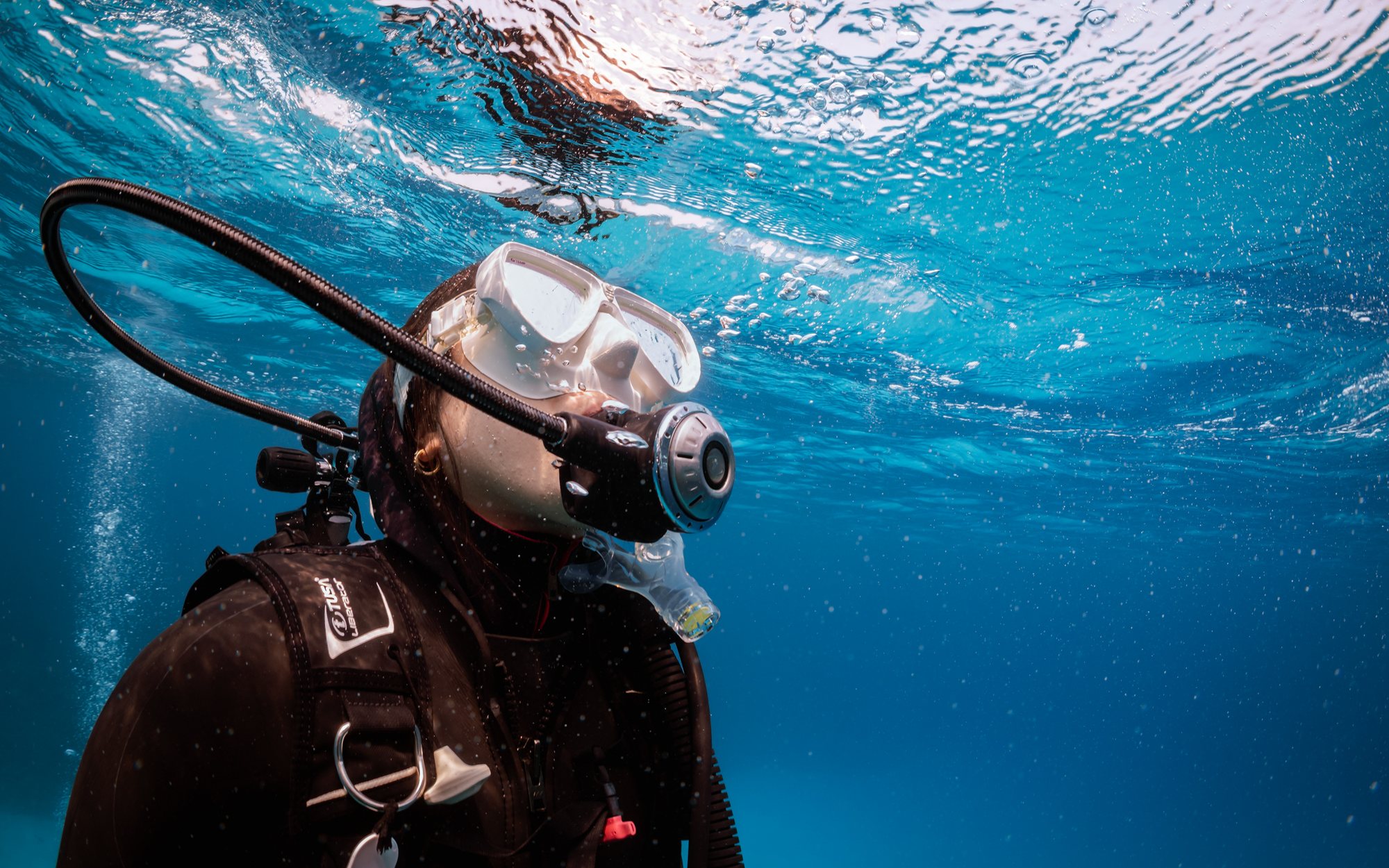
Your whole face under control.
PADI Full Face Mask Diver: the full face diving mask step by step

Course description
A full face diving mask combines the mask and the regulator into one piece. It is entirely different equipment from the popular full face snorkelling masks, which are meant only for swimming at the surface. It protects the face from cold water, lets you breathe through the nose and makes voice communication possible under water. At the same time it changes the basic procedures a diver knows from the PADI Open Water Diver course: you equalise pressure differently, you clear water from the mask differently, and you switch to the alternate gas source in a completely different way.
The PADI Full Face Mask Diver course teaches these differences in a controlled way. We start with fitting and configuring the mask on land, then practise in shallow water, and only later move on to open water dives. We spend the most time on emergency procedures, because they decide safety when the mask stops working as it should.
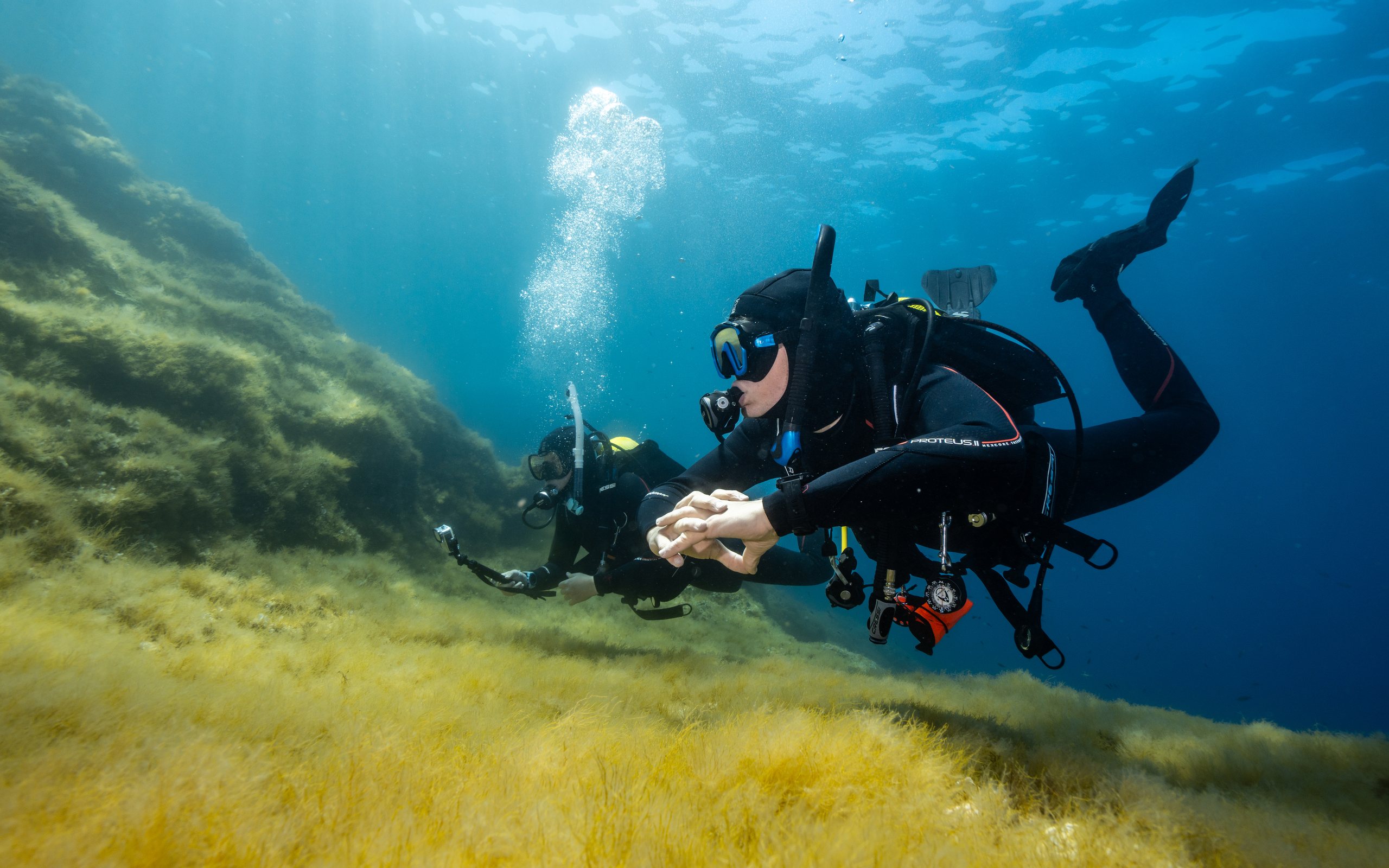
In Polish conditions a full face mask has real uses. In the cold water of lakes, quarries and the Baltic it reduces chilling of the face, and in poor visibility voice communication makes teamwork easier, for example during searches, filming or tasks that need coordination. Such masks are also standard in many uniformed services and in professional diving.
At Long Deco we run the course with an emphasis on buoyancy and trim, because a full face mask changes the distribution of buoyancy around the head and the way you breathe. A diver who controls their position in the water well gets used to the new equipment faster and performs the procedures more calmly.

One training day, covering theory, equipment preparation, a shallow water session and two dives. In the colder season, or with a longer adaptation to the mask, a second day may be needed.
Two open water dives, preceded by practice in shallow water or in a pool. The depth of the dives does not exceed the student’s certification limits.
We plan the training dives within the student’s certification limits, usually shallower than the certificate allows. Emergency procedures in a full face mask are practised first in shallow water, where a direct ascent is easy.
A maximum of 4 students per instructor. Exercises such as switching to the alternate gas source and removing the mask need close assistance, which is why a small group matters especially here.
We run the course on air. Divers with nitrox certification may dive on nitrox, provided the mask and regulator are prepared for use with enriched mixtures.
Skills after the course:
- choosing, fitting and adjusting a full face mask,
- preparing the mask and checking it before a dive,
- equalising the ears in a full face mask,
- clearing water from the mask and dealing with fogging,
- switching to the alternate gas source and changing to a regular mask under water,
- using voice communication and team signals,
- planning a dive that allows for gas consumption in a full face mask.
- minimum age: 12 years,
- PADI (Junior) Open Water Diver certification or an equivalent from another organisation,
- good health confirmed by a medical questionnaire and, if needed, a doctor’s certificate,
- free control of buoyancy and calm performance of mask exercises.
Specialist equipment
- a full face mask with a regulator,
- a regular mask as a backup, in your pocket,
- an alternate gas source with a long or standard hose,
- a voice communication system, if available.
Standard set
- a jacket or wing with a backplate,
- a regulator with a pressure gauge,
- an exposure suit suited to the water temperature,
- a dive computer,
- weights, fins, hood and gloves.
We provide the full face mask and communication for the length of the course. If you have your own mask, bring it and we will check its configuration and fit.
Training fee
The price is set individually.
Registration and certification fee
According to the current price list of the certifying organisation.
Additional costs
Equipment rental, gases, entry to dive sites, travel and any accommodation.
Theory
The theory part covers:
- how a full face mask is built: types, sealing, the inner half mask and the valve,
- advantages and limitations of full face masks compared with a regular set,
- pressure equalisation and managing fogging,
- gas consumption and the risk of carbon dioxide building up in the mask,
- emergency procedures: out of gas, a flooded mask, switching to the alternate source,
- voice communication: rules for talking under water and team discipline,
- cleaning, disinfecting and storing the mask.
Practice
We start in shallow water, where each student practises the procedures at a calm pace. Only once they are mastered do we move on to two open water dives.
Dive 1: adaptation and basic procedures
- putting on and fitting the mask at the surface,
- descending while controlling pressure equalisation,
- clearing water from the mask and controlling fogging,
- working on buoyancy and trim in the new configuration,
- a controlled ascent with a safety stop.
Dive 2: emergency procedures and communication
- switching to the alternate gas source,
- removing the full face mask and putting on a regular mask under water,
- helping a buddy who is out of gas,
- voice communication during a simple team task,
- gas planning that allows for higher consumption.
The regular mask always dives with you, in your pocket, not on the shore. The mask swap procedure only works if you have practised it and have the mask within reach.

FAQ

The next step on your path
- Dry Suit Diver and Ice Diver, if you want to use the mask for diving in cold water,
- Search and Recovery Diver, where voice communication really makes teamwork easier,
- Peak Performance Buoyancy as a foundation before the later stages,
- Tec Basics, when you want to move towards technical diving in a classic configuration.
A full face mask is a tool for specific tasks, not a replacement for your basic set. It is worth keeping up the regular mask procedures day to day.
Trips
- the cold waters of Scandinavia and diving under ice, where face protection matters a lot,
- dives with filming and photography, when the team has to communicate,
- search and documentation projects on Baltic wrecks,
- training trips where the mask is part of a team task,
- dives in low visibility, where hand signals are hard to read.
Take spare mask seals and straps and batteries for the communication system. On a trip it is hard to find parts for a specific mask model.