


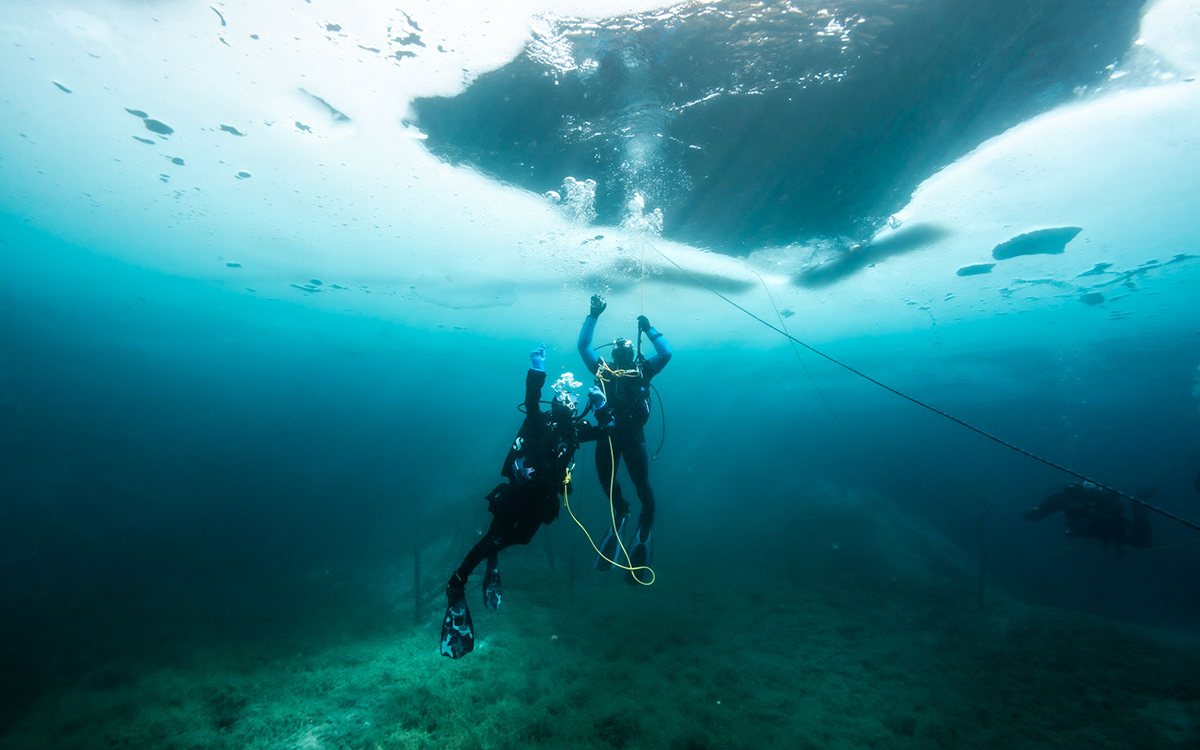
Closed ceiling, open mind.
PADI Ice Diver: ice diving as a team

Course description
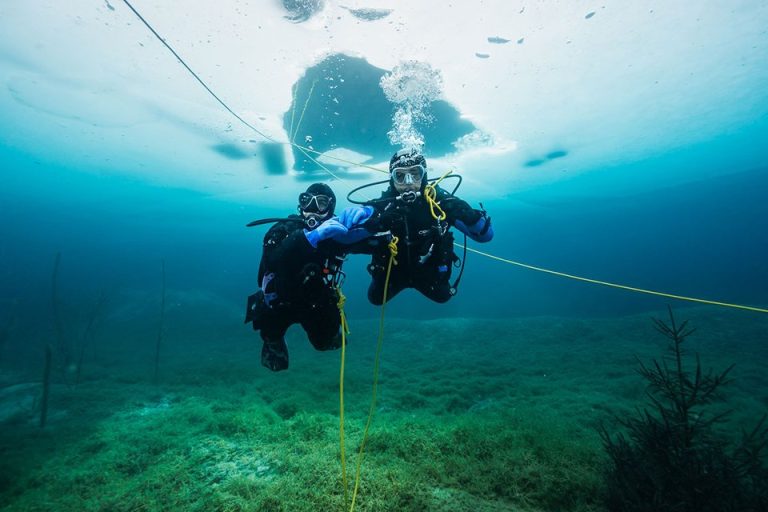
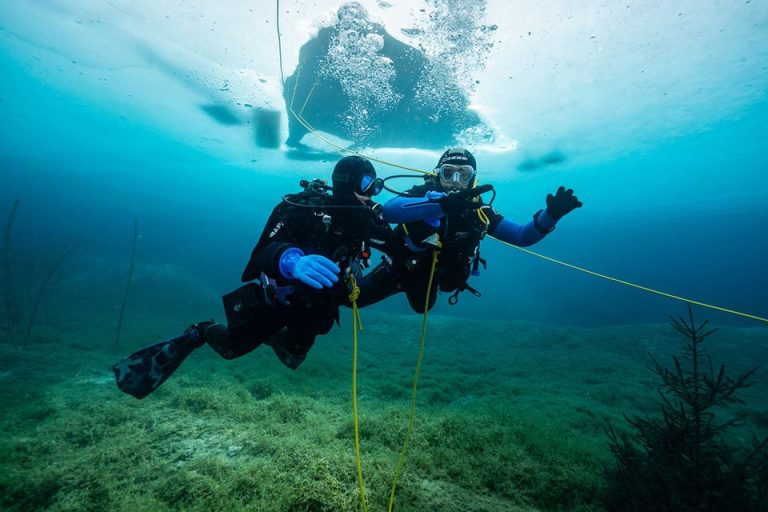
Ice diving is the first environment in which a recreational diver has no direct access to the surface. The only way out leads through the ice hole, and a safety line keeps you connected to it. The PADI Ice Diver course teaches how to plan, organise and carry out such a dive in a team where everyone, including the people on the ice, has a clearly defined role.
The programme covers preparing the dive site and the ice hole, working on a safety line, the line signal system, the duties of the tender and the standby diver, and emergency procedures: loss of contact with the line, a frozen regulator, chilling. We spend a lot of time on land and on the ice, because the safety of this dive starts before you enter the water.
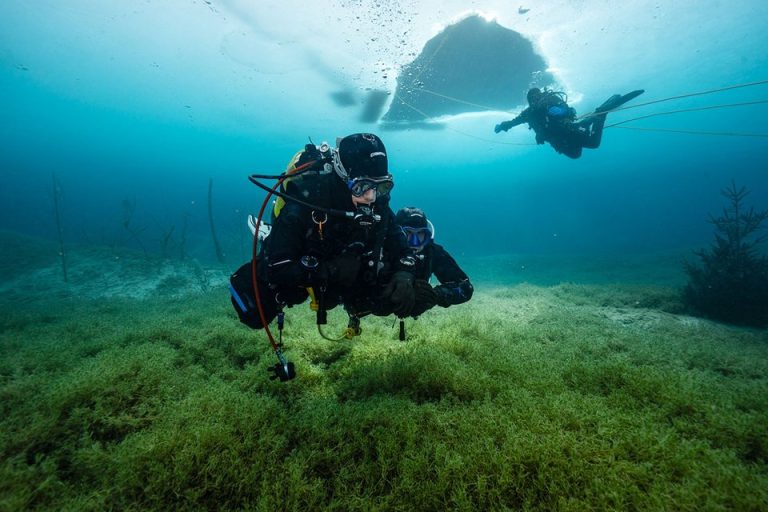
There is no room under the ice for unstable buoyancy. Hitting the ice from below, stirring up silt or a fast ascent with a frozen regulator are real hazards. That is why we require reliable buoyancy and trim in a dry suit (the PADI Dry Suit Diver course is good preparation), and we set up the equipment configuration for cold water: two independent regulators, stowed hoses, nothing that can snag on the line.
Polish winters, though increasingly unpredictable, still allow diving under ice in lakes and quarries. This is a course for divers who dive all year round, and an important step towards diving in enclosed environments: the procedures for working with a line, team discipline and thinking about the way out are the same in caves and on wrecks.

Usually 2 training days: theory and preparation on land, plus three dives under ice. The date depends on ice conditions, so we set the final date shortly before the course.
3 dives under ice. Each dive is preceded by preparing the site and the ice hole, and students also take part as a tender on the ice.
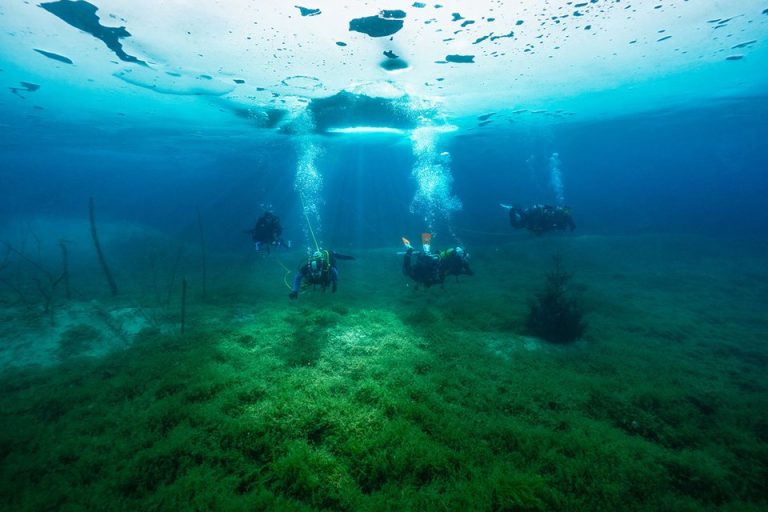
We plan the training dives shallow and a short distance from the ice hole. We limit depth and time because of the water temperature, the risk of a regulator freezing and the fact that you can surface in only one place.
A maximum of 4 students per instructor. For diving under ice we work as a team supported by assistants and a standby diver ready to enter the water.
Air, or nitrox for those with PADI nitrox certification. More important than the mixture is dry gas and a regulator suited to cold water; we keep cylinders warm until assembly.
Skills after the course:
- planning and organising a dive under ice as a team,
- marking out and preparing the ice hole and the site on the ice,
- working on a safety line and the line signal system,
- acting as a tender and as a standby diver,
- configuring cold water equipment with two independent regulators,
- handling a frozen regulator and loss of contact with the line,
- preventing chilling before, during and after a dive.
- minimum age: 18 years,
- PADI Advanced Open Water Diver certification or an equivalent from another organisation,
- good health and a current doctor’s certificate; diving in very cold water puts a real strain on the body,
- experience in a dry suit (PADI Dry Suit Diver recommended) and cold water dives before the course.
Specialist equipment
- a dry suit with an undergarment suited to water close to 0°C,
- a cylinder with a dual outlet valve (H or Y) and two independent regulators suited to cold water,
- a harness for attaching the safety line,
- dry gloves or thick neoprene gloves, a hood,
- a main torch and a backup torch.
Standard set
- a wing or jacket, weights,
- a dive computer,
- mask, fins, a knife or shears,
- warm clothing and drinks for the breaks on the ice.
Long Deco provides the safety line, the equipment for cutting ice holes and the fittings of the station on the ice. Personal equipment can be rented, but your dry suit and gloves should be tested in cold water beforehand.
Training fee
The price is set individually, depending on the location, conditions and number of people.
Registration and certification fee
Registration and certification according to the current PADI price list.
Additional costs
Equipment rental, gases, entry to the water body and permits for diving under ice, travel, any accommodation.
Theory
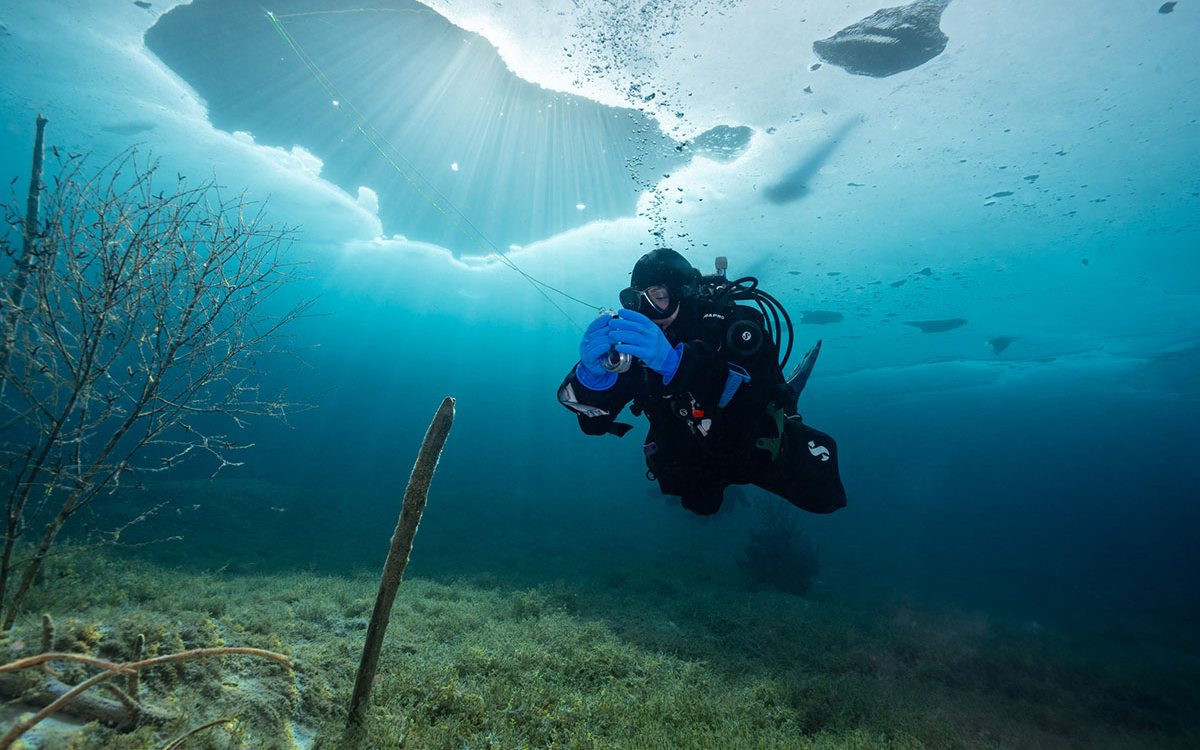
The theory is mostly about organisation. Diving under ice is safe when the team on the ice works as well as the diver under water.
- assessing the ice: thickness, types of ice, load capacity, weather conditions,
- preparing the ice hole and the station on the ice,
- team roles: diver, tender, standby diver, dive supervisor,
- the safety line, how to attach it and the signal system,
- cold water equipment and the causes of regulator freezing,
- cold physiology: chilling, frostbite, recovery between dives,
- emergency procedures: losing the line, a frozen regulator, a diver in distress.
Practice
Each day starts on the ice: assessing conditions, cutting the ice hole, preparing the lines and the station. Students take turns diving and tending.
- preparing the ice hole and marking the dive site,
- checking equipment and putting on a harness with the safety line,
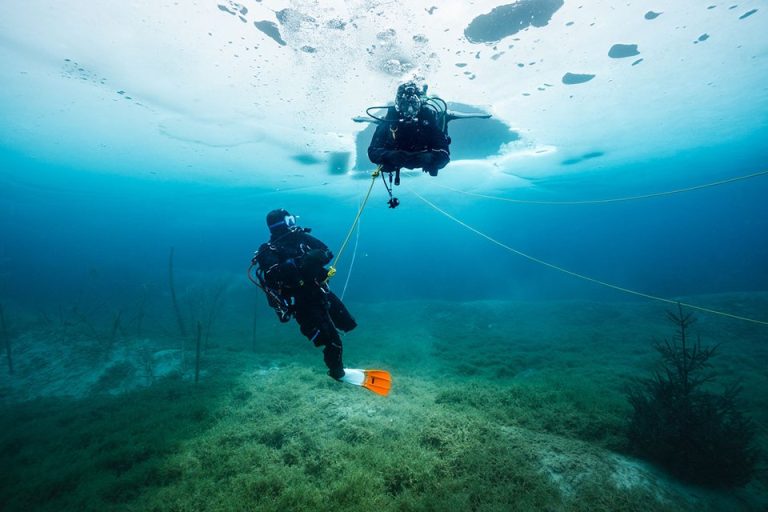
- descending under the ice and controlling buoyancy just below the ice surface,
- communicating with the tender by line signals,
- simulating loss of contact with the line and the procedure for finding it,
- shutting off the flow from a frozen regulator and switching to the second one,
- working as a tender and as a standby diver on the surface.
Do not breathe from the regulator or press the inflator button before entering the water in freezing weather. A wet, chilled regulator mechanism is the most common reason for it freezing in the first minutes of a dive.

FAQ

The next step on your path
- PADI Peak Performance Buoyancy, if you want to refine your buoyancy in a heavy configuration,
- PADI Self-Reliant Diver and PADI Cavern Diver, which develop your thinking about redundancy and the way out,
- PADI Rescue Diver, useful when organising dives in difficult conditions,
- PADI Tec Basics, where the rules of working in an enclosed environment lead into decompression planning.
Ice Diver counts as a specialty towards Master Scuba Diver. The configuration with two independent regulators that you use under the ice is close to the one you will start Tec Basics with.
Trips
- winter dives in Polish lakes and quarries,
- trips to Scandinavia and the Baltic countries,
- mountain lakes in the Alps in the winter season,
- cold fresh water, where the risk of a regulator freezing exists even without ice,
- club trips where the team sets up its own dive station.
For a winter trip take spare gloves, warm boots and a flask of a hot drink. Breaks on the ice chill you more than the dive itself, and cold hands make handling equipment harder.