


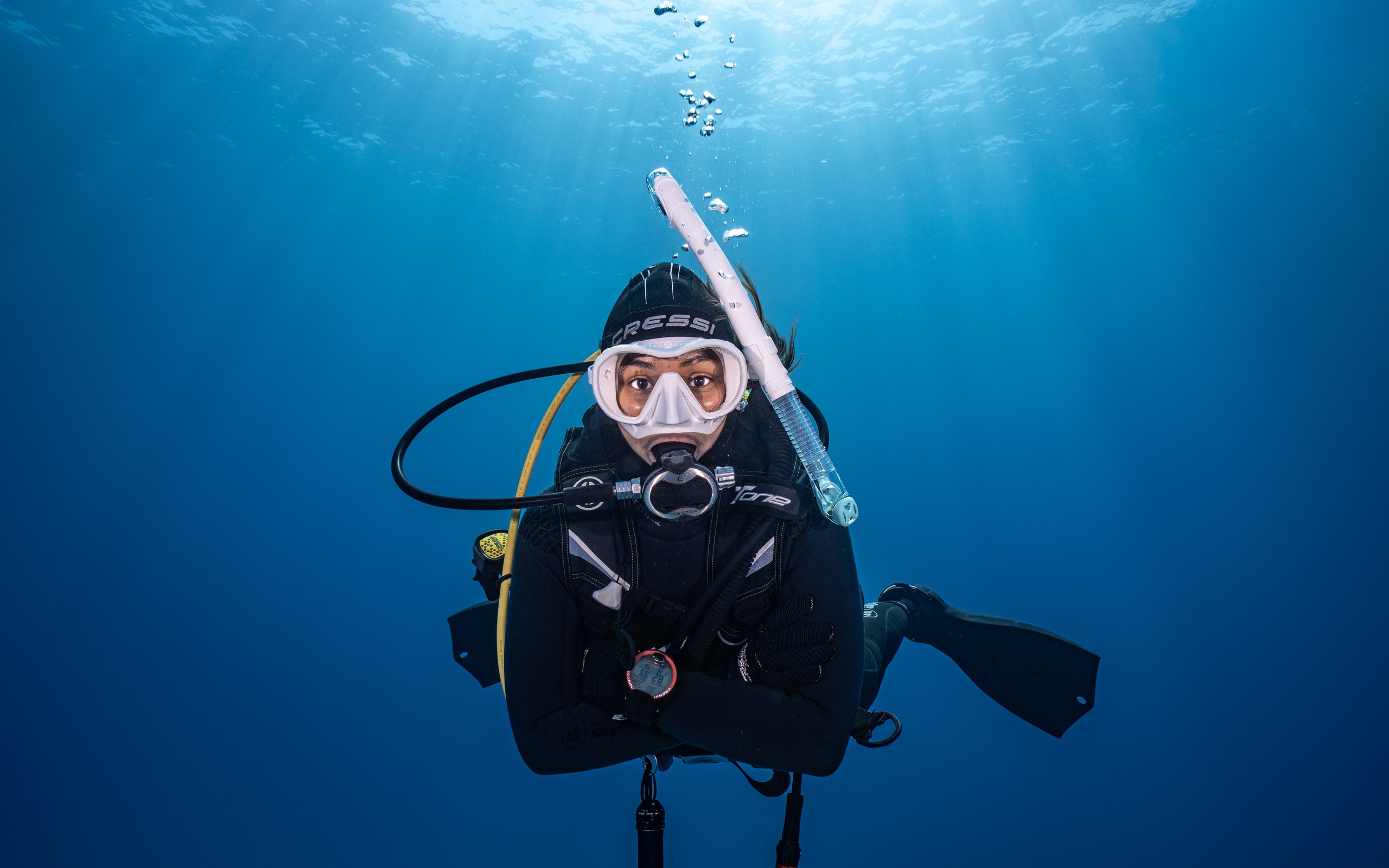
Rely on yourself before anyone has to rely on you.
PADI Self-Reliant Diver: solo diving built on redundancy

Course description
PADI Self-Reliant Diver is a course that prepares you for solo diving, aimed at experienced divers who want to be able to cope underwater without a buddy’s help. Formally it gives certification for independent dives within recreational limits, but at Long Deco we treat it above all as a school of self-reliance: you solve every problem with gas, equipment or orientation yourself, before it becomes the team’s problem.
The basis of the course is redundancy. You learn to dive with an independent, backup gas source (most often a stage or pony cylinder), a second computer or a depth gauge with a watch, a spare mask and a cutting tool. More important than the equipment itself, though, is planning: calculating gas consumption, working out a reserve sufficient for a safe ascent from the deepest point of the dive, and the discipline of sticking to the plan.
The course is good preparation for technical diving. Thinking in terms of redundancy, counting gas in litres instead of bar, working with a cylinder hung at the side and deploying a buoy from depth on your own (practised more fully on the PADI DSMB Diver course) are elements that come back on Tec Basics, Tec 40 and in sidemount configuration. Whoever completes Self-Reliant arrives on the TecRec courses with a different attitude to the plan and the reserve.
In Polish conditions self-reliance matters even more. In the cold water of quarries and lakes, with visibility sometimes counted in single metres, a buddy easily disappears from view. Even if you keep diving in a team, the ability to solve a problem calmly on your own and find your way to the surface is the best safeguard for your buddies.

Usually two training days: a theory part with a workshop on equipment configuration and gas planning, and three open water dives. With good organisation the course can be completed in one extended day.
Three open water dives. On request, or if you are not used to a stage cylinder, we add a shallow water session where you get used to the configuration before the actual dives.
The maximum depth of the training dives and of independent dives after the course is 30 metres. We plan profiles where the reserve in the redundant cylinder lets you ascend from the deepest point with a safety stop.
A maximum of 4 students per instructor. For some exercises you act as if you were alone underwater while the instructor watches from a distance, so a small group is a condition of quality here.
Air or nitrox, if you hold PADI Enriched Air Diver certification or an equivalent. The redundant cylinder must hold a gas that is safe at the full planned depth.
Range of skills after the course:
- planning gas based on surface consumption (SAC),
- calculating the reserve in the redundant cylinder,
- configuring and handling an independent gas source,
- switching to the backup gas in an emergency,
- deploying a DSMB from depth,
- navigating and returning to the starting point without a buddy,
- solving equipment problems underwater on your own.
- aged 18 or over,
- PADI Advanced Open Water Diver certification or an equivalent,
- good health confirmed by a medical questionnaire and, if needed, a doctor’s certificate,
- at least 100 logged dives.
Specialist equipment
- redundant cylinder (stage or pony) with a separate regulator and pressure gauge,
- second dive computer or a depth gauge with a watch,
- spare mask,
- DSMB with a spool or reel,
- compass,
- cutting tool.
Standard kit
- wetsuit or dry suit suited to the water temperature,
- BCD or wing with a backplate,
- regulator with a spare second stage,
- dive computer,
- fins, mask, torch.
We can hire out the stage cylinder with a regulator, a second computer and a buoy. Before the course, tell us what you are missing, so that we can prepare and fit the configuration on land.
Training fee
The price is set individually.
Registration and certification fee
According to the current PADI price list.
Additional costs
Equipment hire, gases (including filling the redundant cylinder), entry to dive sites, travel and accommodation.
Theory
The theory covers PADI materials and a workshop in which we calculate gas for the specific sites where you will dive afterwards.
- advantages and limits of diving without a buddy, and responsibility for your own decisions,
- mental preparation for diving without a buddy,
- gas consumption, SAC and calculating the reserve,
- choosing the capacity of the redundant cylinder for the depth and profile,
- redundant equipment configuration and a streamlined arrangement of gear,
- dive planning, emergency procedures and a surface notification plan,
- conditions in which we do not dive solo.
Practice
Dive 1: configuration and gas consumption
- pre-dive check for diving without a buddy,
- measuring gas consumption at a constant depth,
- switching to the redundant cylinder and back to the main gas,
- working on buoyancy and trim with an additional cylinder.
Dive 2: navigation and buoy
- navigating by compass and the shape of the bottom,
- returning to the starting point within the gas plan,
- deploying a DSMB from depth and a controlled ascent.
Dive 3: independent dive under supervision
- carrying out your own plan from entry to exit,
- solving a simulated equipment problem without help,
- ascending on the backup gas with a safety stop.
The redundant cylinder is there to end the dive, not to extend it. If you have to reach for it, the dive is over.

FAQ

The next step on your path
- PADI Sidemount Diver: the natural extension of working with two independent cylinders,
- PADI Deep Diver: planning gas and reserve at depths down to 40 metres,
- PADI Tec Basics: precise buoyancy, emergency procedures and technical-style planning,
- PADI Tec 40: first dives with mandatory decompression and a decompression gas.
Anyone who dives regularly with a redundant cylinder usually finds out quickly that sidemount gives the same redundancy in a more comfortable, more streamlined form.
Trips
- shore dives in Egypt, where it is easy to plan a calm dive along the reef,
- Malta and Gozo, with many sites accessible from the shore,
- Croatia, where steep walls call for control of depth and gas,
- Polish quarries and lakes with limited visibility,
- photography trips, where divers often separate from their buddy.
Before you go, check that the dive centre allows diving without a buddy and has stage cylinders with regulators on site. They are not available everywhere straight away.