


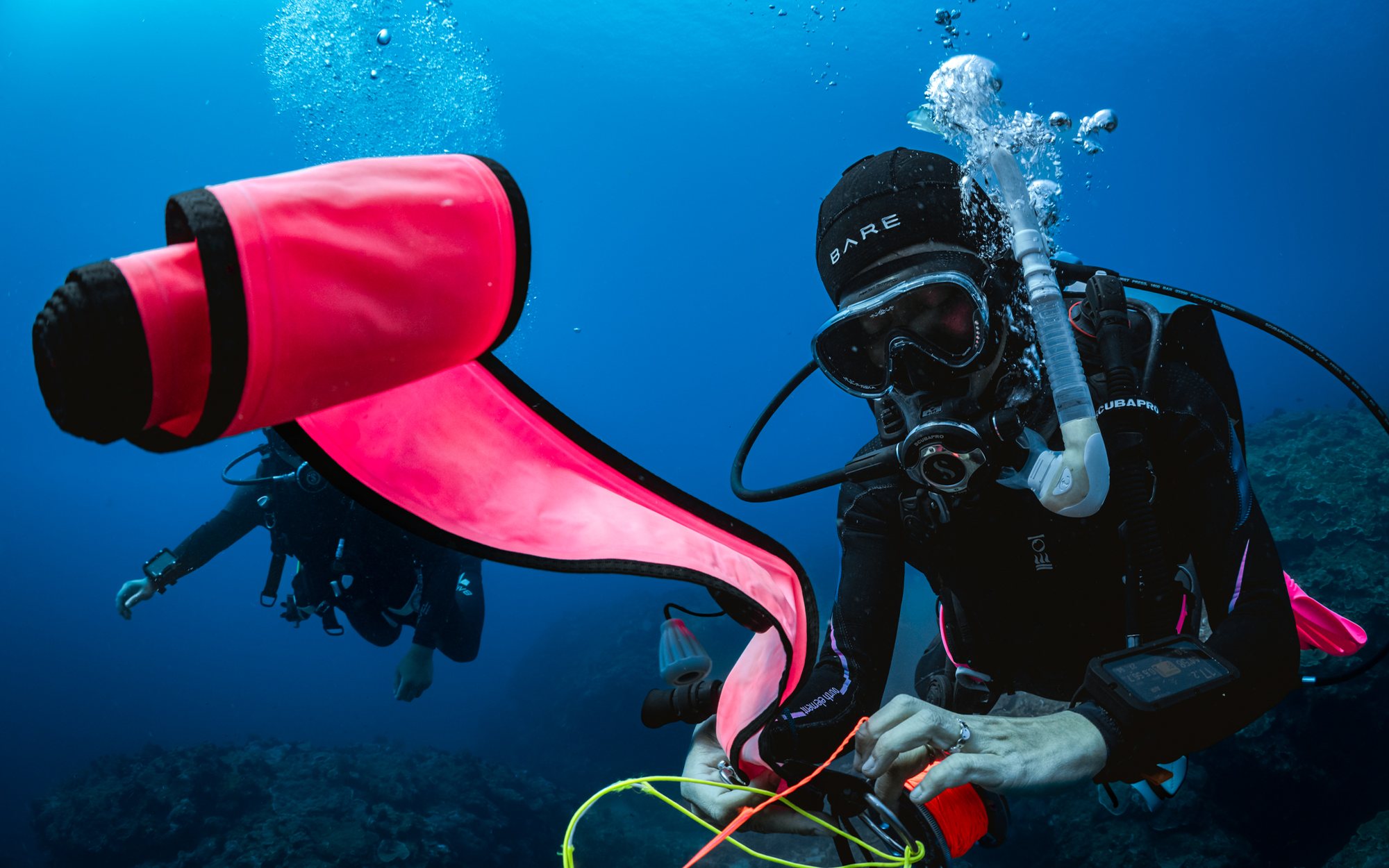
Buoy on the surface, diver under control.
PADI DSMB Diver: a decompression buoy launched without losing buoyancy

Course description
PADI Delayed Surface Marker Buoy Diver is a short course devoted to one key skill: launching a DSMB decompression buoy from depth and ascending on its line. The buoy tells the boat crew and other water users where the diver is surfacing, and the line gives a fixed reference point during a safety or decompression stop.
Launching a buoy seems simple until you do it in mid-water, in cold water and in thick gloves. Typical mistakes are being pulled upward together with the buoy, a tangled line and losing stop depth. On the course we learn to work so that the whole procedure happens without changing your position in the water: in trim, with neutral buoyancy and with control over the spool or reel.
At Long Deco we teach the course with further development in mind. We launch the buoy from the stop, in horizontal trim, from a spool clipped on in a way that does not risk entanglement. It is the same procedure we require later on Tec Basics and on the PADI Tec 40 course, where a buoy with a line is the basic tool for a controlled ascent with decompression stops.
In Poland a dive buoy is needed more often than it seems. On the Baltic we dive from a boat at wrecks, where surfacing in mid-water without a buoy means surfacing in a place the crew cannot see. On lakes and in quarries the buoy protects against boat and pedal boat traffic, and in poor visibility the line helps you hold stop depth.

One training day: a short theory part with exercises on land and two open water dives.
Two open water dives. Before them we practise handling the spool and assembling the buoy on land and, if needed, in shallow water too.
Dives take place within the limits of your certification. We launch the buoy from several different depths, including the safety stop depth.
A maximum of 4 students per instructor. Everyone launches the buoy several times, and the instructor needs to see up close the work of the hands, the spool and the body position.
Air or nitrox, if you hold PADI Enriched Air Diver certification or an equivalent.
Skills after the course:
- choosing a buoy, spool and reel for the type of dive,
- preparing the buoy and clipping it to your configuration in a streamlined way,
- inflating the buoy by mouth, from the second stage or with the inflator,
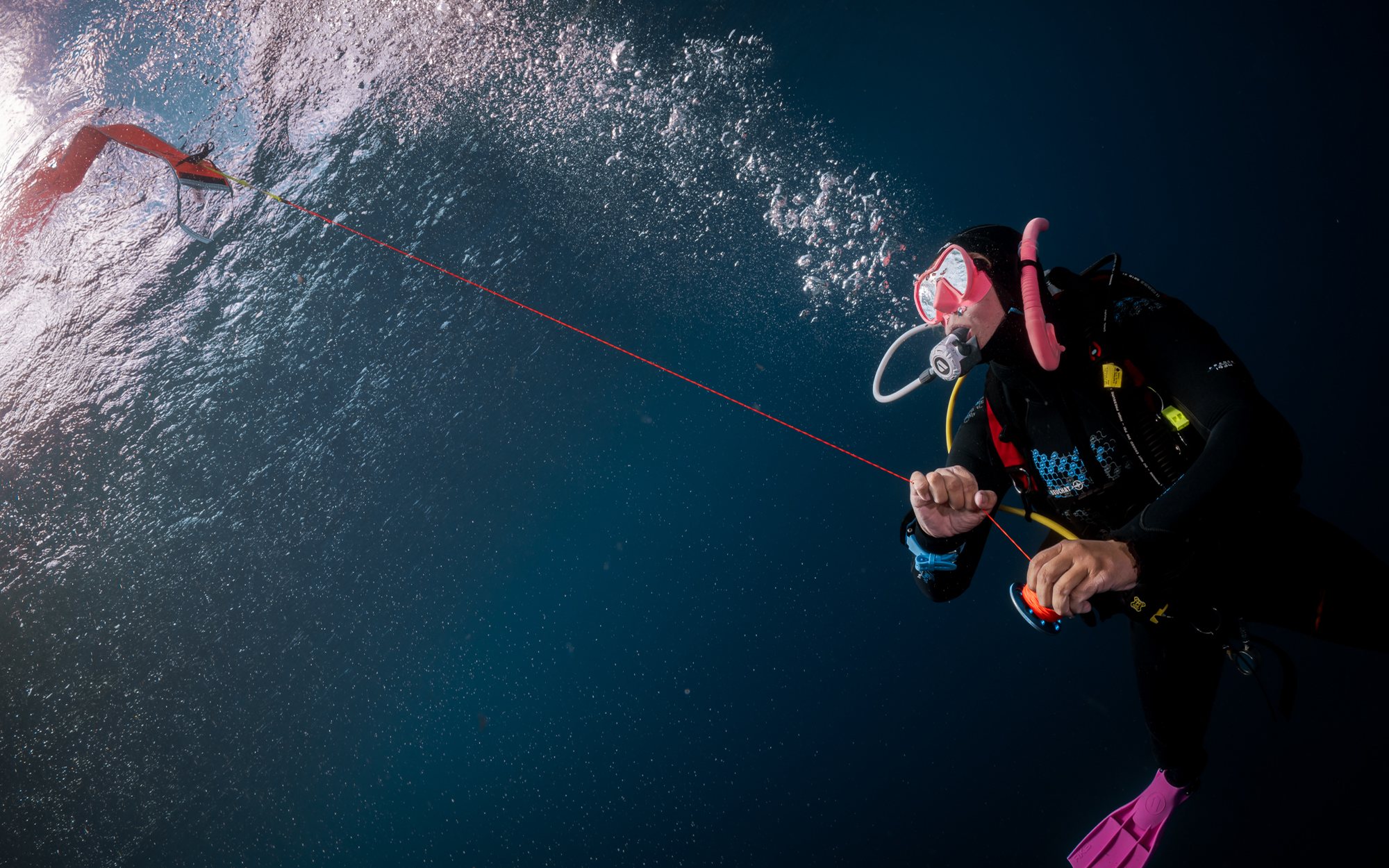
- launching the buoy with neutral buoyancy and in trim,
- a controlled ascent on the line at a steady speed,
- holding stop depth at the buoy line,
- dealing with entanglement or a jammed spool.
- aged 12 or over,
- PADI (Junior) Open Water Diver certification or an equivalent,
- good health confirmed by a medical questionnaire and, if needed, a doctor’s certificate,
- basic buoyancy control; the better your trim, the more the course gives you.
Specialist equipment
- a closed DSMB or one with an overpressure valve,
- a spool or reel with a line suited to the depth,
- a clip for attaching the buoy and spool,
- a cutting tool.
Standard kit
- a wetsuit or dry suit suited to the water temperature,
- a BCD jacket or a wing with a backplate,
- a regulator with a spare second stage,
- a dive computer,
- fins, mask, gloves.
We can rent you a buoy and spool. If you have your own, bring them to the course, because it is best to learn on the equipment you will dive with afterwards.
Training fee
Price set individually.
Registration and certification fee
According to the current PADI price list.
Additional costs
Equipment rental, gases, entry to dive sites, boat logistics for sea dives, travel and accommodation.
Theory
The theory part covers:
- the role of the DSMB in communicating with the boat and in surface safety,
- types of buoys, spools and reels, and their pros and cons,
- ways of clipping the buoy to your configuration without dangling parts,
- how the gas volume in the buoy changes and how it affects the diver’s buoyancy,
- hazards: being pulled upward, entanglement, ascending too fast,
- the buoy as a signal: colours, markings and emergency procedures,
- ascending on the line with a safety stop.
Practice
Dive 1: technique at a fixed point
- launching the buoy close to the bottom with a reference point,
- comparing inflation by mouth, from the second stage and with the inflator,
- reeling in the line during the ascent and controlling the speed,
- safety stop on the buoy line.
Dive 2: buoy in mid-water
- launching the buoy in mid-water with neutral buoyancy,
- launching the buoy from stop depth,
- dealing with a jammed spool,
- the team ascending on a single buoy.
Before you start inflating the buoy, check that the line has not wrapped around your equipment. You always let the spool go, you never hold it by force.

FAQ

The next step on your path
- PADI Peak Performance Buoyancy: buoyancy and trim that make working with the buoy easier,
- PADI Self-Reliant Diver: the buoy as part of full self-reliance underwater,
- PADI Deep Diver or PADI Wreck Diver: the buoy on deeper dives and boat dives,
- PADI Tec Basics: launching the buoy as a standard technical diving procedure.
It is worth launching the buoy on every dive, even when it is not necessary. A skill you do not practise fails you at the moment you need it.
Trips
- the Baltic and wreck dives from a boat,
- Egypt and drift dives from a boat in the Red Sea,
- Malta and Gozo, where many dives take place near boat traffic,
- Croatia and dives on wrecks in the open sea,
- Norway and the cold sea, where surfacing far from the boat can be dangerous.
Some boat operators require every diver to have their own DSMB. Pack it with your mask and computer, not in the bag with the accessories.