


Deeper, but with a plan.
PADI Deep Diver: depth as a planned decision

Course description
The PADI Deep Diver course prepares you for dives from 18 to 40 metres, the limit of recreational diving. It is not about collecting another number on your computer but about understanding what changes with depth: we use gas faster, we can stay for a shorter time without a decompression obligation, nitrogen narcosis appears, and every problem has to be solved further from the surface.
On the course we teach planning a deep dive from scratch: choosing the gas, calculating the reserve, setting the bottom time and the way of ascending with a safety stop. We practise buoyancy control with the changing volume of the suit, a controlled descent and ascent along a line or wall, and emergency procedures, including gas sharing at depth.
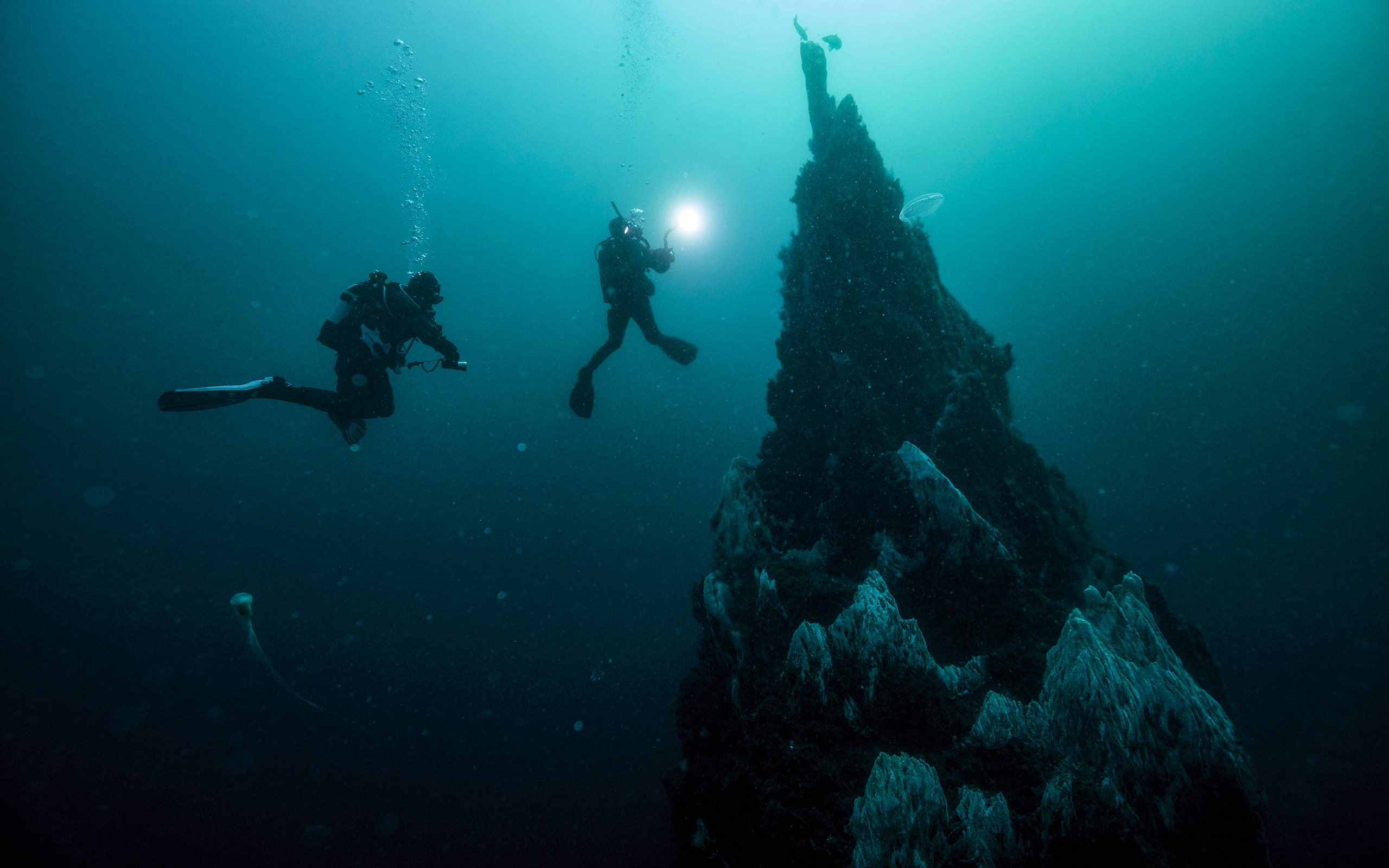
In Polish conditions depth usually means cold water, darkness and poor visibility below the thermocline. That is why we put great weight on equipment configuration, easy access to a backup source, good lighting and teamwork. We dive in lakes and quarries of suitable depth, with a clearly set plan and a turn point.
This deep diving course is a natural step after the PADI Advanced Open Water Diver course and at the same time a foundation for technical diving. The habits we build here (discipline of the plan, gas control, calm work at depth) are exactly the ones we expect on the Tec Basics and Tec 40 courses.

Usually 2 training days: a theory part (e-learning or classroom sessions) and two diving days with two dives each. On a trip the course can be spread over more days and combined with other dives.
4 training dives in open water. The first dive can be credited on the basis of the deep dive from the Advanced Open Water Diver course.
We run the first dive in the 18-30 metre range and the following ones gradually down to a maximum of 40 metres. Every dive stays within no-decompression limits.
Maximum 4 students per instructor. At depth a small group means the instructor is in constant contact with every participant and can react without delay.
Air, and with a PADI nitrox certification also nitrox, with a mandatory MOD check for the planned depth. On the course we discuss why, at 40 metres, the gas mix matters for both decompression and oxygen toxicity.
Skills after the course:
- planning a deep dive with a gas reserve and a turn point,
- controlled descent and ascent at a steady rate,
- recognising the symptoms of nitrogen narcosis in yourself and your buddy,
- managing no-decompression limits with a computer,
- carrying out a safety stop and an emergency stop,
- sharing gas and ascending with a buddy at depth,
- equipment configuration for diving in cold, dark water.
- minimum age: 15,
- PADI Adventure Diver certification or equivalent (in practice most often AOWD),
- good health confirmed by a medical questionnaire, and by a doctor’s certificate if needed,
- stable buoyancy; experience in dives to about 30 metres is recommended but not required.
Specialist equipment
- dive computer,
- main light,
- decompression buoy (DSMB) with a reel or spool,
- knife or cutting tool,
- in cold water: dry suit and two independent regulators.
Standard kit
- mask, fins,
- suit suited to the water temperature,
- jacket or wing,
- regulator with an octopus or a second regulator,
- cylinder and weights.
Missing equipment, including lights and buoys, can be rented at Long Deco. Before the course it is worth consulting the instructor about the regulator configuration for cold water.
Training fee
Price set individually.
Registration and certification fee
According to the current PADI price list.
Additional costs
Equipment rental, gases, entry to dive sites, any boat logistics, travel and accommodation.
Theory
The theory part covers:
- physiology of deep diving: nitrogen narcosis, oxygen toxicity, decompression sickness,
- gas consumption at depth and calculating a reserve,
- no-decompression limits, the dive computer and conservatism,
- planning the descent, bottom time and ascent,
- emergency procedures: out of gas, lost buddy, exceeding a limit,
- equipment configuration and lighting in cold, dark water,
- preparing for boat and wall dives.
Practice
We build the four dives step by step: each one is slightly deeper and gives the student a new task.
Dive 1: descent and orientation
- planning and team briefing,
- controlled descent along a line or wall,
- comparing how equipment and colours behave at different depths,
- safety stop.
Dive 2: narcosis and tasks
- a simple task done at the surface and at depth to compare reactions,
- monitoring gas and the no-decompression limit,
- controlled ascent at a steady rate.
Dive 3: emergency procedures
- gas sharing at depth,
- shared ascent with a buddy,
- simulated emergency stop.
Dive 4: own plan
- a dive planned and led by a team of students,
- deploying a decompression buoy,
- discussing the plan and how it went after leaving the water.
First we decide when we turn back, then where we swim. A deep dive plan starts with the gas reserve, not the maximum depth.

FAQ

The next step on your path
- PADI Enriched Air Diver, if you do not have it yet: an informed choice of gas and knowing the MOD at depth,
- PADI Peak Performance Buoyancy and PADI Self-Reliant Diver: precise buoyancy and self-reliance,
- PADI Tec Basics: technical configuration, work with two regulators and an introduction to decompression,
- PADI Tec 40 and PADI Tec 45: planned decompression dives beyond recreational limits.
This course is not an end in itself. If after the course you feel you want to stay longer at depth, the next step is planned decompression, not exceeding limits.
Trips
- Red Sea: wall reefs and wrecks lying deeper than 30 metres,
- Malta and Gozo: wrecks and walls at depths of 30-40 metres,
- Croatia: wrecks from the world wars and boat dives,
- Baltic: wrecks at greater depths, in cold, dark water,
- Polish quarries and lakes with deeper sections as a place to train.
On trips depth is easier to reach than at home, because the water is warm and clear. All the more reason to stick to the plan and the computer, and not to the impression that it is shallower than the depth gauge shows.