


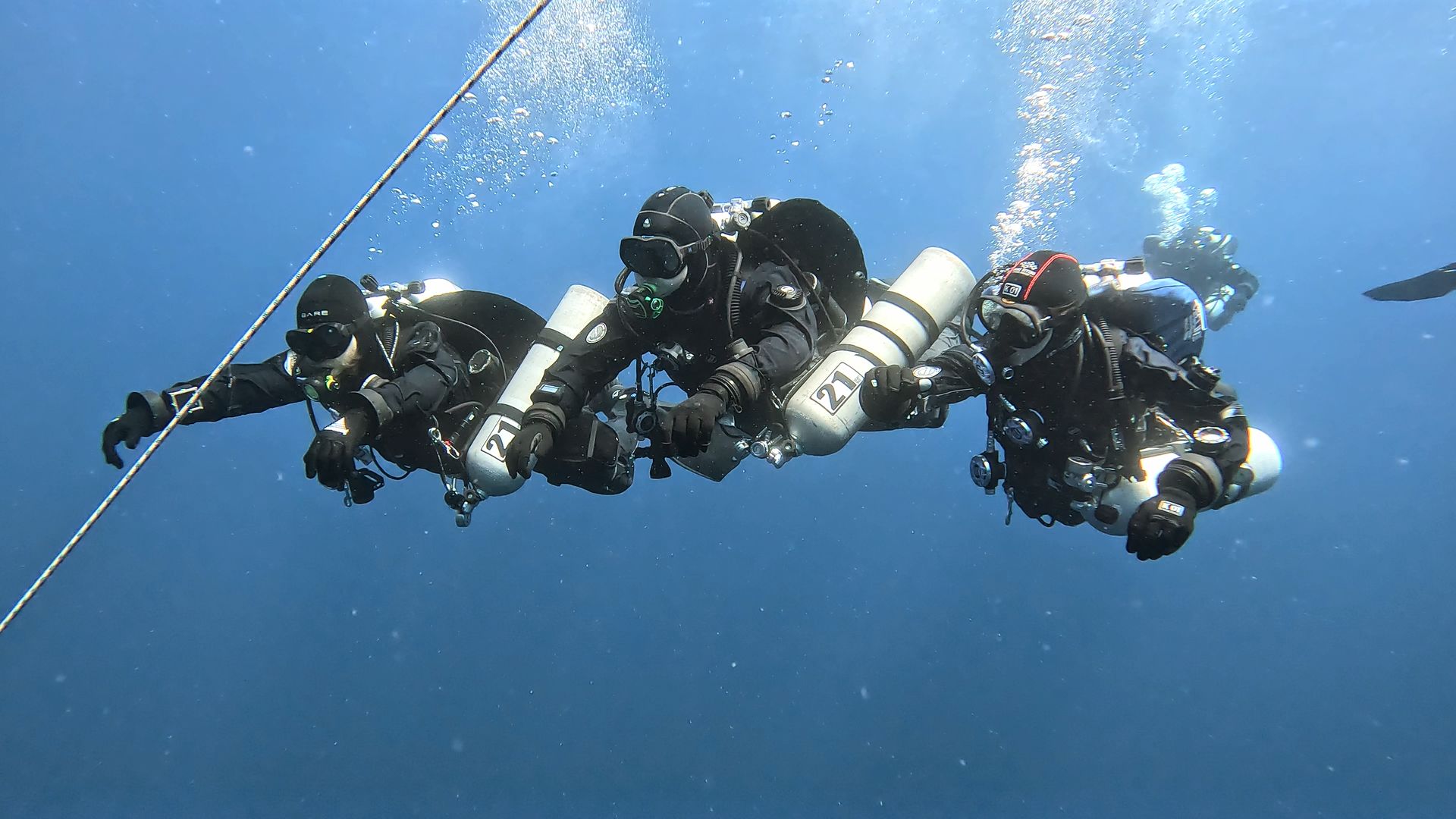
The first level of technical diving in GUE: trimix, decompression gas, failures and teamwork.
GUE Technical Diver 1 (T1)

Course description
GUE Technical Diver 1 is the first level of technical diving in the GUE system. It teaches you to plan and carry out decompression dives in a team, with trimix and one decompression cylinder. On T1 you move from exercises to real trimix dives, and decompression is part of the plan: it demands control of time, depth, equipment and gases. The course builds on the skills from the Technical Fundamentals level.
The programme is based on realistic profiles: bottom time, planned decompression and work with a decompression gas. You plan a dive taking into account gas consumption, reserves and emergency scenarios, and then you learn to adapt the plan to the situation. The second pillar is the team: communication, anticipating your buddies’ moves and calm, orderly reactions to problems. Planning, gas management, teamwork and consistent use of procedures decide the safety of the whole group. An important part of the training is planning and carrying out dives with a specific goal, which prepares you to take part in project, exploration and documentation dives.
You choose your bottom gases from the standard GUE gases. Each has its own depth range, and the ascent profiles for a given gas are always the same. The team knows them by heart and does not calculate the mix from scratch. With helium gases you need an independent drysuit inflation system, because helium cools you down quickly.

At least 6 training days. The exact time depends on conditions, location and the pace of the team.
The course has four parts: self study with the materials pack you receive after registration, lectures, surface sessions with field exercises, and dives. We teach the land sessions in groups of up to 6 people per instructor, and in the water up to 3.
At least 7 training dives of increasing complexity. The maximum depth is 51 m.
A maximum of 3 students per instructor during the in water sessions.
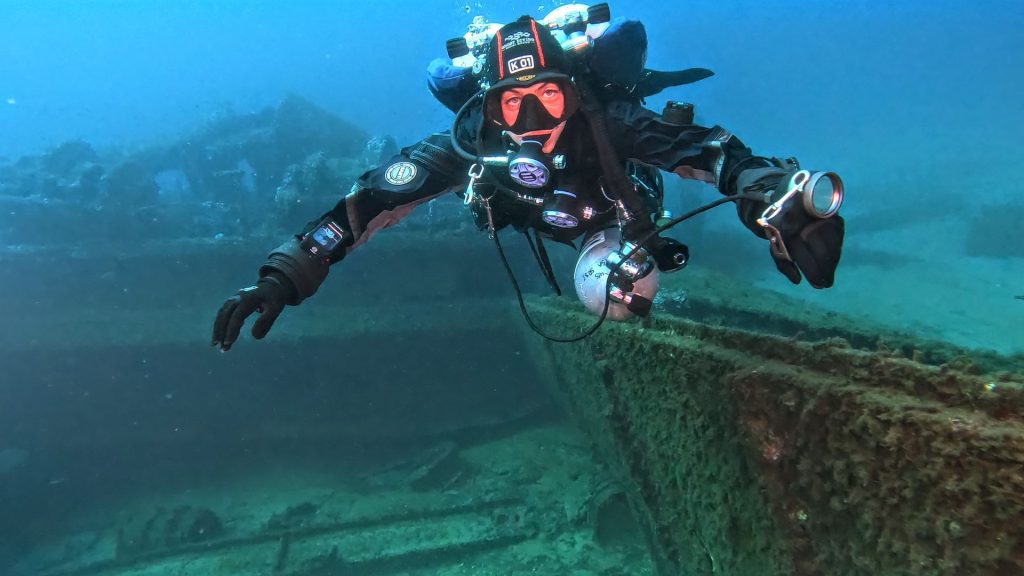
Backmount twinset and one stage cylinder.
Bottom gases: Trimix 21/35 and Trimix 18/45.
Decompression gases: Nitrox 50 or 100% oxygen.
We run the course according to GUE standards and procedures, with an emphasis on team standardisation, planning accuracy and a high level of individual skills.
The GUE Technical Diver 1 certificate qualifies you to dive within the limits of the certificate:
- to a depth of 51 m,
- with decompression planned in DecoPlanner of no more than 30 minutes,
- with one decompression cylinder with Nitrox 50 or 100% oxygen,
- within the oxygen partial pressure limits: 1.2 on the bottom in technical diving and 1.6 during decompression.
The T1 certificate is a prerequisite for GUE Technical Diver 2.
- age: at least 18,
- certificate: GUE Technical Fundamentals and GUE Rescue Primer or an equivalent from another organisation,
- experience: at least 100 logged dives,
- fitness: swimming 375 m in under 14 minutes without stopping and 18 m underwater on a single breath.
Main configuration
- Twin cylinder set (at least 2×12 L) with an isolation manifold.
- Steel or aluminium backplate with a DIR type harness.
- Two sliding D rings on the shoulder straps, bent at 45°.
- One sliding, straight D ring on the left hip strap.
- Crotch strap with two D rings.
- Wing (buoyancy compensator) with a lift of 18 to 22 L.
- Trilaminate drysuit with a telescopic torso.
- Two first stages and two second stages of regulators.
- Regulator hoses: long hose 200 to 210 cm, backup about 55 to 60 cm.
- Wing inflator hose matched to a short inflator.
- Drysuit inflation hose 70 to 80 cm.
- Elastic neck cord (necklace).
- Pressure gauge on a 55 to 60 cm hose with a bolt snap.
Stage cylinder
- One stage cylinder of 7 L or 11.1 L with rigging.
- Oxygen clean stage regulator: first and second stage with a 100 cm hose.
- Pressure gauge on a short hose of 15 to 20 cm.
Measurement and safety
- Dive computer or digital depth gauge (bottom timer).
- Surface marker buoy with a spool, at least 30 m of line.
- Reel, at least 60 m of line.
- Backup mask.
- Wetnotes.
- Cutting tool in a holster on the harness.
Additionally
- A laptop or tablet with the GUE DecoPlanner software.
- Basic tools (multitool, spanners) and spare parts.
Training fee
It depends on where the course takes place and on the number of people in the team. Contact us and we will give you the details.
Registration and certification fee
According to the current GUE price list. It covers registration, the certificate, training materials and the DecoPlanner app.
Additional costs
Breathing gases, dive logistics, travel, accommodation and meals.
Theory
Before the course you receive a pack for self study. In the lectures we discuss:
- breathing gases: oxygen, nitrogen, helium, carbon dioxide and carbon monoxide, partial pressures and oxygen limits,
- hypoxia, oxygen convulsions and hypercapnia: causes, symptoms, prevention and treatment,
- narcosis and the effects of helium, gas density and its effect on breathing,
- the standard GUE bottom gases and the rules for choosing them for the depth and purpose of the dive,
- gas management: surface consumption (SCR), tracking bottom and decompression gas, minimum gas,
- decompression theory: tissue saturation, Bühlmann models and bubble models, M values, gradient factors, deep stops and how research assesses them,
- planning in DecoPlanner and the rules for using a dive computer,
- decompression sickness: risk factors, symptoms, treatment, recompression,
- dive planning: the GUE EDGE dive brief, equipment checks and failure points, responsibility for the team, strategies for when problems arise.
We stress why a procedure exists and what happens if you skip it or do it wrong.
Practice
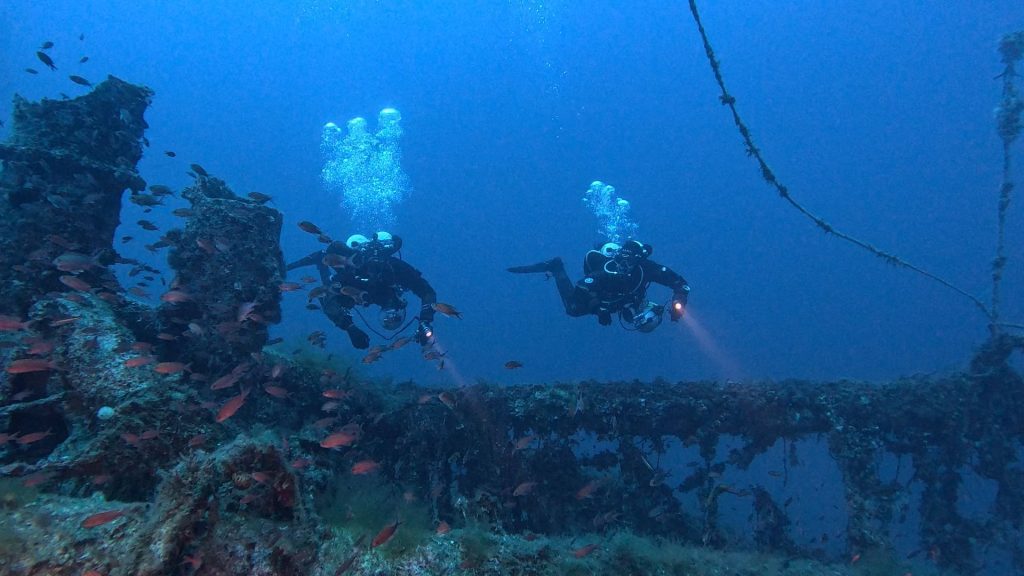
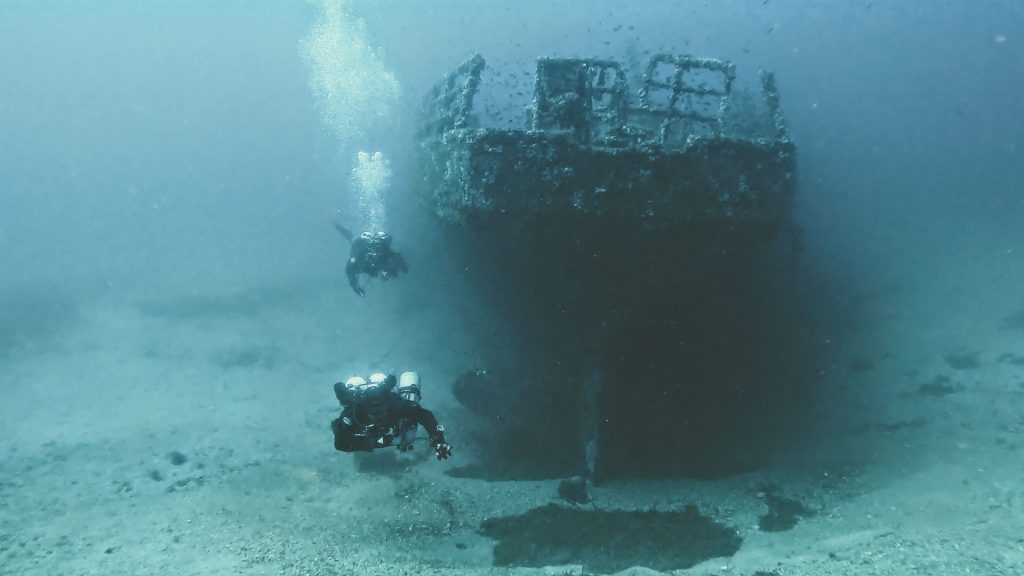
- You make decompression dives of increasing complexity according to plans prepared in advance. You work with a decompression gas, carry out the planned stops and practise emergency procedures.
- Before every dive you go through the same sequence: a flow check (a modified valve drill), a modified S-drill, a bubble check and the GUE EDGE dive brief.
In the water you practise:
- gas switching according to the GUE protocol,
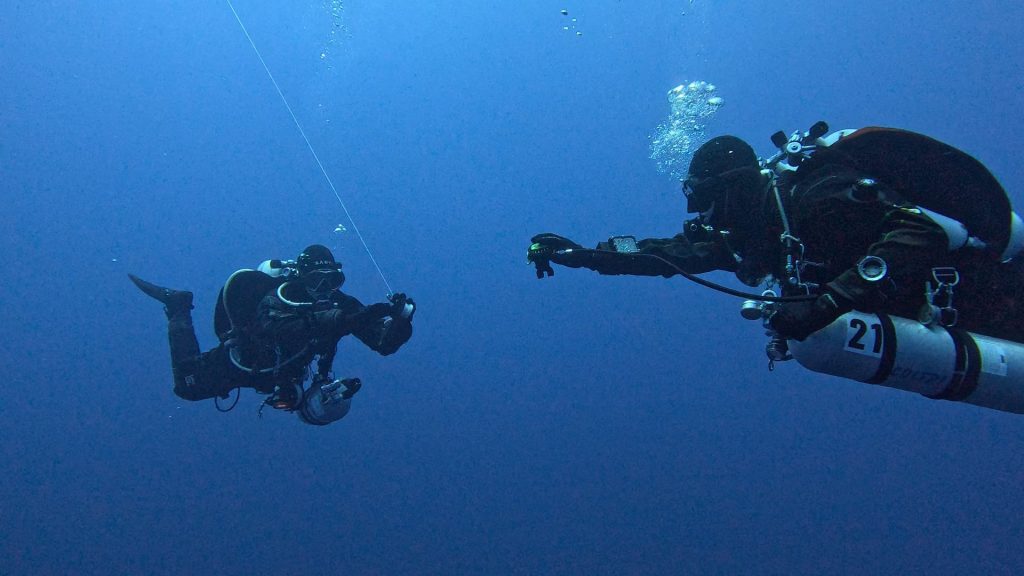
- a decompression cylinder failure and gas sharing on the bottom, during the ascent and at the stops,
- an ascent with a buddy who is out of gas to the nearest gas source, which is your own decompression cylinder,
- valve handling and regulator failures, also with decompression gas,
- five minute situational checks that help the team stay within its limits,
- rescuing an unconscious diver and an assisted exit from the water.
We pay special attention to buoyancy and trim, holding position on long stops and controlling the ascent rate. The team repeats every exercise many times.

FAQ
Projects
T1 teaches you to plan and carry out dives with a specific goal, so it opens the way to take part in:
- advanced GUE diving projects,
- exploration dives,
- documentation dives.
In such projects the plan has to be clear, and the whole team carries it out consistently.
Further training
After T1 you can develop in several directions:
- GUE Technical Diver 2 (T2): the next level of technical diving, for which the T1 certificate is a prerequisite,
- GUE CCR Fundamentals: rebreather training,
- CCR Tech 1 Upgrade,
- GUE Cave 1 (C1) and GUE Cave 2 (C2): a cave path that you can combine with technical diving.
For the Tech 60, Tech 2 and CCR 1 courses GUE additionally requires at least 25 dives at T1 level.
Trips
We organise training and project trips for technical divers at Long Deco:
- training trips, where you log dives at T1 level,
- project trips, where you dive in a team with a specific goal.
We announce current dates and places separately.